Irrigation Calculator
Estimate weekly irrigation gallons, runtime per zone, application depth, and watering frequency from crop demand, soil storage, root depth, system efficiency, flow rate, and area.
Use local ET and rainfall observations when available. This calculator plans irrigation demand only; reduce the weekly depth by effective rainfall or soil moisture readings before running a field schedule.
Irrigation Schedule Estimate
Results use weekly crop water demand, grossed up for system efficiency, then split across zones and watering events.
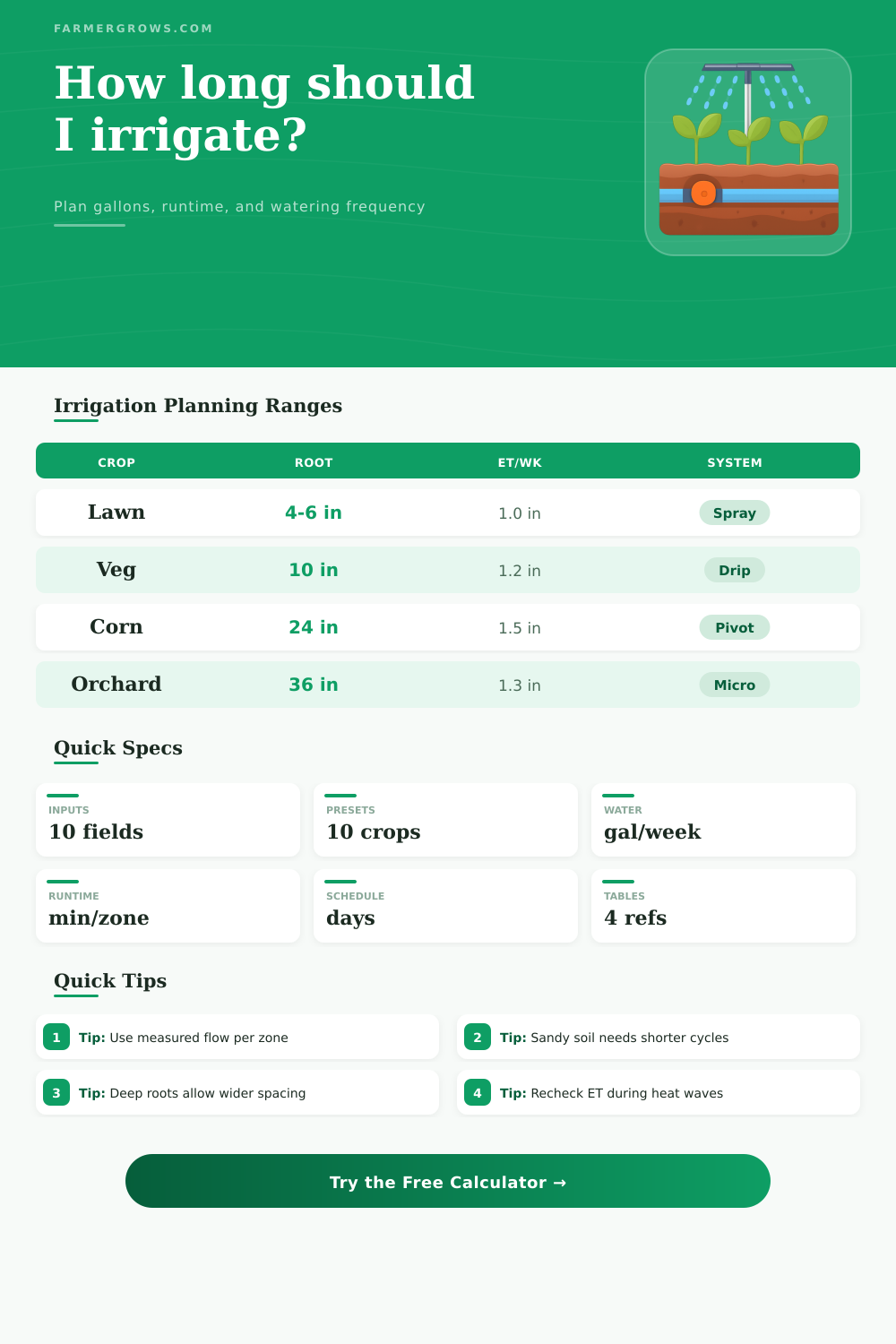
| Crop group | Typical active root depth | Peak ET planning range | Schedule note |
|---|---|---|---|
| Cool-season lawn | 4-8 in | 0.8-1.3 in/week | Frequent enough to avoid shallow stress; avoid daily light watering once established. |
| Mixed vegetables | 8-18 in | 1.0-1.5 in/week | Keep moisture steadier during flowering, fruit set, and germination periods. |
| Corn or grain | 18-36 in | 1.2-1.8 in/week | Demand peaks near tasseling, silking, flowering, and grain fill. |
| Orchard or vineyard | 24-48 in | 1.0-1.6 in/week | Deep roots allow longer intervals if the wetted pattern reaches enough soil volume. |
| Containers or nursery | 4-12 in | 1.5-2.5 in/week | Low storage means smaller, more frequent irrigation cycles. |
| Soil type | Available water | Usual infiltration behavior | Planning implication |
|---|---|---|---|
| Sand or loamy sand | 0.6-0.9 in/ft | Fast intake, low storage | Use shorter, more frequent events and check below-root leaching. |
| Sandy loam | 1.0-1.4 in/ft | Moderate-fast intake | Often works with moderate depth events and drip or sprinkler systems. |
| Loam | 1.5-2.0 in/ft | Balanced intake and storage | Flexible scheduling if compaction and runoff are managed. |
| Silt loam | 1.8-2.3 in/ft | Good storage, can seal | Watch crusting and apply water slowly enough to prevent runoff. |
| Clay or clay loam | 1.6-2.4 in/ft | Slow intake, high holding | Use lower application rate or cycle-soak scheduling. |
| System | Typical efficiency | Best fit | Runtime caution |
|---|---|---|---|
| Drip tape or dripline | 85-95% | Rows, beds, orchards, vineyards | Flow may be low, so runtime can be long even when gallons are efficient. |
| Micro sprinkler | 75-90% | Orchards, nurseries, berries | Check wetted diameter and wind drift before stretching intervals. |
| Fixed spray or rotor | 60-80% | Lawns and small blocks | High precipitation rate can exceed clay or compacted soil intake. |
| Center pivot or linear | 75-90% | Field crops and pasture | Nozzle package and speed setting control actual gross depth. |
| Traveler or big gun | 55-75% | Pasture and irregular acreage | Wind loss and high instantaneous rate need extra attention. |
| Water depth | Gallons per 100 sq ft | Gallons per 1,000 sq ft | Metric equivalent |
|---|---|---|---|
| 0.25 in | 15.6 gal | 156 gal | 6.35 mm over area |
| 0.50 in | 31.2 gal | 312 gal | 12.7 mm over area |
| 0.75 in | 46.8 gal | 468 gal | 19.1 mm over area |
| 1.00 in | 62.3 gal | 623 gal | 25.4 mm over area |
| 1.50 in | 93.5 gal | 935 gal | 38.1 mm over area |
Measure flow at the zone: Bucket-test or meter the actual gpm after filters, pressure regulators, and elevation losses. Nameplate pump flow can overstate runtime accuracy.
Use soil storage as a guardrail: If the calculator calls for deep events on sandy soil or containers, split the same weekly gallons into more cycles.
Irrigation is the application of water to plants. Often, irrigation become challenging when some plants in the same location receive too little water while other plants in that same location receive to much water. Understanding how much water reaches the root zone of the plants is necesary because the water may evaporate before it reach the plants roots or may run off the land before it reaches the plants’ roots.
Additionally, understanding the schedule of watering the plants based off general rules is less effective than understanding the schedule of watering based on the conditions of the soil and the plants themselves. The first step in establishing an efficient irrigation schedule for a crop is to understand the water needs of that crop. One measurement of the water needs of a field is the evapotranspiration rate of that field.
How to Make an Irrigation Schedule
The evapotranspiration rate of a field is the amount of water that evaporate from the soil and is used by the plants in that field. For instance, cool-season lawn areas tend to have an evapotranspiration rate of one inch of water per week, while corn fields may lose one and a half inches of water per week. The grower must also consider the root depth of the plants in that field because the depth of the root system determine how much water can be accessed by the plants.
The soil type in the field must also be considered because the soil type determines how much water the soil can hold. Fields with clay soil can hold more water than sandy soil. However, clay soil absorbs water more slow than sandy soil.
Because clay soil absorbs water slowly, irrigation schedules will need to be changed for clay soil fields. System efficiency is another consideration in the irrigation process. System efficiency refer to how much of the water that is applied to the fields actualy reaches the plants.
Drip irrigation systems are the most efficient at delivering 85 to 95 percent of the water to the plants. Overhead sprinkler systems are less efficient at delivering 60 to 80 percent of the water to the plants due to evaporation and wind. Using the calculator on this page, you can enter the information for your crop, soil type, root depth, system efficiency, and flow rate to determine your irrigation needs.
The calculator will provide information regarding the amount of gallons of water that is needed for your fields per week, the runtime for each irrigation zone, and the number of day that should pass between each irrigation event. Tables is included on this page to provide typical values for different group of crops and soil types to help verify the values that you enter into the calculator. Many individuals make the mistake of treating the entire field for irrigation as if it is one large uniform block.
Dividing the field into irrigation zones is a better idea because the different zones within the field may contain different types of soil, have different amounts of sunlight exposure, or have different depths for the roots of the plants within that field. Treating each field as one large uniform block may lead to irrigation events that cause the water to run off the fields in some areas while other areas within that field are underwatered. Additionally, the other extreme is to irrigate each area of a field that contains different types of plant or soil with the same amount of water.
This may also create problems for the field as some areas may be overwatered while others are underwatered. The solution to these problems is to divide each field into irrigation zones and to irrigate each zone with shorter irrigation cycles with soak time between each irrigation cycle. Flow rate is another critical measurement for irrigation schedules.
However, many individuals dont understand or underestimate the flow rate of the water that come out of each irrigation zone. Flow rate is often based off the specifications of the manufacturer of the irrigation system. However, the manufacturer makes those specifications for ideal conditions for the system that may not be met in the actual fields and irrigation systems in place.
A flow rate can be determined through a bucket test or an inline flow meter. Once the flow rate is determined, the user can calculate the runtime for each irrigation zone by dividing the number of gallons needed by the flow rate of the irrigation system. The information regarding soil storage limits will provide information regarding how many days should pass between each irrigation run for that field.
Weather conditions will change the irrigation schedule for a field. Rain will add moisture to the soil, while heat waves will increase the evaporation of moisture from the soil. Checking the weather in the area where the crops are grown before each irrigation will allow the irrigator to adjust the irrigation schedule according to the needs of the soil and the plants.
While the calculator will provide an individual with a good starting point for the irrigation schedule, that schedule can and should be adjusted according to what the soil and plants requires of each individual day. The goal of irrigation is to maintain the root zone in the correct amount of moisture. The goal is to maintain the moisture levels of the root zone so that the plants receives enough water to perform the processes necesary to grow but not so much water that the water runs past the roots of the plants.
By using the real measurements of the plants, soil, and irrigation systems rather than making assumptions about those variables, irrigation schedules will prove to be reliable and adjustable to the needs of that field. You should of used real measurements to avoid errors.