Nitrogen Conversion Calculator
Convert between elemental N, nitrate-N, nitrate, ammonium-N, ammonium, urea, protein equivalent, fertilizer analysis, liquid density, lb/ac, ppm, mg/L, and kg/ha.
Choose the reported form and unit first. The calculator converts everything to an elemental N basis, then rebuilds nitrate, ammonium, urea, protein, product pounds, liquid gallons, ppm, and kg/ha equivalents.
Nitrogen Conversion Results
All outputs are tied back to elemental N so nitrate, ammonium, urea, protein, product rate, liquid gallons, and field units stay comparable.
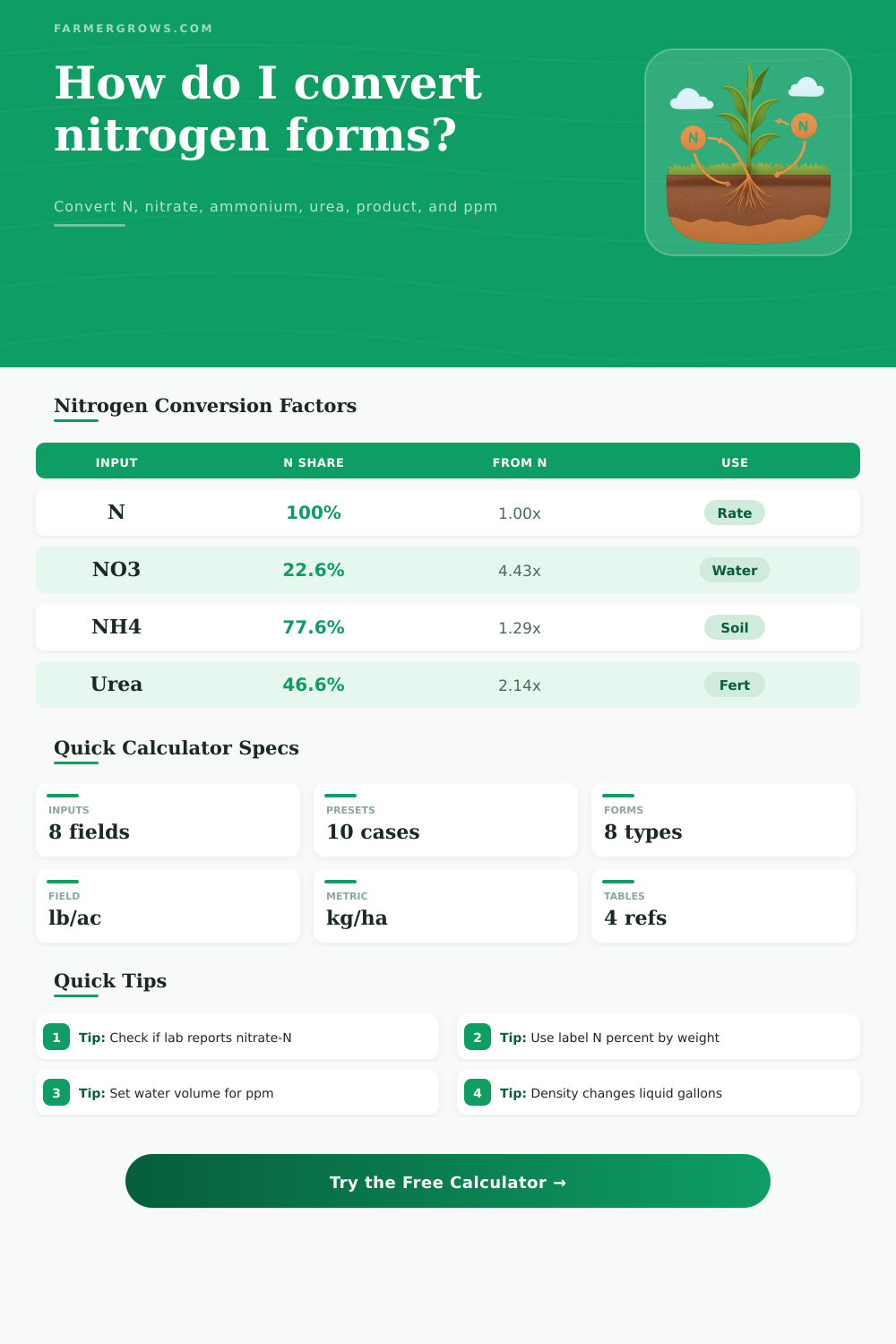
| Reported form | N fraction used | Convert from N | Common report source | Field note |
|---|---|---|---|---|
| Elemental N | 1.0000 | 1.000 lb N = 1.000 lb N | Fertilizer recommendation | Use directly for lb/ac or kg/ha rates. |
| Nitrate-N | 1.0000 | 1.000 lb N = 1.000 lb NO3-N | Soil or water nitrate-N | Do not multiply by nitrate molecular mass again. |
| Nitrate NO3 | 0.2259 | 1.000 lb N = 4.427 lb NO3 | Water nitrate as NO3 | Convert to nitrate-N before comparing with N rates. |
| Ammonium-N | 1.0000 | 1.000 lb N = 1.000 lb NH4-N | Manure, soil, wastewater | Already expressed as the N portion. |
| Ammonium NH4 | 0.7765 | 1.000 lb N = 1.288 lb NH4 | Ion concentration reports | Full ammonium mass is larger than N mass. |
| Urea CO(NH2)2 | 0.4665 | 1.000 lb N = 2.144 lb urea | Urea molecule or reagent | Fertilizer-grade urea is commonly labeled 46% N. |
| Unit conversion | Formula basis | Example | Result | When to use |
|---|---|---|---|---|
| lb/ac to kg/ha | lb/ac x 1.12085 | 100 lb/ac N | 112.1 kg/ha N | Move US rates into metric plans. |
| kg/ha to lb/ac | kg/ha x 0.89218 | 150 kg/ha N | 133.8 lb/ac N | Convert metric recommendations. |
| mg/L to lb/ac | mg/L x L/ac / 453592 | 10 mg/L over 1 acre-inch | 2.26 lb/ac | Irrigation and fertigation water. |
| ppm water | 1 ppm = 1 mg/L | 150 ppm NO3-N | 150 mg/L NO3-N | Hydroponic or injector reports. |
| Product lb/ac | lb product x N% | 200 lb/ac urea 46% | 92 lb/ac N | Dry fertilizer product rates. |
| Product gal/ac | gal x density x N% | 20 gal UAN 32 | 70.8 lb/ac N | Liquid fertilizer rates. |
| Product example | N analysis | Density if liquid | Product for 100 lb N | Liquid gallons |
|---|---|---|---|---|
| Urea 46-0-0 | 46% | Dry | 217 lb/ac | Not liquid |
| UAN 28-0-0 | 28% | 10.6 lb/gal | 357 lb/ac | 33.7 gal/ac |
| UAN 32-0-0 | 32% | 11.06 lb/gal | 313 lb/ac | 28.3 gal/ac |
| Ammonium sulfate | 21% | Dry | 476 lb/ac | Not liquid |
| Calcium nitrate | 15.5% | Varies | 645 lb/ac | Use label density |
| Anhydrous ammonia | 82% | Pressure product | 122 lb/ac | Equipment specific |
| Use case | Choose form | Choose unit | Extra field that matters | Output to watch |
|---|---|---|---|---|
| Soil nitrate test | Nitrate-N or nitrate | lb/ac or kg/ha | Report basis from the lab | Elemental N basis |
| Irrigation nitrate | Nitrate or nitrate-N | mg/L or ppm | Applied water gal/ac | lb/ac N delivered |
| Liquid UAN rate | Product analysis | gal product/ac | Density and N percent | lb/ac N and kg/ha |
| Dry fertilizer rate | Product analysis | lb product/ac | N percent on label | product needed for target |
| Forage protein | Protein equivalent | lb/ac or kg/ha | Protein uses N x 6.25 | N removed by protein |
Lab basis: Read whether nitrate is reported as nitrate-N or nitrate. That single wording difference changes the N result by about 4.43 times.
Liquid products: Analysis is by weight, not by volume. A gallon conversion needs both N percent and density from the product label.
Nitrogen are an essential component of the fertility decision, but the values reported as nitrogen in many circumstances use different units of measurement. For instance, an laboratory analysis may report the value of nitrate-N, but another laboratory may report the full value of nitrate. Another source of nitrogen may report the percent of N by weight of the fertilizer products, and a water analysis report the amount of nitrogen in milligrams per liter.
Because there are different units of measurement for nitrogen, it is possible to either overapply or underapply the element if you dont first convert the values to an elemental basis. The value of nitrogen depend on the molecule being analyzed. For instance, when analyzing nitrate, there will be oxygen in the molecule.
How to Convert Nitrogen Units
The presence of this element add to the weight of the molecule, but it does not contribute to the nitrogen that is provided to the crop. Therefore, the value for nitrogen expressed as nitrate will be more different than that expressed as nitrate-N. This same principle apply to molecules like ammonium that contains hydrogen instead of nitrogen.
Using a calculator will remove the need for remembering these types of unit conversion. Since many liquid fertilizers are analyzed in terms of their weight per product, but farmers often purchase and apply the fertilizer in terms of gallon, it is essential to be able to convert gallons to nitrogen in elemental form. The nitrogen percentage of the fertilizer can be entered into the calculator, as well as the density of the fertilizer in weight per gallon.
The calculator will convert the gallons per acre to elemental nitrogen per acre. The elemental nitrogen per acre can then be entered as well. In this instance the calculator will determine how many gallons of fertilizer are needed to provide the desired elemental nitrogen per acre.
Another factor to consider for nitrogen application is the volume of water that is applied. Water that contains 10 milligrams of nitrogen per liter may seem low, but if the water is applied to an acre and the number of gallons of water per acre is multiplied by the rate of nitrogen in the water, the resulting nitrogen will be sufficient to provide several pounds of nitrogen to that acre. The field volume is entered in the calculator in order to ensure that the nitrogen calculations are based off the actual irrigation pass.
Field size will allow the user to calculate how much nitrogen will be applied to the entire field. If the rate of nitrogen suggested per acre is applied to the total number of acres within the field, the result will be the number of tons of nitrogen that will be needed for that field. The calculator display both the per acre and total nitrogen rates.
Common mistakes include those in which the person is not consistent in the units being used. For instance, nitrogen values from a laboratory analysis may be read as if they are expressed as nitrate-N, but the unit was actualy expressed as nitrate. In addition, many will dose a liquid product by the gallon without considering the density of that product.
Another common mistake is the comparison of the target rate of nitrogen for a field to a protein value from a forage test. The outcome of each of these mistakes alter the amount of nitrogen by a factor of two or more, so tables are used to determine the fractions of each form of nitrogen that are used in these calculations. Finally, it is essential that the nitrogen that is applied to the soil is the same as the nitrogen required by the crop.
For instance, rainfall or irrigation may wash urea applied to the soil away, but an ammonium source may remain near the soils surface. While the calculator will not choose what nitrogen is used for the field, it will ensure that the rates of nitrogen are comparable to one another to allow the grower to make an informed decision on which nitrogen source to use. The same principle used for converting between forms of nitrogen apply to the conversion between metric units and imperial units.
For instance, a recommendation for nitrogen in terms of kilograms per hectare will need to be adjusted to compare with the soil test in terms of pounds per acre. While the two units are easily convertible, it is possible to overlook the adjustment if the season is already in progress. The value of any nitrogen calculation will involve some type of action.
If laboratory, label, and irrigation analysis reports are all converted to an elemental nitrogen value, it will be possible to determine whether the nitrogen program for the field is light, adequate, or excessive. By using the calculator, the grower can focus on the biology of the crop and the budget for the farm operations rather than the calculations of nitrogen units.