Lawn Fertilizer Calculator
Estimate turf nitrogen, fertilizer product pounds, N-P-K delivery, slow-release behavior, bag count, schedule splits, and spreader overlap for cool-season and warm-season lawns.
Load a common turf scenario, then adjust lawn size, grass species, season, nitrogen target, fertilizer analysis, soil P-K status, slow-release percent, and spreader overlap.
Lawn Fertilizer Plan
Your turf fertilizer estimate will appear here.
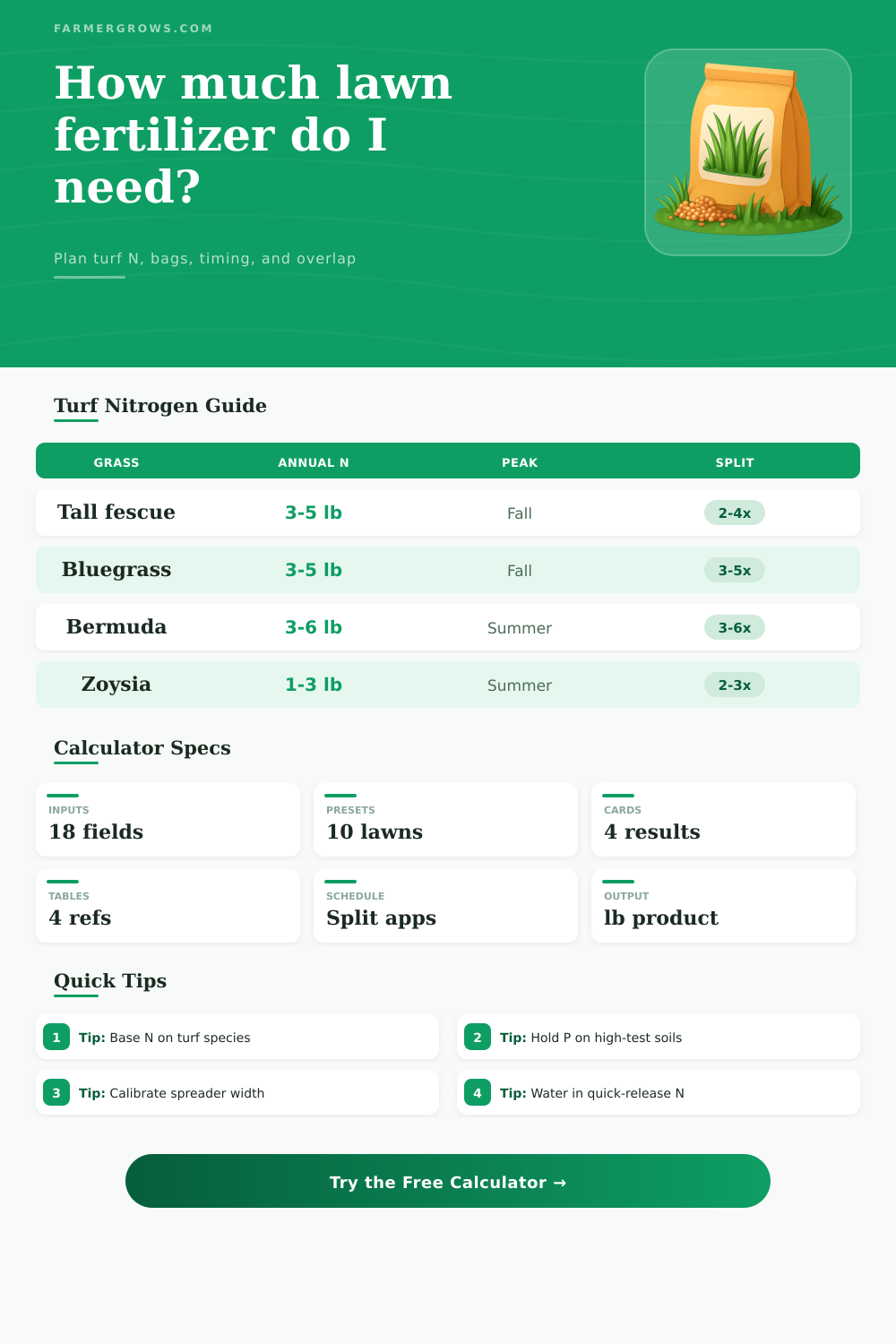
| Grass species | Typical annual N | Main feeding season | Single-app range | Lawn note |
|---|---|---|---|---|
| Turf-type tall fescue | 3 to 5 lb N/1,000 sq ft | Fall, light spring | 0.5 to 1.0 lb N | Durable cool-season turf; avoid heavy summer N in heat. |
| Kentucky bluegrass | 3 to 5 lb N/1,000 sq ft | Fall and spring | 0.5 to 1.0 lb N | Responds to split feeding when irrigation supports growth. |
| Bermuda grass | 3 to 6 lb N/1,000 sq ft | Late spring through summer | 0.5 to 1.0 lb N | Feeds best while actively growing and fully green. |
| Zoysia grass | 1 to 3 lb N/1,000 sq ft | Late spring through summer | 0.25 to 0.75 lb N | Too much nitrogen can create thatch and disease pressure. |
| Centipede grass | 0.5 to 2 lb N/1,000 sq ft | Late spring only as needed | 0.25 to 0.5 lb N | Low-input grass; overfertilizing is a common mistake. |
| Season | Cool-season turf | Warm-season turf | Typical share | Watch point |
|---|---|---|---|---|
| Spring | Light green-up, avoid excess top growth | Wait until green-up is underway | 15% to 30% annual N | Do not push dormant warm-season grass early. |
| Early summer | Usually light or skipped in heat | Strong feeding window | 20% to 30% annual N | Water product off leaf blades after spreading. |
| Summer | Stress season for many cool lawns | Peak warm-season growth | 20% to 35% annual N | Reduce rate during drought or watering limits. |
| Fall | Primary recovery and density window | Taper before dormancy | 25% to 45% annual N | Avoid late high-N push on warm-season turf. |
| Starter | Use when seeding and soil test allows P | Use for sod or seed establishment | 0.5 to 1.0 lb N | Phosphorus rules can vary locally. |
| Soil P or K status | Phosphorus guidance | Potassium guidance | Fertilizer fit | Calculator response |
|---|---|---|---|---|
| Low | Starter or P-containing product may fit | Potash-containing product may fit | Balanced or starter blends | Allows P-K contribution in breakdown. |
| Medium | Maintenance only if recommended | Maintenance K is often useful | Low P, moderate K | Flags product if P is higher than needed. |
| High | Usually avoid added P | Usually reduce added K | No-P nitrogen products | Warns when product adds P or excess K. |
| Unknown | Use caution until soil test returns | Use caution until soil test returns | N-focused, low P | Shows nutrient load but suggests testing. |
| Spreader pattern | Overlap allowance | Field setup | Best use | Risk if ignored |
|---|---|---|---|---|
| Drop spreader | 3% to 6% | Wheel tracks just touch previous pass | Edges, strips, small lawns | Missed lanes or dark stripes. |
| Rotary broadcast | 6% to 12% | Overlap feathered edge of throw pattern | Most home lawns | Light edges and heavy centers. |
| Large broadcast | 8% to 15% | Calibrate swath width with catch pans | Large turf areas | Uneven N and product shortage. |
| Handheld spreader | 12% to 20% | Use half rate in two directions | Patch work and small areas | Hot spots near turns and starts. |
Soil-test tip: Use nitrogen to drive turf color and density, but use a soil test to decide phosphorus and potassium. High P lawns usually need a no-phosphorus product.
Spreader tip: Calibrate by weighing product before and after a measured area. For tricky lawns, apply half the rate in two crossing passes.
Applying fertilizer to your lawn require you to determine an amount of fertilizer product that you need for your lawn. If you apply too much fertilizer to your lawn, runoff or thatch could result. If you apply too little fertilizer, your lawn may begin to look tiredly.
The calculator allow you to enter the dimension of your lawn and the species of grass that grow on your lawn. Based off those entry, the calculator will provide you with an indication of the amount of fertilizer that you should apply to your lawn. Your entries must be accurate in order for the calculator to provide you with the correct calculation.
How Much Fertilizer Does Your Lawn Need
Fertilizers contain nitrogen, the amount of which are responsible for the growth and color of grass blade. Different grass species requires different amount of nitrogen. For instance, tall fescue and Kentucky bluegrass require moderate level of nitrogen, but you should applied in a manner that does not allow for excessive growth of that grass species.
In contrast, applying too much nitrogen to zoysia or centipede grass can lead to those grass types thinning or developing thatch. Using the calculator to determine your grass species will help ensure that the amount of nitrogen to be applied to your lawn fall within the parameters for which your grass species need that nitrogen. Cool-season grass species tend to require most of they nitrogen to be applied in the fall and spring months, while warm-season grass type require most of there nitrogen to be applied during the summer.
Fertilizer products contain either slow release or fast release forms of nitrogen. Slow-release fertilizers are less likely to cause injury to the grass if they are applied at too high of a rate, but the grass blades will not receive all of the nitrogen from those slow-release fertilizers at once. By entering the fertilizer analysis and the percentage of the nitrogen that the fertilizer slowly releases into the calculator, the calculator can provide you with an understanding of how much immediate and extended nitrogen the fertilizer product will provide.
This information will allow you to decide what type of fertilizer to purchase and how often to apply it to your lawn. Testing the soil in your lawn will tell you how much phosphorus and potassium are contained in your soil. Many lawn have established levels of phosphorus in their soil.
Adding too much phosphorus to your lawn can lead to water-quality problem. The calculator will alert you to fertilizers that contain phosphorus or potassium if your lawn soil test reveal high levels of those element. Instead, you will be required to use a fertilizer that is high in nitrogen and low in unnecessary phosphorus and potassium.
Additionally, if you plan on using a spreader to distribute the fertilizer even on your lawn, you will have to account for the fact that some of the fertilizer may be spread through the same area as other passes. Adding an eight or ten percent allowance for spreader overlap will ensure you dont run out of fertilizer before you have even seeded your lawn. The schedule in which you apply the fertilizer to your lawn will impact the health of the root in your lawn.
Applying too much fertilizer at once can create too much top growth of grass without adequate root development, but applying smaller amount more often will ensure even growth of grass. The calculator will alert you to the amount of fertilizer that should be applied in each stage of the fertilizer schedule. This information will allow you to overseed your lawn proper.
The calculator will tell you the number of bags of fertilizer is required to provide the amount of nitrogen to your grass that the grass need. After you determine the fertilizer, the calculator will provide you with the number of whole bag that will be required for your lawn. This number can be compared to the amount of fertilizer bag that are manufactured by the fertilizer company.
Any difference between these two number should be noted. Many people make mistake when fertilizing their lawn. For instance, many people fertilize the same amount each year without analyzing their soil for grass species and phosphorus levels.
Additionally, many people dont account for spreader overlap. However, by using this calculator, you wont make these mistake. The calculator will only work if you correctly measure the area of your lawn and enter the number from your fertilizer bag.
However, if the amount of nitrogen that the fertilizer provides match the needs of your grass species, and if the schedule of application match the needs of your grass species, you can be sure that your lawn will effectively utilize the nitrogen.