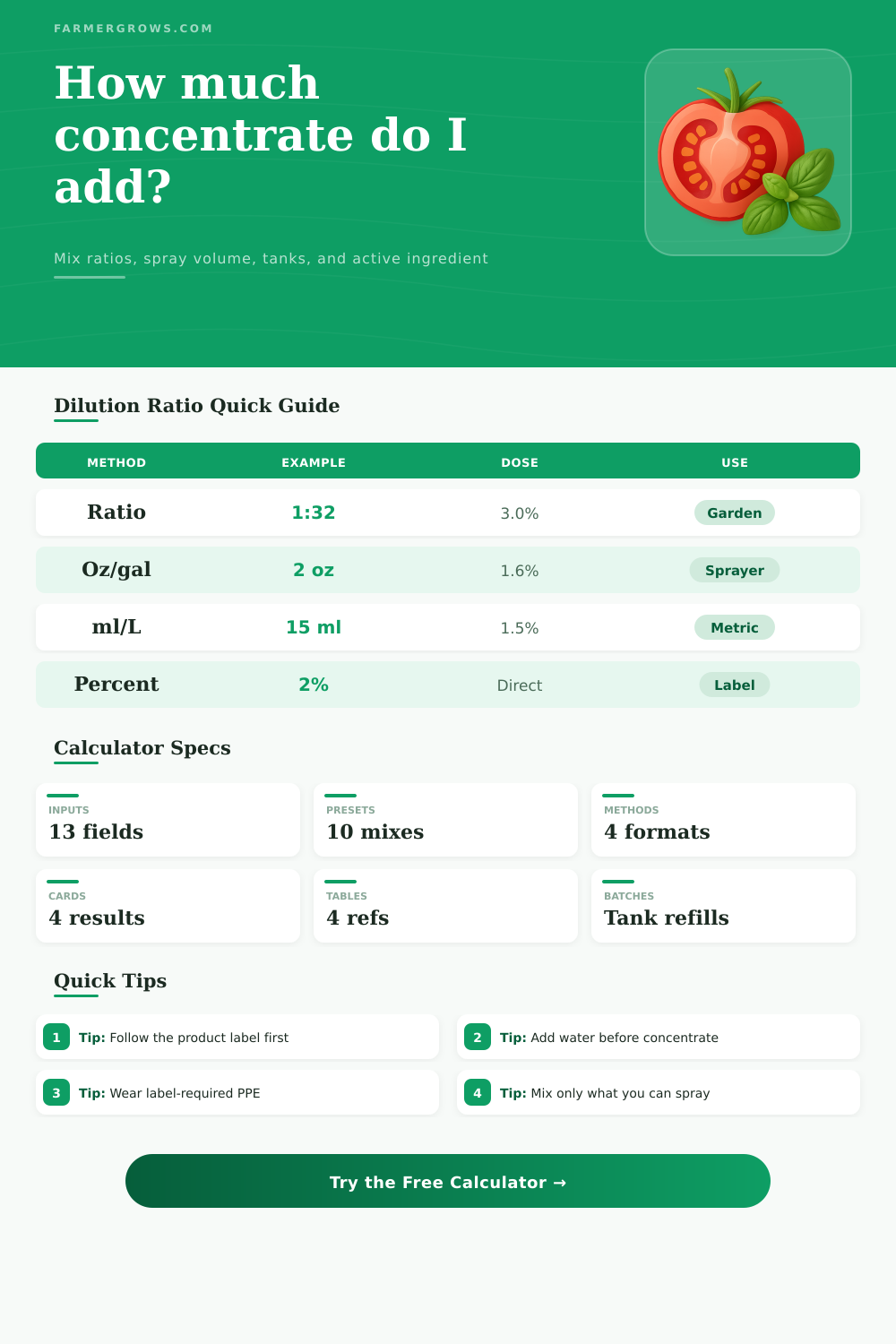
Dilution Ratio Calculator
Convert label directions into concentrate, carrier water, active ingredient, tank refills, and coverage checks for farm, garden, orchard, greenhouse, and lawn spray mixes.
Use the product label as the controlling source. This calculator helps translate common dilution formats and plan batches; it does not override crop restrictions, re-entry intervals, water quality, or legal label rates.
Dilution and Tank Mix Estimate
Results convert the selected label format into a practical tank mix. Round only after checking the product measuring device.
| Ratio | Product share | Approx oz/gal | Approx ml/L | Typical use |
|---|---|---|---|---|
| 1:10 | 9.09% | 11.64 oz/gal | 90.9 ml/L | Strong cleaner or sanitation mix when allowed by label. |
| 1:16 | 5.88% | 7.53 oz/gal | 58.8 ml/L | Heavy garden, barn, or tool wash mixes. |
| 1:32 | 3.03% | 3.88 oz/gal | 30.3 ml/L | Common hand sprayer and greenhouse dilution range. |
| 1:64 | 1.54% | 1.97 oz/gal | 15.4 ml/L | Light sanitation, foliar products, and maintenance sprays. |
| 1:100 | 0.99% | 1.27 oz/gal | 9.9 ml/L | Very light stock, additive, or sensitive plant mixes. |
| Application job | Common carrier rate | Coverage focus | Notes |
|---|---|---|---|
| Backpack garden spray | 1 to 2 gal/1000 sq ft | Leaves and stems | Walk speed and nozzle pattern change real output. |
| Boom field sprayer | 10 to 20 gal/acre | Uniform broadcast | Calibrate nozzles before relying on acres per tank. |
| Orchard airblast | 50 to 100 gal/acre | Canopy penetration | Tree size, pruning, and air speed matter. |
| Greenhouse bench | 0.5 to 1 L/sq m | Tray or bench wetting | Drainage and runoff can change delivered dose. |
| Spot treatment | Label directed | Target weeds | Do not convert spot sprays into illegal broadcast rates. |
| Conversion | Value | Use in calculator | Practical note |
|---|---|---|---|
| 1 gallon | 128 fl oz | oz/gal dosing | Use fluid ounces for liquid concentrate. |
| 1 gallon | 3.785 L | US to metric | Useful when a tank has metric markings. |
| 1 liter | 1000 ml | ml/L dosing | Measure small batches with a graduated cylinder. |
| 1 acre | 43,560 sq ft | Area rates | Needed for boom and pasture calculations. |
| 1 hectare | 2.471 acres | Metric area | Used when labels list L per hectare. |
| Tank size | At 2 oz/gal | At 15 ml/L | At 2% | Planning note |
|---|---|---|---|---|
| 1 gal hand sprayer | 2 fl oz | 57 ml | 2.56 fl oz | Good for spot work and test patches. |
| 4 gal backpack | 8 fl oz | 227 ml | 10.24 fl oz | Agitate between refills when product settles. |
| 15 gal ATV tank | 30 fl oz | 852 ml | 38.4 fl oz | Useful for lawn, fence line, or orchard jobs. |
| 50 gal skid tank | 100 fl oz | 2.84 L | 1.0 gal | Measure carefully before topping up with water. |
| 300 gal field tank | 4.69 gal | 17.0 L | 6.0 gal | Premix if the label requires slurry or induction. |
Read before mixing: Confirm the crop, target pest, dilution, personal protective equipment, water order, agitation, re-entry interval, and disposal directions on the label before opening the container.
Mix in the right order: Start with part of the water, add measured concentrate slowly, agitate, then top up to final volume. Never guess with an unmarked tank.
Getting the dilution correct for your farm or garden spray product is an important task. Getting the dilution correct is necesary to avoid either wasting your product or fail to comply with the legal rules regarding that product. The label that is attached to your product will provide instructions regarding how to mix the product.
These instructions may be provided as a ratio (such as one part concentrate to thirty-two parts water), as ounces of the concentrate per gallon of final spray mixture (such as two ounce per gallon), as milliliters of the concentrate per liter of final spray mixture (such as fifty milliliters per liter), or as the percentage of the final spray mixture that should be the concentrate (such as 1.5 percent). Each of these indicates the same mixture in different ways, and the calculator will assist you in translating those instructions into a measurement that you can use in your mixing process. To use the calculator, you must enter the mixing method, the volume of the final spray mixture that you will create, and the size of your spray tanks.
How to Mix Spray for Your Farm or Garden
The label on the spray product will contain the legal specifications regarding the use of that product. It will tell you the amount of the product that you should use. If the product use a ratio on its label, that ratio means that you should measure the number of parts of the concentrate to the number of parts of water.
If the product uses an ounces-per-gallon rating, that rating will tell you how many ounces of the concentrate you should use in every gallon of the final spray mixture. If the product uses a milliliters-per-liter rating, that amount will indicate the amount of the concentrate that should be utilized in every liter of the final spray mixture. Finally, if the label indicates a percent solution of the concentrate in the spray mixture, the percentage will indicate the percentage of the total volume that should be the concentrate.
Each of these values can be selected on the calculator so that you dont have to remember the math for each of the values. You should enter a variety of different values on the calculator. For instance, the tank size will determine how many batches of spray mixture you will have to prepare.
The area that you will spray and the rate at which you will apply the mixture to the area will determine how much mixture you will need to prepare in total. Finally, the field for the active ingredient will allow you to adjust the amount of concentrate that your spray tank will dispense if the concentrate that you are using is not of full strength. The tables that is provided on the calculator can be of great benefit to you.
For instance, you can use the tables to determine that one gallon is equal to one hundred twenty-eight fluid ounces, that one acre is equal to forty-three thousand five hundred sixty square feet, and that one liter is equal to one thousand milliliters. These tables will allow you to check your calculations prior to spraying your area. Additionally, the batch planning table will provide you with information regarding how each dose will change with different tank sizes.
There are a variety of common mistakes that may be made with the spray mixture calculations. For instance, many people will measure the concentrate prior to adding the water to the tank. However, this can cause the concentrate to foam and make it difficultly to thoroughly mix the spray solution.
Furthermore, people will often ignore the strength of the concentrate and think that the amount of the concentrate that is measured for each portion of water will remain the same, regardless of how strong the concentrate is. Finally, a third common mistake is for individuals to treat a spot treatment rate as if it will be valid for large areas rather than small areas. You must remember each of these steps as the individual applying the spray.
Any calculations performed on this calculator will be performed at your expense, and you are required to always follow the product label that is attached to the product. Finally, the order in which you add the liquids to your spray tank is important. First, you should add some of the water to the tank.
Second, you should add the measured concentrate to the tank while agitating the liquid within the tank. Finally, you should fill the tank with water to the total amount of the tank. Following this procedure will prevent the concentrate from settling at the bottom of the spray tank.
Additionally, following this order will make it easier to correct the amount of concentrate that was added if you accidentaly pour too much concentrate into the tank. While the calculator will calculate the concentrate for you, you will still have to use the markings on your measuring device to ensure that you correctly pour that amount of concentrate into the tank. One of the main benefits of the calculator is that it ensures that you can repeatably create the same mixture of concentrate and water.
By writing down the measurements that you calculate with the calculator, you can ensure that you can use those same measurements for future spraying jobs. Using these same measurements will ensure that you create the same mixture each time, which is important for jobs that must be performed numerous times. Therefore, you will utilize the same field, the same nozzle, and the same product label in each spraying job, and the calculator will allow you to create such a process.