Crop Yield Calculator
Estimate farm yield from harvested weight, crop test weight, moisture shrink, dockage, field loss, and marketable percentage across common grain and oilseed crops.
Use scale tickets when available. If the starting weight is entered as bushels, the calculator uses the entered test weight to estimate wet pounds before applying moisture, dockage, and field loss.
Yield Results
Adjusted from harvested weight through moisture shrink, dockage, loss, and marketable percentage.
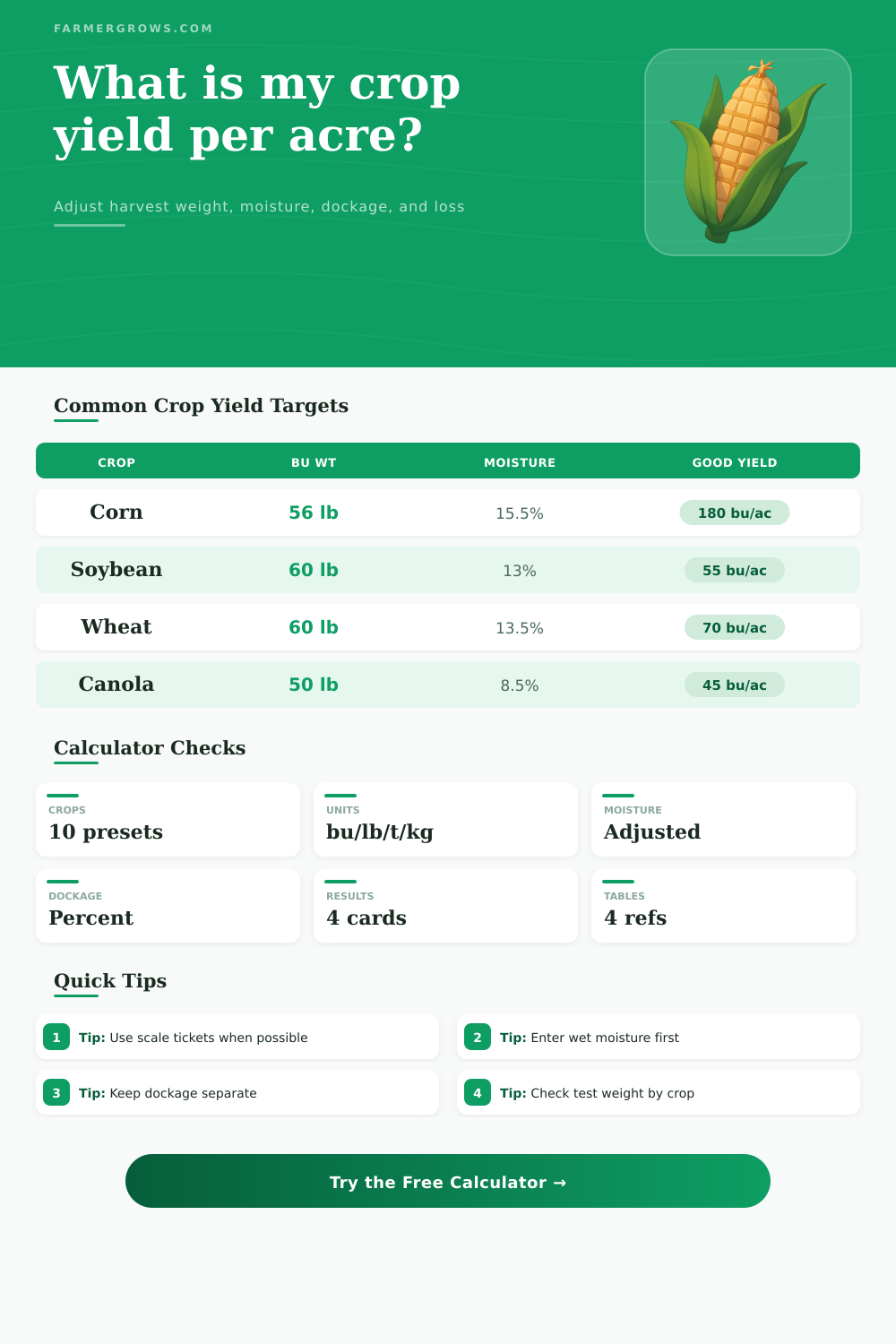
| Crop | Standard bushel weight | Typical target moisture | Good field yield |
|---|---|---|---|
| Corn grain | 56 lb/bu | 15.5% | 160 to 220 bu/ac |
| Soybeans | 60 lb/bu | 13.0% | 45 to 70 bu/ac |
| Wheat | 60 lb/bu | 13.5% | 55 to 90 bu/ac |
| Barley | 48 lb/bu | 13.5% | 70 to 115 bu/ac |
| Canola | 50 lb/bu | 8.5% | 35 to 55 bu/ac |
| Crop condition | Moisture adjustment used | Example shrink | Field note |
|---|---|---|---|
| Wet corn at 20% | (100 - 20) / (100 - 15.5) | 94.7% | Dry matter stays, water weight is reduced |
| Soybeans at 15% | (100 - 15) / (100 - 13) | 97.7% | Small moisture change can still move totals |
| Canola at 10% | (100 - 10) / (100 - 8.5) | 98.4% | Oilseed moisture targets are lower |
| Dry sample below target | Factor capped at 1.00 | No gain | This calculator does not add water weight back |
| Unit entered | How it becomes wet pounds | Best source | When to use |
|---|---|---|---|
| Bushels | Bushels x actual test weight | Combine monitor or wagon volume | When volume is known but scale weight is not |
| Pounds | Pounds x 1 | Scale ticket | Most direct harvest calculation |
| US tons | Tons x 2,000 | Truck scale total | Large loads or whole-field summaries |
| Kilograms | Kilograms x 2.20462 | Metric scale total | Metric records converted to US bushels |
| Adjustment | Where it applies | Formula effect | Typical range |
|---|---|---|---|
| Moisture shrink | Before dockage | Reduces wet pounds to target moisture | 0% to 12% |
| Dockage | After moisture | Removes foreign material or fines | 0% to 8% |
| Harvest loss | After dockage | Accounts for field or handling loss | 1% to 10% |
| Marketable portion | Final step | Applies grade, damage, or saleable share | 85% to 100% |
For clean comparisons: Use the same target moisture and dockage method across fields. That keeps hybrid, variety, and management comparisons from being skewed by harvest timing.
For bushel entries: Update test weight by crop lot. Low test weight reduces pounds per measured bushel and can change the final commercial bushel total.
A yield calculator are a tool that will allow a person to determine the actual amount of crops that a person has harvested. Farmers often have inaccurate figure presented on the combine because the combine harvests grain that contain water and other substances. The yield calculator for the combine will remove these variable to allow the farmer to obtain the actual amount of the crop that the crop variety delivered.
If a person doesnt use a yield calculator, two fields may appear to have the same amount of the crop harvested, but the actual amount of each crop variety may differ. The first adjustment that a person must make with the yield calculator is the amount of moisture that the grain contain. The weight of grain that is sold and stored contain a standard amount of moisture.
How a Yield Calculator Helps Farmers
The yield calculator will adjust the weight of the harvested grain to the standard amount of moisture that is sold. If the amount of moisture in the grain is high when it is harvested, the grain will lose some of that water weight before the bushel of grain can be counted. The percentage of moisture in the harvested grain must be entered into the calculator as the moisture needs to be measured at the time of harvest when the grain is weighed.
Using an estimation of the moisture content of the grain based off the weather can result in the addition of extra weight to the grain that is harvested, resulting in a more higher count of bushels of grain then should be counted. The second adjustment that a person must make is the test weight of the grain. The combine that is harvesting the crop will calculate the amount of grain in bushels.
A bushel of grain will not necessarily weigh the same than a bushel that is measured by weight. If the test weight of the grain is lower than when it was planted, then there will be fewer pounds of grain in that amount of bushel. The person will enter the test weight into the calculator so that the bushels are weighed in pounds, as well as so that all of the other calculations is based on a standard weight of the crop.
The yield calculator can also calculate dockage and field loss. Dockage is the amount of foreign material in the grain as calculated by an elevator. Field loss is the amount of grain that may be lost during the harvest of the field.
Some of the grain may remain in a pile behind the combine that harvested the field. Some of the grains may never enter the header that harvest the field. These percentage can be entered into the calculator to determine if the field loss is from the grain cleaner or the field itself.
This can allow the farmer to decide if the header should be tuned or if the variety of crops is losing grain due to fine in the harvested portion of the field. The final adjustment is the marketable percentage. The marketable percentage is the portion of the total number of bushels of grain that will meet the grade required of farmers and buyers of the grain.
The marketable percentage will be applied to the weight of the grain after the moisture is accounted for, the test weight is entered, and the field loss and dockage is calculated. After these calculations are performed, the marketable percentage will indicate the amount of grain that will earn revenue for the farmer. The reference tables that is included with the combine yield calculator are used to list the weights of bushels of grain and the yields of different type of crops.
These reference tables are used as benchmarks for farmers and are not the targets that farmers should aim for with the production of their crops. The yields of fields that are determined to be below the average yields for the reference tables may be the result of a late planting date for crops or thin stand of crops. Yields of fields that are determined to be above the average yields for reference tables may be the result of a need to investigate the reason for the high yields of grain from those field.
Comparing the yields of several field with the same moisture and dockage settings can remove the noise that is created by the varying harvest dates. Using the yield calculator for the entire growing season allows a farmer to compare the performance of each hybrid of crops and each field. The yield calculator allow the farmer to compare the test weights of different hybrid crops and to compare the number of fields that lose grain to shatter.
Using the yield calculator over an extended period of time allows a farmer to determine which crops hold up over time and to make decisions regarding planting and harvesting of crops. While the yield calculator does not help the farmer to understand the significance of the data that the calculator calculates, it does remove the noise created by the math so the farmer can focus on making decision about the crops based on that data.