Planting Population Calculator
Plan row-crop seeding rate from acres, row spacing, seeds per foot, target population, germination, emergence, planter skips, doubles, seed spacing, and bag units.
Use this as a planning check before planting. Actual stand can shift with seed lot quality, soil temperature, planter condition, crusting, insects, disease, residue, and replant decisions.
Planting Population Results
Results use row feet per acre, planned seed drop, germination, emergence, planter skip and double adjustments, and the selected seed unit size.
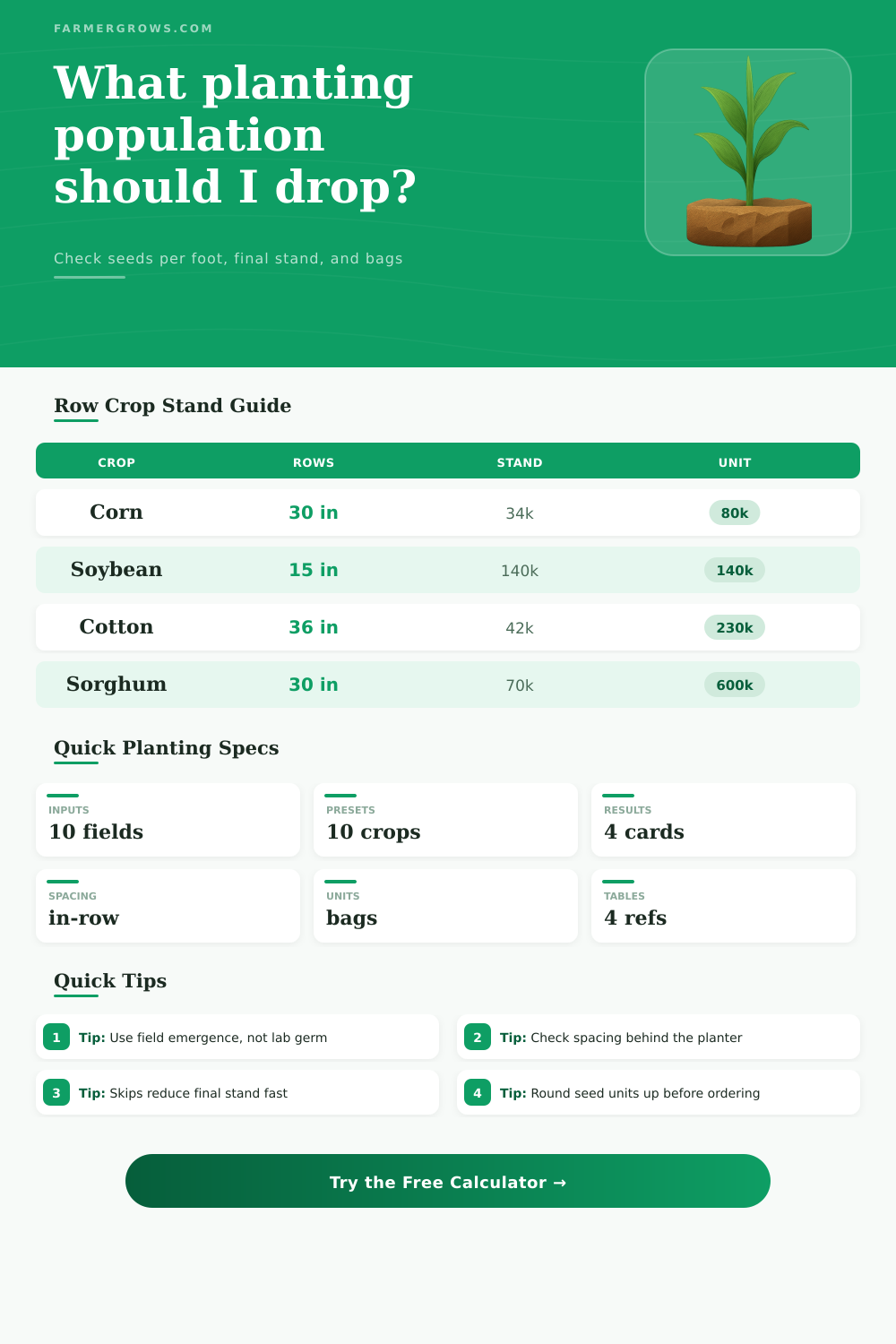
| Crop | Common rows | Typical final stand | Planning note |
|---|---|---|---|
| Corn | 20 to 36 in | 26,000 to 38,000 plants/ac | Adjust for hybrid, moisture, yield goal, and dryland risk. |
| Soybean | 7.5 to 30 in | 90,000 to 160,000 plants/ac | Narrow rows often close canopy sooner in many regions. |
| Cotton | 30 to 40 in | 32,000 to 55,000 plants/ac | Variety, irrigation, and row pattern change the target. |
| Grain sorghum | 15 to 30 in | 45,000 to 90,000 plants/ac | Lower populations are common where moisture is limiting. |
| Sunflower | 20 to 30 in | 16,000 to 28,000 plants/ac | Oilseed and confection markets often use different targets. |
| Row spacing | Row feet per acre | Seeds/ac per 1 seed/ft | Use case |
|---|---|---|---|
| 7.5 in | 69,696 ft | 69,696 seeds/ac | Small grain drills and narrow soybean rows |
| 15 in | 34,848 ft | 34,848 seeds/ac | Soybean, sorghum, canola, and split-row planters |
| 20 in | 26,136 ft | 26,136 seeds/ac | Narrow corn and dry bean systems |
| 30 in | 17,424 ft | 17,424 seeds/ac | Common corn, sunflower, sorghum, and soybean rows |
| 36 in | 14,520 ft | 14,520 seeds/ac | Cotton, peanut, and some vegetable row systems |
| Seed unit size | Crop example | Acres at 34k drop | Acres at 140k drop |
|---|---|---|---|
| 80,000 seeds | Corn bag | 2.35 ac | 0.57 ac |
| 100,000 seeds | Dry bean unit | 2.94 ac | 0.71 ac |
| 140,000 seeds | Soybean unit | 4.12 ac | 1.00 ac |
| 230,000 seeds | Cotton unit | 6.76 ac | 1.64 ac |
| 600,000 seeds | Sorghum bag | 17.65 ac | 4.29 ac |
| Planter condition | Skip rate | Double rate | Stand effect | Field check |
|---|---|---|---|---|
| Excellent singulation | 0% to 1% | 0% to 1% | Near target | Uniform spacing, few misses, few multiples |
| Good field setup | 1% to 3% | 1% to 3% | Small net change | Watch row units with residue or rough seedbed |
| Worn meter or vacuum issue | 3% to 6% | 2% to 6% | Unsteady spacing | Check singulators, plates, vacuum, speed, and seed size |
| Rough planting conditions | 5% to 10% | 0% to 4% | Final stand drops | Look for bounce, poor closing, crusting, or shallow seed |
| Target plants/ac | 7.5 in rows | 15 in rows | 20 in rows | 30 in rows | 36 in rows |
|---|---|---|---|---|---|
| 28,000 | 0.40 seeds/ft | 0.80 seeds/ft | 1.07 seeds/ft | 1.61 seeds/ft | 1.93 seeds/ft |
| 34,000 | 0.49 seeds/ft | 0.98 seeds/ft | 1.30 seeds/ft | 1.95 seeds/ft | 2.34 seeds/ft |
| 70,000 | 1.00 seeds/ft | 2.01 seeds/ft | 2.68 seeds/ft | 4.02 seeds/ft | 4.82 seeds/ft |
| 100,000 | 1.43 seeds/ft | 2.87 seeds/ft | 3.83 seeds/ft | 5.74 seeds/ft | 6.89 seeds/ft |
| 140,000 | 2.01 seeds/ft | 4.02 seeds/ft | 5.36 seeds/ft | 8.04 seeds/ft | 9.64 seeds/ft |
For final stand: Use field emergence from your soils and planting window rather than only the seed tag germination number. Cool, wet, crusted, or compacted fields can cut emergence quickly.
For planter checks: Dig behind several row units after changing seed size, plate, vacuum, speed, or downforce. Real seed spacing is the best audit of the calculator settings.
Planting populations play a role in the total yield that a crop will produce. The planting population for a field determine how much competition that the plants will experience for factors like light, moisture, and nutrients. If the grower sets the planting population too low for the acres of land in a field, then the grower will leave many of the potential yield on the table.
If the planting population is set too high for the acres of land in a field, then each of the plants will compete with each other for the same resources that they would otherwise share with other plants in the field. The grower often establish the target planting population based off the conditions within the field in previous growing seasons. However, the grower will have to adjust for the expected field condition within the field in which they will be establishing the crop.
How to Set the Right Planting Population
The seed tag for the crop can indicate the germination rate for a crop. However, germination rates in the field will always be lower than the germination rate for the seeds under ideal conditions in the laboratory. Many factors affects the emergence of plants from the field, including moisture, temperature, soil crusting, and soil depth.
Because field emergence rates will often differ from those indicated by the seed tag, growers can use a calculator to determine the difference between the two rates. Another factor that may impact the planting population is the accuracy with which the planter delivers the seeds into the field. Skips and doubles with the planter can reduce the evenness of the distribution of the plants in the field.
However, skips and doubles does not necessarily cancel one another out. The net effect of skips and doubles will depend upon the percentage of each that the planter incorporates into each row unit. The planter can be tested in a few different ways, but one of the easiest ways is to simply walk behind the planter while it is in operation.
Alternatively, the math for determining the skip and double rates can be used to determine if the skip rate is acceptable or if you should check the planter. Row spacing can also impact the actual population of plants that are distributed into the acre. If the rows are narrow, then more plants can be distributed into the same acre.
Narrow rows can assist in the even closure of the canopy that the plants form. However, narrow row spacing implies that any problem with the planter that affects one row unit will impact a larger portion of the field with narrow rows. Rows that are spaced further apart from one another will reduce the impact of any problem in one row unit on the rest of the field.
However, if the rows are too wide, then there will be more space between each of the plants, which the grower must manage with cultivation or chemical treatments. The size of the seed units that the planter distributes will impact the amount of seed that must be ordered. Each crop will have different bag sizes that contain the seeds for that crop.
The amount of seed that is needed to plant the acres of land will depend upon the size of each seed unit and the desired planting population for that crop. The grower must determine the size of each acre that each unit of seed can cover, factoring in skips, doubles, emergence, and other variables. The grower will round up the amount of seed that should be ordered for planting prior to ordering the seed.
Rounding up the order is a cheaper process than running out of seed during planting. Reference tables can be used to quickly determine if the calculations for planting population are correct. These tables can indicate the number of row feet that are contained in each acre for common row spacings.
Reference tables can also indicate the acres that are covered by common sizes of seed units. These tables should not provide the final answer to the population calculations, but they can be used to compare the growers calculations to those that are common within the crop-growing industry. Factors in the field that cannot be accounted for in the calculator include weather and soil conditions.
Field emergence rates for crops may drop significantly if the field experiences a week of cold and wet weather after planting. Factors like soil residue can also impact planting depth. Because it is hard to quantify the impact of the soil and weather variables, growers may include a safety margin within the amount of seed that falls from the planter.
This safety margin will ensure that the grower can achieve their target planting population with the field emergence rates that are established through the planting season. The calculator is a tool to be used in the planning process for establishing a crop. Rather than using the emergence rate indicated on the calculator, use the emergence rate that was calculated for the field.
Rather than using the skip and double rates that the planter manufacturer provides, adjust those percentages according to the observations of the field conditions during the previous planting season. Finally, walk the field after planting to determine if any adjustments should be made to the planter setting. By repeating this process, the grower will gain a knowledge of the field, the crop, and the seed population that should be established.