Chicken Breeding Calculator
Plan rooster-to-hen ratios, fertile egg collection, incubator set dates, candling checks, lockdown, hatch day, expected chick count, and brooder space.
Use this as a planning estimate for small farm and homestead breeding pens. Actual hatch results depend on breeder age, rooster soundness, egg storage, incubator calibration, shell quality, and flock health.
Chicken Breeding Results
Dates and chick counts update from your set date, breed incubation period, rooster ratio, egg collection span, fertility estimate, and brooder space target.
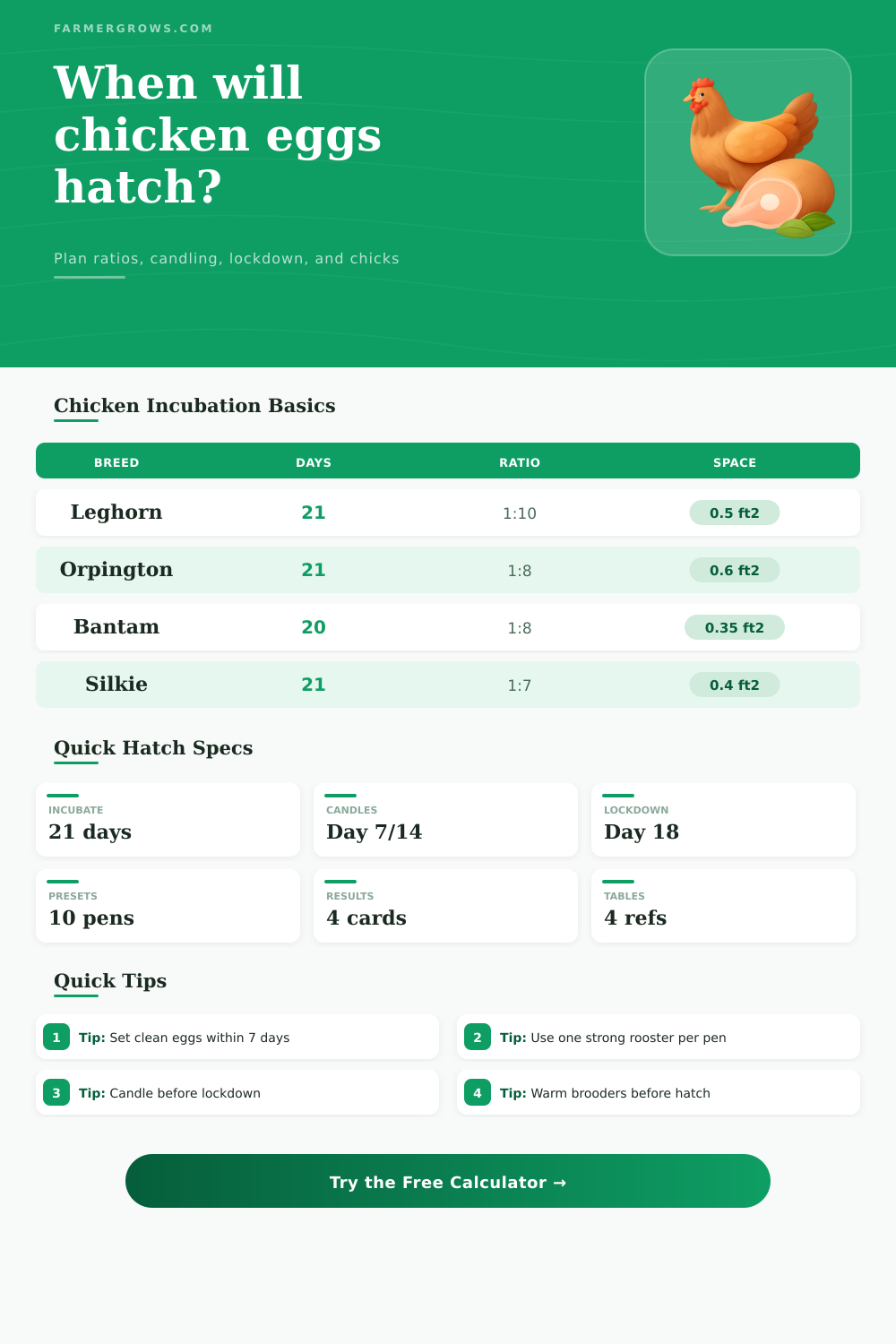
| Breed or type | Incubation days | Suggested rooster ratio | Egg output note | Planning note |
|---|---|---|---|---|
| Production layer | 21 days | 1 rooster per 9 to 12 hens | High settable egg volume | Watch thin shells and older hens |
| Rhode Island Red | 21 days | 1 rooster per 8 to 10 hens | Strong brown-egg layer | Good general homestead breeding pen |
| Orpington or Wyandotte | 21 days | 1 rooster per 7 to 9 hens | Moderate egg volume | Heavy birds need good footing and body condition |
| Silkie | 21 days | 1 rooster per 6 to 8 hens | Small eggs, broody lines | Often used for small specialty hatches |
| Bantam | 20 to 21 days | 1 rooster per 6 to 9 hens | Small eggs and chicks | Plan less brooder space but more temperature care |
| Incubation stage | Day range | Calendar task | What to check |
|---|---|---|---|
| Set eggs | Day 0 | Start incubation or set under broody hen | Clean shells, correct storage, marked dates |
| Early candle | Day 5 to 8 | Remove clear eggs if confident | Veins, embryo growth, cracked shells |
| Mid candle | Day 12 to 15 | Confirm development and air cells | Quitters, clears, uneven air cell growth |
| Lockdown | Day 18 | Stop turning, set hatch tray, raise humidity | Position, water channels, no frequent opening |
| Hatch window | Day 20 to 22 | Allow chicks to hatch and dry before brooding | Pips, zips, weak chicks, brooder readiness |
| Egg storage age | Fertility planning factor | Handling note | Best use |
|---|---|---|---|
| 1 to 3 days | 100% | Freshest setting group | Priority eggs from valuable matings |
| 4 to 7 days | 98% to 100% | Common small-farm collection window | Most incubator batches |
| 8 to 10 days | 90% to 96% | Store cool and turn gently | Useful when building a full tray |
| 11 to 14 days | 75% to 88% | Expect more early loss | Only when genetics or timing require it |
| Brooder age | Space per chick | Temperature guide | Management focus |
|---|---|---|---|
| Week 1 | 0.25 to 0.35 sq ft | About 95°F at chick level | Dry litter, fresh water, easy feed access |
| Week 2 | 0.35 to 0.50 sq ft | Reduce heat if chicks spread out | Watch crowding and damp corners |
| Week 3 to 4 | 0.50 to 0.75 sq ft | Feathering improves heat tolerance | Raise feeders and add space before picking starts |
| Week 5 to 6 | 0.75 to 1.00 sq ft | Heat depends on weather and feathering | Plan grow-out pens before brooder is crowded |
| Week 7 to 8 | 1.00 to 1.50 sq ft | Usually little supplemental heat | Separate by size if needed |
For better fertility: Match rooster count to hen count and watch behavior. Overmating can injure hens, while too few active roosters can leave clear eggs.
For better hatch planning: Label collection dates, set the cleanest eggs first, and have the brooder warmed before the first external pip appears.
To ensure that your hatch is successful, you must prepare carefuly. Managing the rooster ratios, the age of the eggs, the incubation schedules for the eggs, and the space in which the chicks will have to grow is all part of careful preparation. To ensure fertility from the eggs, you must manage the rooster ratios, you must manage the age of the eggs, you must manage the incubation schedules for the eggs to ensure a successful hatch, and you must manage the brooder space to ensure that the chicks has enough space to grow.
The calculator will provide a mathematical plan for you based off the breed of the chicks, when you would like to set them, and the details of the pen. The calculator will remove the guesswork in determining the number of chicks that will hatch so that you will not have empty trays of eggs or chickens that are forced to compete for the limited brooder space. Rooster ratios will play an important role in the number of eggs that is fertile.
How to Plan a Successful Chick Hatch
If the ratio of roosters to hens is too low, there will be a decrease in the fertility of the eggs laid by the hens. Additionally, if there are too many roosters in the ratio of the number of hens, the roosters will begin to cause the hens to suffer the injuries or wear of their feathers. The common ratio of roosters to hens is one rooster for every eight or nine hens.
However, if the hens are light layer, the ratio could be one rooster for every ten or eleven hens. The calculator adjusts for the number of roosters to the number of hens to ensure that the fertility of the eggs is factored into the expected number of chicks. Additionally, the age of the eggs will impact the fertility of the hens eggs.
If the eggs are collected within seven days from the time in which they are laid, there will be a highly rate of fertile eggs that will hatch. However, if the collected eggs are ten days old or older, the number of fertile eggs will diminish. The calculator applies a penalty to the expected number of chicks based on the age of the eggs collected.
The calculator will factor in the age of the eggs in determining the number of chicks that will hatch. Thus, knowing the age of the eggs will allow the person to decide whether to begin the incubation process for the eggs or to seek fresh eggs. Finally, the incubation schedules will determine the successful hatching of the chicks from the eggs.
Steps such as candling and lockdown must be taken on specific date during the incubation period. Early candling allows for the removal of non-fertile eggs from incubation to prevent the eggs from rotting. A second candling occurs later in the incubation period to ensure that the embryos has proper development.
Lastly, lockdown will occur seven days before the chicks will hatch. During this time, the incubator will stop rotating the eggs and increase the humidity within the incubator so that the membranes surrounding the chicks will remain flexible once the eggs are hatched. Beyond placing the candling and lockdown dates on your calendar based on the set date for hatch day, the calculator also ensure that even if the length of incubation for your eggs changes, the schedule will remain consistent.
Brooder space is necessary for chicks once they hatch from the eggs. You will need to plan for the right amount of brooder space for your number of chicks. Chicks require approximately half a square foot of space when they are four weeks of age, but they will require more space as they grow and develop their feathers.
You should plan for a safety margin for the chicks in your brooder to ensure that you do not run out of space for your chicks once they have grown in size. The calculator will multiply the number of chicks you expect by the space requirement for chicks and a safety margin, and it will tell you the total amount of space that you need for your brooder. The number of chicks that will hatch from your eggs may not necessarily match the estimated number of chicks because various factors can influence the number of chicks that hatch successfully from the eggs you set aside to incubate.
For example, the age of the hen, the quality of the egg shell, the calibration of the incubator, and the number of temperature change that occur daily can all impact the number of chicks that hatch from your eggs. The calculator provides for a planning range for the number of chicks that will hatch because this allows for the preparation of situations where there may be fewer or more chicks than estimated. Additionally, the planning range can indicate the impact that changes in variables like the number of days that the eggs are collected or the rooster ratio can have on the number of chicks that hatch.
Various breeds of chicks may require different management practices when they are developing into chicks. The calculator adjusts automatically for the differences between the breeds of chicks that you may be raising. For example, bantams hatch earlier and require less brooder space then other breeds of chicks, but other heavy heritage breeds may require a different ratio of roosters to ensure the fertility of their eggs.
Whenever you change the breed of chicks in the calculator, it will automatically update the length of incubation, the target ratio of roosters, and the allowance of space for chicks in the brooder. In using this calculator, you can reduce the number of surprises that may be experienced on hatch day. The calculator will ensure that you know the correct dates for candling and lockdown of the eggs and the amount of brooder space to prepare for your chicks.
Although the tool performs the math in this tool to determine the workable plan for hatch day, the plans are simple to understand and execute.