Cattle Breeding Calculator
Plan bull turnout, AI service dates, pregnancy checks, expected calving windows, synchronization timing, replacement heifer readiness, and likely calving distribution.
Use this planning tool with your veterinarian and herd records. Date ranges are estimates because individual gestation, semen fertility, bull soundness, nutrition, disease pressure, and heat detection can shift real outcomes.
Breeding Calendar Results
Dates are calculated from the selected service date, gestation length, heat cycle, synchronization protocol, and breeding season length.
| Breed or type | Gestation days used | Normal planning range | Common production note |
|---|---|---|---|
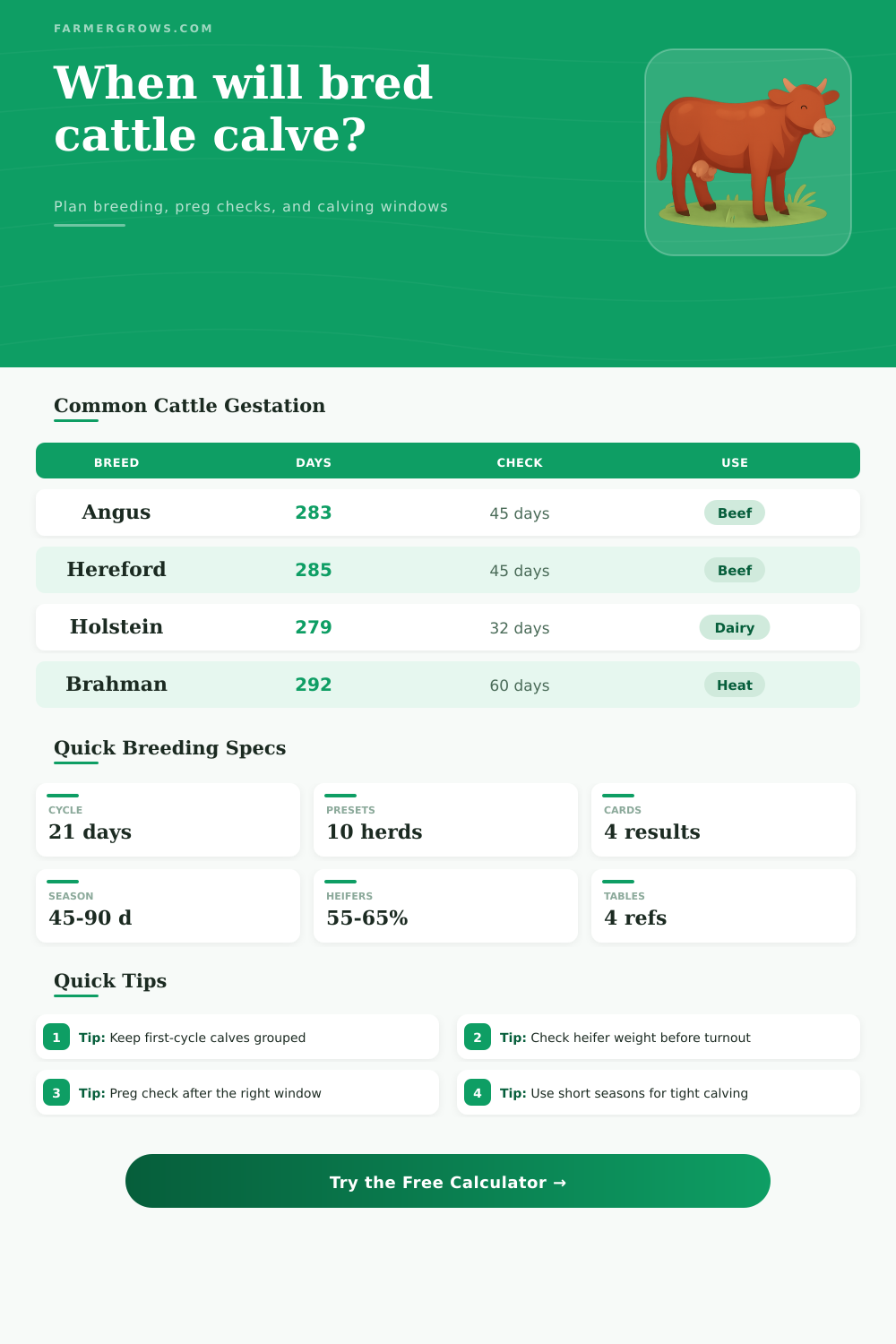
| Angus | 283 days | 276 to 290 days | Common beef baseline for spring and fall herds |
| Hereford | 285 days | 278 to 292 days | Slightly longer beef planning value |
| Charolais | 287 days | 280 to 294 days | Use calving ease data on heifers |
| Brahman influence | 292 days | 285 to 299 days | Heat-adapted cattle often plan longer gestation |
| Holstein | 279 days | 272 to 286 days | Dairy breeding calendars often use shorter gestation |
| Jersey | 278 days | 271 to 285 days | Useful for dairy heifer calving-age planning |
| Synchronization protocol | Anchor event | Approximate timing around AI | Best fit |
|---|---|---|---|
| No synchronization | Heat or bull turnout | Watch return heats every 18 to 24 days | Low-labor natural service herds |
| 7-day CO-Synch + CIDR | Timed AI date | CIDR and GnRH about 10 days before AI, pull CIDR about 3 days before AI | Beef cows needing compact AI |
| 5-day CO-Synch + CIDR | Timed AI date | CIDR and GnRH about 8 days before AI, prostaglandin near removal | High-response timed AI groups |
| MGA-PG | Heifer AI date | MGA feeding period before prostaglandin and heat breeding | Replacement heifer development groups |
| Two-shot prostaglandin | AI or heat breeding | Two injections about 11 to 14 days apart | Cycling cows or heifers with heat detection |
| Replacement heifer check | Common target | Why it matters | Action if short |
|---|---|---|---|
| Age at breeding | 13 to 15 months | Supports first calving near 24 months | Delay exposure or improve development plane |
| Weight at breeding | 55% to 65% mature weight | Improves puberty and rebreeding odds | Sort light heifers and feed separately |
| Body condition | BCS 5 to 6 beef, 3.0 dairy | Thin heifers cycle later and breed back slower | Raise energy before breeding season |
| Pelvic and health review | Pre-breeding exam | Reduces calving and reproductive risk | Work with a veterinarian before turnout |
| Calving distribution group | Breeding timing | Expected calving timing | Management focus |
|---|---|---|---|
| First cycle | Day 1 to 21 | Earliest 3-week calving group | Best replacement and weaning-weight candidates |
| Second cycle | Day 22 to 42 | Middle calving group | Watch nutrition and newborn workload overlap |
| Third cycle or cleanup | Day 43 to season end | Late calving group | Review late breeders before next season |
| Open females | No confirmed pregnancy | No calf from this season | Preg check, cull, treat, or rebreed by plan |
For tighter calving: Keep the breeding season short enough to cover two or three heat cycles, then preg check and make decisions while records are fresh.
For replacement heifers: Sort by weight before breeding. Heifers that are old enough but under target weight often need separate feed and a later exposure date.
Cattle breeding decisions depends on timing, and cattle breeding decisions require you to understand how timing affect the cattle. A cow that is bred on a specific date will give birth to a calf approximately nine month later. However, the length of pregnancy can vary depending on the breed of cow and the method of breeding.
Furthermore, the timing of when the cow gives birth will affect the weight of the calves when they is weaned and the impact on the pastures where the cattle will graze. For instance, a calf that is born in early March will experience different outcome than a calf that is born in late April. These differences will impact which animals will become the candidates for replacement animals in the herd.
Cattle Breeding: Timing and Planning
By aligning the breeding dates with pregnancy checks and the calving spreads of the cows, the cattle producer can manage the herd more effectively. A breeding calculator requires different specific inputs to determine when the calves will be born. These inputs may include the breed of the cow to be bred, the length of the heat cycle for the cows, when pregnancy checks will take place, and how long the breeding season will be.
The breed of the cow will impact the length of pregnancy for the cow. For instance, a Jersey cow will have a shorter pregnancy length than a Brahman-influenced cow. The length of the heat cycle will impact how quickly the cow can become bred again after the breeding cycle.
By determining when pregnancy checks will occur, the farmer will know when the pregnancy results will be reliable. Finally, the length of the breeding season will impact the length of time over which the cows will calve. Each of these variables is important in determining the labor requirement of the farm and the amount of feed that will be required for the herd of cattle.
The method the producer uses will change the outcome of the breeding process. For example, when using natural service to breed cattle, the breeding can be evened out over a longer period for the cows to calve. Using natural service requires less labor for the farmer to perform the breeding.
However, natural service will result in a greater distribution of when the cows calve. Using Timed Artificial Insemination (AI) will allow the farmer to concentrate the births of the calves but will require very precise date for the cows to be bred. For instance, using both AI and an cleanup bull will allow for high-value genetics to be bred to the herd first while ensuring that the remainder of the cows will be bred to the cleanup bull.
The breeding calculator will calculate these different breeding methods after the farmer inputs the date on which the breeding will occur, the breeding methods that will be used, and the conception estimate for the herd. The management of the replacement heifers are also a part of the breeding plan for the cattle. The management of the replacement heifers requires that farmers monitor the age of the heifers and there weight.
The targets for the age and weight of the heifers will help determine whether or not the heifer will cycle and become bred again. Most dairy farms will require that the heifer reaches between 55 and 65 percent of it’s mature weight before it is bred. Heifers will reach this weight because heifers that are too light will take longer to conceive to become pregnant.
Consequently, if the heifer takes longer to conceive, it will have more difficulty maintaining its body condition while it is lactating for the first time. These numbers for the heifers will need to be checked against the remainder of the herd. By checking these numbers, the cattle farmer will be able to decide if some of the younger heifers will need to be sorted to receive more feed.
The synchronization protocol are another component of the breeding plan for the cow herd. These synchronization protocols will create specific dates on which the farmer will handle the herds of cows. For example, synchronization protocols such as CO-Synch plus CIDR will create predictable ovulation window for the cows.
However, these protocols will also create dates on which the cows will be handled. These dates will need to line up with the available labor and facilities for the farm. The breeding calculator will allow the farmer to plan these events relative to the AI date for the herd.
The breeding calculator will assist the farmer in avoiding the missing of an injection or the removal of an ovarian tissue sample. The outcome of the breeding of the cows will not always correlate with the breeding plan that was made with the breeding calculator. For instance, the outcomes of the breeding can vary due to issues with the nutrition of the cows, the soundness of the bull used to breed the herd, and the number of cows that were observed in heat.
If the cows are not receiving the proper nutrition or if the bull is not sound, the conception rates will shift and the length of pregnancy will change. For example, a long breeding season might be convenient for the farmers but will result in the calves being born over a long period that will overwhelm the labor of the farm workers. For instance, a short breeding season will allow for the calves to be grouped together but requires that farmers are employing either heat detection protocols or synchronization methods to ensure that the heifers and cows will conceive at the same rate.
While the breeding calculator will provide the map for the breeding operation, the actual breeding of the cows will be adjusted according to the actual pregnancy check numbers for the herd. At the end of the breeding season, the breeding map will help the farmer make decisions about the herd of cattle. For instance, the open females can be identified for breeding in the following season.
Additionally, the breeding records will show which breeding cycle the cows missed. These breeding records will help the farmer to decide whether to cull or rebreed the cows. The goal of breeding management for the herd is not to achieve perfection in the births of the calves, but to have fewer surprises when the calves are born.
Its going to be alot of work, but it could of been worse if the farmer didnt use a calculator.