Cattle Feed Protein Calculator
Estimate crude protein deficit, supplement dry matter, as-fed delivery, urea exposure, daily herd protein pounds, and the forage-to-supplement blend needed for cattle.
Use this as a protein-correction worksheet for cattle rations. It does not replace a full ration balancer, forage test, mineral program, veterinarian, or nutritionist review.
Protein Supplement Result
Dry matter protein correction using forage CP, target CP, supplement CP, as-fed conversion, and caps.
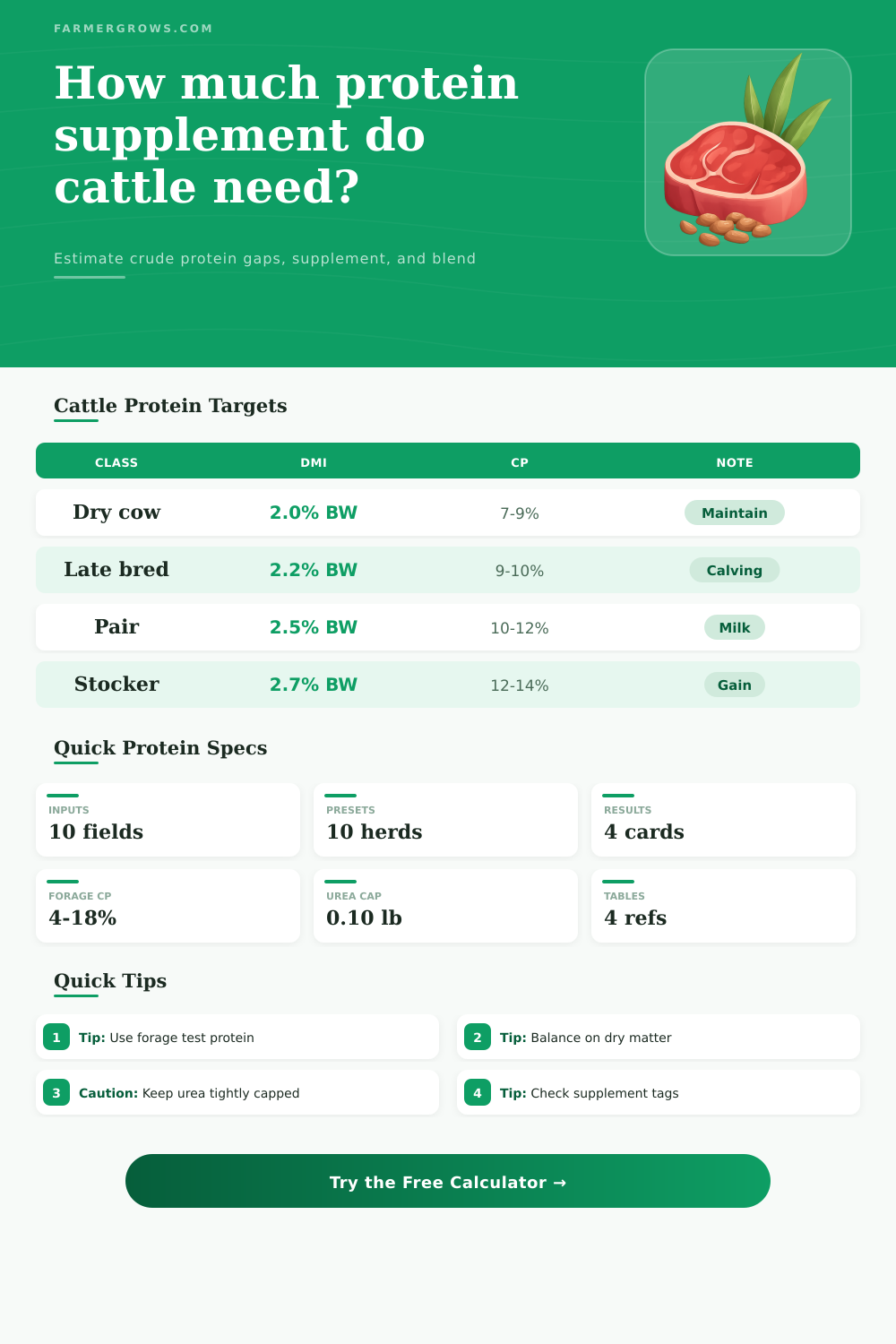
| Cattle class | Typical intake | Target CP % of DM | When to use |
|---|---|---|---|
| Dry mature beef cow | 1.8% to 2.2% of body weight | 7% to 9% | Maintenance cows in good body condition on adequate forage. |
| Late gestation cow | 2.0% to 2.3% of body weight | 9% to 10% | Last trimester when protein demand rises before calving. |
| Lactating beef cow pair | 2.3% to 2.8% of body weight | 10% to 12% | Milk production and calf growth increase daily protein need. |
| First-calf heifer | 2.4% to 2.8% of body weight | 11% to 13% | Young cow is lactating and still needs nutrients for growth. |
| Stocker or replacement | 2.4% to 3.0% of body weight | 12% to 14% | Growing cattle where gain target changes protein demand quickly. |
| Mature bull | 1.8% to 2.1% of body weight | 8% to 10% | Maintenance outside breeding season, adjusted for condition. |
| Forage type | Typical CP % of DM | Typical DM % | Protein note |
|---|---|---|---|
| Crop residue or straw | 3% to 5% | 85% to 90% | Usually needs protein support so cattle can digest fiber better. |
| Mature grass hay | 5% to 7% | 84% to 90% | Common winter deficiency for late gestation and lactating cows. |
| Average mixed hay | 7% to 9% | 82% to 88% | May hold dry cows but can be short for young or milking cattle. |
| Good grass hay | 9% to 11% | 84% to 90% | Useful base forage when intake and energy are also adequate. |
| Grass-legume hay | 12% to 16% | 84% to 90% | Often reduces purchased protein need for beef cow groups. |
| Alfalfa hay | 15% to 22% | 84% to 90% | Can oversupply protein if paired with high-protein supplements. |
| Grass or corn silage | 7% to 10% | 30% to 45% | As-fed pounds are high because moisture is high. |
| Supplement source | Typical CP % of DM | Typical DM % | Use note |
|---|---|---|---|
| Soybean meal | 44% to 48% | 88% to 91% | High protein density, so the calculated pounds may be small. |
| Cottonseed meal | 36% to 41% | 88% to 92% | Common beef supplement where available; check local labels. |
| Canola meal | 36% to 38% | 88% to 91% | Moderate protein source for cattle rations. |
| Distillers grains, dry | 26% to 32% | 88% to 92% | Also adds energy, fat, phosphorus, and sulfur considerations. |
| Range cubes | 20% to 38% | 88% to 92% | Use the exact tag protein and dry matter when possible. |
| Liquid supplement | 16% to 40% | 55% to 75% | As-fed conversion can change delivery pounds a lot. |
| Urea in supplement | NPN equivalent | Variable | Blend thoroughly, limit intake, and avoid feeding free-choice mistakes. |
| Dry matter factor | As-fed conversion | Example | Calculator use |
|---|---|---|---|
| 90% DM | DM lb / 0.90 | Dry pellets or meal | 1.0 lb DM equals about 1.11 lb as-fed. |
| 88% DM | DM lb / 0.88 | Dry hay or cubes | 1.0 lb DM equals about 1.14 lb as-fed. |
| 70% DM | DM lb / 0.70 | Moist byproduct | 1.0 lb DM equals about 1.43 lb as-fed. |
| 60% DM | DM lb / 0.60 | Liquid supplement | 1.0 lb DM equals about 1.67 lb as-fed. |
| 35% DM | DM lb / 0.35 | Corn silage | 1.0 lb DM equals about 2.86 lb as-fed. |
Test the forage: A book value can miss the real crude protein by several points. That small-looking miss can double the supplement estimate.
Cap urea carefully: Urea is not natural protein. Use only in well-blended supplements with enough energy, adaptation time, and controlled intake.
Protein is one of the nutrients that are often lacking in the rations provided to the cattle during the winter season. The lack of protein in winter rations is invisible to the rancher until the cattle begin to lose body condition or until the calves is born with low weights. A practical protein calculator allow the rancher to identify the protein gap that exists within the ration.
Furthermore, the calculator transforms the forage test and target requirements for the herd into a figure that determines the amount of supplement that are required to close that protein gap. The calculator allows the ranchers to avoid supplement amounts that may have been established through tradition within the ranch or from suggestions from a feed stores. Instead, the calculator determines the supplement needs through the use of actual data.
How to Use a Protein Calculator for Winter Cattle Feed
The inputs for the protein calculator include the class of cattle that is to be managed on the ranch, the crude protein value of the forage that is to be used in the ration, the crude protein content of the supplement that is to be provided, the dry matter percentage of that supplement, the cap field for the supplement, and the blend ratio for the ration. The protein calculator will provide the rancher with the results of those inputs. For instance, the protein calculator will provide the protein deficiency for the ration in pounds per head of cattle, it will determine the dry matter requirements of the supplement, the protein calculator will determine the amount of protein that will be provided to each head of cattle in as-fed amounts, the protein calculator will provide information about the blend ratio of the ration, and the protein calculator will provide information regarding the amount of urea that will be exposed to the cattle ration against a conservative cap.
The protein calculator will also display various numbers for the rancher regarding the ration, including the total amount of protein needed for the herd and the amount of protein that will be needed per head of the herd. Providing herd-level numbers on the calculator is useful for those who purchase and delivers feed to the ranch for the entire group of cattle rather than purchasing hay for each individual animal. Forage testing is a necessary step prior to using a protein calculator to determine protein needs for the herd.
Without determining the protein content of the forage through forage testing, a protein calculator will only provide a guess regarding the size of the protein gap that must be filled. Providing a protein calculator the value of protein that was determined through forage testing allows the rancher to more easy perform the simple arithmetic calculations required to determine the amount of supplement that is needed. Furthermore, reference tables can be used to compare the protein content of the forage to the target values required for the various classes of cattle.
Many ranchers make mistakes when calculating the amount of protein that is required for the ration for their herd. For instance, many under estimate the dry matter intake of the herd in winter months and with poor quality forage. Additionally, some mistakes are made in the treatment of the supplement cap.
Some consider it optional for the feeding of the herd. Furthermore, ranchers make some mistakes by adding urea to the ration without considering the energy content of the ration or the length of time that it will take for the rumen microbes to be exposed to the urea. These mistakes can all be avoided through the use of the protein calculator.
Furthermore, the protein calculator will also help the rancher make various daily decisions regarding feeding the herd. For instance, the protein calculator can be used to decide if the current supplement being provided to the herd will allow the ration to close the protein gap, or if another supplement with more protein is required. Additionally, using the protein calculator will allow the rancher to determine how the blend ratio will change based off the improvements in the quality of the forage.
Furthermore, the protein calculator will help the rancher to understand how protein, along with energy, minerals, and management of the bunk, each interact with the protein math for the ration. The effectiveness of the protein ration plan will become readily apparent at the time of calving. If the cows have maintained their body condition throughout the winter, they will produce calves that weigh more, and they will be ready to be rebred according to the breeding cycle.
These positive outcomes are only possible if each rancher is aware of the amount of protein that is being lacking in there ration. Furthermore, the protein that is provided to the herd must be both delivered and within the limits of the supplement that is actualy available to that herd.