Dairy Cow Ration Calculator
Estimate daily dry matter intake, forage and concentrate pounds, crude protein supply, NEL energy, forage NDF, and mineral buffer for milking cows.
Use this as a ration planning worksheet, not a substitute for a dairy nutritionist. Forage tests, milk components, body condition, manure scoring, heat stress, and feed refusals can change the final ration.
Dairy Ration Estimate
Results are calculated on a dry matter basis, then converted to as-fed pounds using the entered forage and concentrate dry matter.
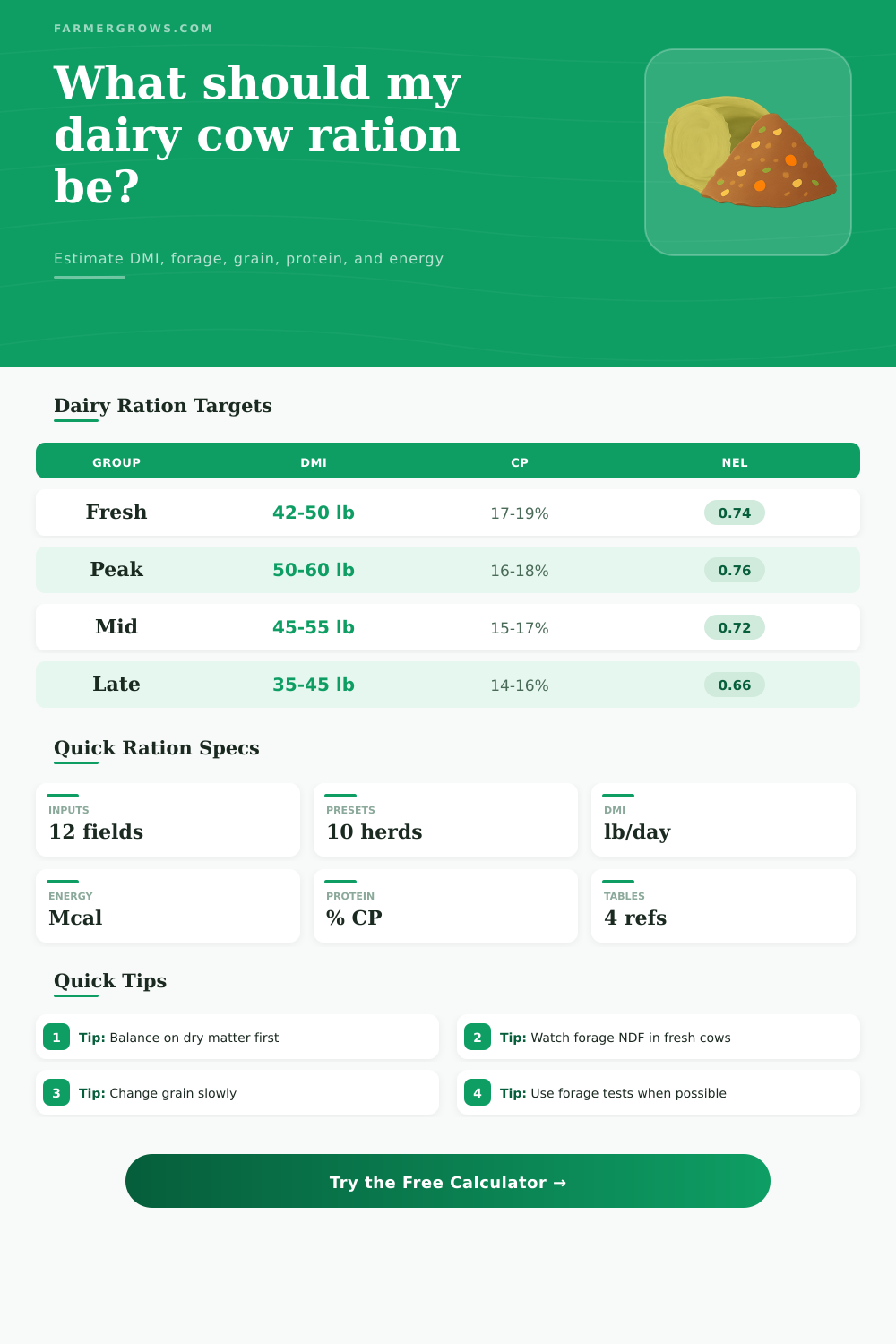
| Cow group | Typical DMI | % body weight | Notes |
|---|---|---|---|
| Fresh Holstein | 36-48 lb/day | 2.6-3.2% | Intake rises after calving; watch refusals and displaced abomasum risk. |
| Peak Holstein | 50-62 lb/day | 3.5-4.2% | High milk cows need excellent bunk access and palatable forage. |
| Mid lactation cow | 44-56 lb/day | 3.1-3.8% | Often the easiest group to hold steady if forage quality is consistent. |
| Late lactation cow | 34-46 lb/day | 2.5-3.2% | Control energy density if body condition is climbing too fast. |
| Jersey cow | 32-44 lb/day | 3.6-4.5% | Smaller cows often eat a higher percent of body weight. |
| Feed or need | NEL value | Use in ration | Watch point |
|---|---|---|---|
| Corn silage | 0.70-0.76 Mcal/lb DM | High-energy forage base | Kernel processing and dry matter change usable energy. |
| Alfalfa haylage | 0.60-0.68 Mcal/lb DM | Protein and effective fiber | Over-mature haylage lowers intake and energy density. |
| High grain mix | 0.82-0.92 Mcal/lb DM | Raises milk energy supply | Step changes up slowly to protect rumen pH. |
| Maintenance need | 0.08 x BW^0.75 | Baseline daily Mcal | Cold stress, walking, and mud raise maintenance demand. |
| Milk need | about 0.31 per lb milk | Adjusted upward for fat | Higher butterfat increases energy exported in milk. |
| Lactation stage | Typical CP target | When to raise it | When to check waste |
|---|---|---|---|
| Fresh cows | 17-19% of DM | Poor early peak, high milk, or low forage protein | High MUN, loose manure, or excess purchased protein |
| Peak cows | 16-18% of DM | Rapid milk rise or high component production | If energy is short, more CP will not fix production |
| Mid lactation | 15-17% of DM | Thin cows with strong production response | When milk is stable and MUN trends high |
| Late lactation | 14-16% of DM | Young cows still growing or very high milk persistency | When milk yield has tapered and body condition is adequate |
| Jersey groups | 15.5-17.5% of DM | High component herds with strong intake | Use milk urea nitrogen and ration amino acid balance |
| Forage source | Typical NDF | Ration effect | Practical note |
|---|---|---|---|
| Corn silage | 36-45% of DM | Moderate fiber with strong starch contribution | Digestibility and chop length drive intake response. |
| Alfalfa haylage | 38-48% of DM | Effective fiber plus high protein | Early-cut forage can support high intake. |
| Grass haylage | 48-62% of DM | Can limit intake if mature | Use digestibility tests for high-grass rations. |
| Small grain silage | 46-58% of DM | Useful crop rotation forage | Harvest stage swings NDF and energy widely. |
| Total forage NDF | 18-24% of ration DM | Supports rumination and butterfat | High-producing cows still need enough physically effective fiber. |
Tip: Balance the ration on dry matter before looking at as-fed pounds. Silage moisture changes can make the wagon weight look right while nutrients drift.
Caution: If the calculator shows a large energy or protein gap, do not jump grain or protein overnight. Make staged changes and watch cud chewing, manure, milk fat, and refusals.
A dairy cow’s ration are a group of decisions that determine the amount of milk that the cow will produce and the amount of body condition that the cow will maintain. Furthermore, the ration also determines whether the rumen of the dairy cow will remains stable under conditions of heat, cold, or stress. Each of these decisions must be accurate in relation to the diet of the dairy cow, as even small changes in the amount of dry matter that the cow consumes or the energy balance of the cow will lead to a drop in the components of the milk that the cow produce.
As a result of a drop in the components of the milk, the person may face increased costs associated with veterinary bills for the herd, or may have to make a decision to cut some of the cows from the herd altogether. The calculator include fields for the various inputs that will create the ration that will produce the desired outcomes from the dairy cow. One of these inputs will be the body weight of the dairy cow, as the body weight will determine the maintenance requirement for the cow.
Using the Dairy Cow Ration Calculator
Additionally, the milk volume and butterfat of the milk will be inputs, as these variables will determine the energy that is either supplied to the cow or consumed from the reserves of the cows body. The days in milk of the cow is another of the inputs for the calculator, as this variable will indicate whether the cow is approaching it’s peak in the production of milk, or whether it is beginning to dry off from milk production. The forage type and dry matter percentage of that forage is an input for the ration, as these variables will determine how much of the actual feed must be provided to the dairy cow in order to meet the target amount of dry matter (as dry matter percentage and type of forage will have an impact upon the dry matter intake of the cow).
Additionally, the moisture levels of the forage is another of the inputs that the dairy farmer must monitor, as even a small change in moisture percentage will lead to changes in the actual amount of dry feed that the feed mixer can supply to the dairy cow. Another of the inputs that must be provided to the calculator will be the percentage of NDF content of the forage that will be supplied to the dairy cow, as well as the ratio of the forage to the concentrate that will be supplied to the cow. If there is too little effective fiber provided to the forage ration, then the butterfat percentage of the cows milk will drop.
Conversely, if there is too many effective fiber supplied to the ration, then the dry matter intake of the dairy cow will drop, especially if the weather to which the dairy cow is exposed is hot and hot weather reduce the dry matter intake of dairy cows. The other inputs for the calculator will be the protein and energy content of the concentrate that is to be supplied to the dairy cow. Additionally, while the weight of the minerals and buffers is small relative to the other variables of the ration, the effect that these inputs can have upon the dairy cow is significant; thus, these variables is also included in the calculator.
The different outputs of the calculator will allow the person to quickly review the ration that will be supplied to each of the cows in the dairy herd. One of the variables that can be determined is the dry matter intake of the dairy cow, which will indicate whether the dairy cow will consume the amount of feed that is required to support the ration that is to be supplied to the cow. Another of the variables will be the forage and concentrate split, which will indicate the amount of each type of feed that needs to be weigh for the ration.
Additionally, the calculator can determine the levels of protein and net energy of the ration, as each of these variables will help to reveal whether the ration is short of nutrients, if the ration is provided in the appropriate amount of nutrients, or if the ration is providing too many nutrient to the dairy cow. Finally, the percentage of forage NDF content can also be determined, which will provide a warning to the dairy farmer if the ration is either too low or too high in relation to the physically effective fiber content of the ration. Although these outputs of the calculator can be utilized to determine whether the ration that will be provided to each dairy cow is appropriate, they should not be utilized as the final recipe to supply to the cows.
Instead, the outputs of the calculator will provide a quick review of the ration that will be supplied to the herd, and provide the information necessary for the dairy farm to create a ration that will meet the needs of the herds cows. Many dairy farms will utilize three or four different rations for their cows. For example, fresh cows, peak-producing cows, and cows that are in the late-lactation period will each have different requirement for the diets of those cows.
Thus, the calculator allows for each of these groups of cows to have different rations without having to create separate spreadsheets for each group of cows. For instance, fresh cows will require a ration that contains more concentrate and will require a more constant monitoring of which cows are refusing to consume the ration. Conversely, late-lactation cows may have less grain provided to them in their ration, as their milk production will naturaly decrease during these period of time.
However, the ration that is supplied to the cows may need to change with the change in the weather, the forage that is available for the cows, or even if there was a mistake in the mixing of the ration. For instance, if it is hot weather in which the cows are being raised, the dry matter intake of the cows will decrease. Thus, if the ration is supplied to the cows that is based off the assumption that the cows will consume the amount of feed that is provided, then the cows may not meet the requirements of the ration.
In such cases, the forage ratio for the ration may need to be altered, or the feed with digestible fiber may be supplied to the cows instead. Additionally, if haylage is harvested at different times during the year, the NDF percentage may change for that haylage. Thus, if the percentage of haylage with NDF drop, then more concentrate can be supplied to the cows to meet their energy requirement.
In such cases, the dairy farmer must notice the change in haylage, and the ration must be changed accordingly. Thus, if either the forage ration or any other variable related to the ration changes, the calculator will need to be run again in order to determine if the ration that is supplied to the cows is still appropriate for each cow in the herd. The goal in creating a ration for the cows that are supplied with milk is not to achieve perfection in the rationing process and the creation of the ration.
Rather, the goal is to create a ration that will keep the cows eating and allow the components of the milk to remain at the correct level. Thus, the calculator will allow the person to focus on the cows, rather than upon the calculator itself.