Soil Removal Calculator
Estimate excavation cut volume, soil swell, loose disposal volume, haul weight, truck or bin counts, and spoil pile footprint for farm, yard, trench, and building-pad work.
Load a realistic starting point, then adjust dimensions, depth, soil type, swell, truck size, and pile slope for your own site.
Use for barn pads, driveway undercuts, garden strips, and shallow soil replacement.
Best when trench walls are nearly vertical and the top width matches the bottom cut.
Use side slope when safe access, loose sand, wet soil, or local rules require wider top cuts.
Useful for post holes, piers, tree pits, tank anchors, and repeated small excavations.
Soil Removal Results
Results update from the selected dimensions, soil swell, and haul capacity.
| Soil type | Typical swell | Loose density | Removal note |
|---|---|---|---|
| Topsoil | 15% to 25% | 1900 to 2300 lb/cu yd | Usually lighter, but roots and sod can bulk up loads. |
| Loam or mixed soil | 20% to 30% | 2200 to 2700 lb/cu yd | Good default for farm and yard excavation planning. |
| Clay | 25% to 45% | 2500 to 3300 lb/cu yd | Sticky, heavy when wet, and often payload-limited. |
| Sand | 8% to 18% | 2400 to 3000 lb/cu yd | Lower swell, but trench sides and piles may slump. |
| Broken rock | 45% to 70% | 2800 to 3800 lb/cu yd | High void space and heavy haul weights are common. |
| Excavation shape | Bank volume formula | Depth handling | Best use |
|---|---|---|---|
| Rectangular pad or pit | length x width x depth | Common removal depth field | Pad undercuts, garden strips, shallow pits |
| Straight trench | length x width x depth | Common removal depth field | Utility cuts with near-vertical walls |
| Sloped trench | length x depth x average width | Uses trench depth and side slope | Safe-sided trenches or unstable soil |
| Round holes | pi x radius squared x depth x count | Common removal depth field | Fence posts, piers, tree holes |
| Known bank volume | entered bank volume | No depth field needed | Survey, machine control, grade model |
| Container or truck | Typical loose capacity | Planning use | Weight caution |
|---|---|---|---|
| Dump trailer | 2 to 4 cu yd | Small farm or landscape removals | Payload limit often arrives before volume is full. |
| Single axle dump | 5 to 7 cu yd | Short hauls and tight access | Useful for lanes, barns, and small excavation spoil. |
| Tandem dump | 9 to 12 cu yd | Common utility and pad excavation | Check legal payload with wet clay or rock. |
| Tri axle dump | 13 to 16 cu yd | Larger pads, basins, and bulk removal | Needs stable approach and dump area. |
| Roll-off bin | 10 to 20 cu yd | Urban or staged disposal | Soil can exceed bin weight limits quickly. |
| Spoil pile slope | Where it fits | Footprint effect | Field note |
|---|---|---|---|
| 1.25:1 | Dry granular or short-term firm pile | Smallest footprint | Avoid near traffic, wet soil, or trench edges. |
| 1.5:1 | Average mixed spoil | Moderate footprint | Useful default for quick laydown planning. |
| 2:1 | Wet, sandy, or loose material | Larger footprint | Use when dumped soil slumps after unloading. |
| 3:1 | Low working pile or loader access | Largest footprint | Better for repeated handling and safer access. |
This calculator is for estimating. Confirm utility locates, shoring, spoil setbacks, erosion control, haul limits, and disposal requirements before excavation.
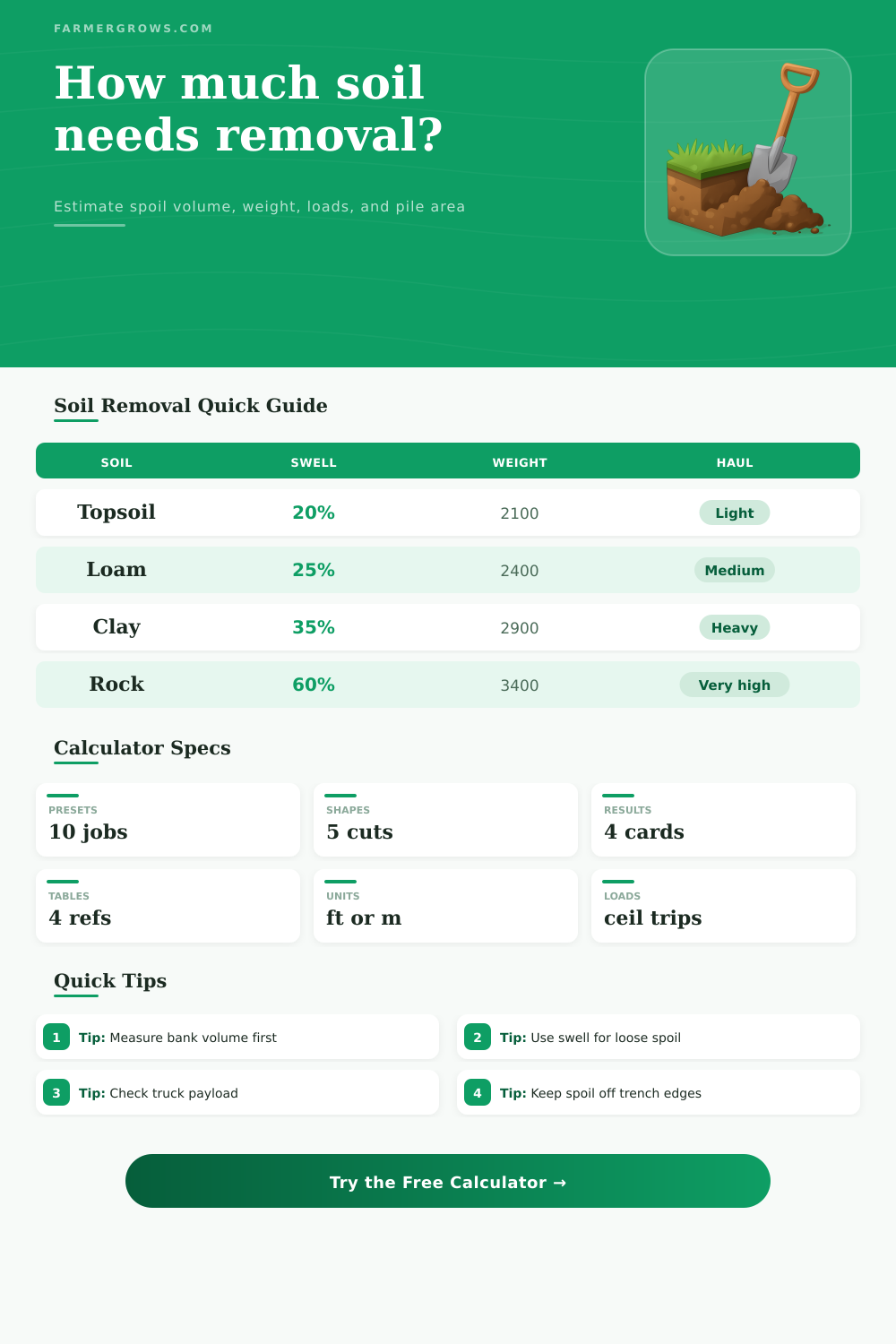
When you move dirt, you have to account for the difference between the volume of that dirt while it’s in the ground and after that dirt is moved. The volume of the dirt while it’s in the ground is called the bank volume. However, the volume of the dirt after it is moved is called a loose volume.
The difference between these two measurement is called the swell. Swell occur when the dirt is dug, and air gets into the soil. Different soil types swell at different percentage.
How to Measure and Haul Dirt
For instance, clay can swell to 35% more volume than the bank volume, and broken rock can swell to 100% more volume than the bank volume. If you dont account for swell, you will have to buy more truck than you need to haul the dirt to its destination. The dirt hauler calculator on this page provide four specific measurements for dirt hauling projects.
You will input the shape of the excavation, the type of soil, and the capacity of your truck. This calculator will calculate the loose volume of the dirt to be hauled, the total weight of the dirt to be hauled, the number of truck loads to haul all the dirt, and the footprint of the dirt pile. These four measurement provide information regarding the space requirements of the dump truck for your site.
The first calculation to perform is to input the shape of the excavation. Different excavation shape require different amounts of dirt to be moved. For example, a flat pad require less dirt to be moved than a trench with sloped side.
Additionally, round hole for posts require a calculation of the dirt to be moved because the large area of the round hole require a significant amount of dirt to be hauled to the spoil site. The soil type for the excavation site will impact the dirt hauling process. The type of soil will impact the swell of the dirt and the density of the soil.
The density of dirt is the weight of dirt in a given volume. If the density of the dirt is high, the dump truck will reach their weight limit before the dirt bed are full. This is true for soil type such as clay and gravel.
On the other hand, sand and loam have low density so the truck will be limited by the volume of their bed rather than the weight of the dirt. You can find the density of the soil on the reference grid on this page. When you select the type of soil, the density and swell percentage of the soil will change according to.
An over-excavation allowance accounts for additional dirt that might need to be removed from the site. Crews often use an over-excavation allowance because they need extra space to clean up the excavation site. An over-excavation of 10% is common, but if the grade of the excavation is yet to be determined, using an over-excavation of 20% will provide extra room for dirt cleanup.
This number is multiplied by the bank volume before the calculator calculates the swell of the soil. Therefore, this number can significantly impact the number of load of dirt that are needed to complete the excavation. The calculator will compare the loose volume and the weight of the dirt to the capacity of the trucks.
This comparison will provide two number for the project. The calculator will show you the governing number for the project, and it will be rounded up to the nearest whole load. This number is the total number of trip that the trucks will have to make to haul all of the dirt.
Additionally, the weight of the dirt per load will help you determine if you will exceed the legal weight limit for the trucks hauling the dirt. If the dirt to be hauled is wet, the weight will be more higher. In this instance, you might find yourself exceeding the weight limit for some of the truck trip.
The footprint of the spoil pile where the dirt will be dumped is another consideration in dirt hauling calculations. You will enter the height of the dirt pile and the slope of the side of the dirt pile into this calculator to determine the base area of the dirt pile. A high slope reduce the area that the dirt pile will take up, but a high slope can be problematic for wet or sandy soil.
A flat dirt pile is more stable so that it does not slide down the slope, but it will take up alot of area at the spoil site. Knowing the footprints of the dirt pile will allow you to determine if the dirt will fit at the site or if it will have to be hauled away. This calculator will provide you with an estimate of the amount of dirt to be hauled.
However, four other factor will impact the dirt hauling job. Weather can impact the density of the dirt. Rain will make the dirt heavier and more difficult to move.
There might be rules regarding where the dirt pile can go at the site, so it is essential to ask your local authorities for the rules for the spoil pile. You must measure the bank volume of the dirt first. Then, using the swell and density information, you can calculate the loose volume of the dirt.
Knowing these two number will allow you to know how much dirt will leave the site and where it will land.