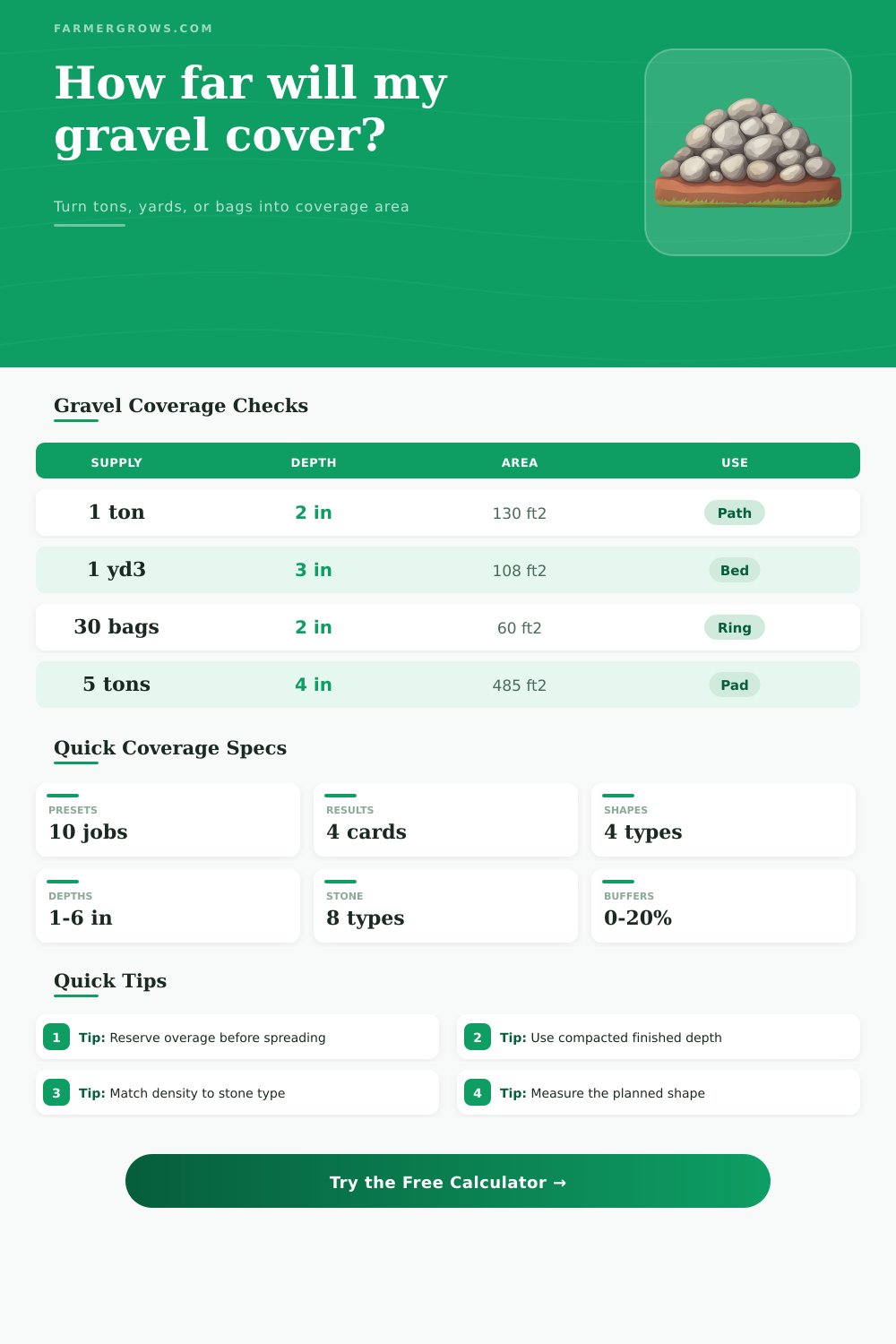
Gravel Coverage Calculator
Convert available gravel tons, loose cubic yards, and bag counts into the finished area you can cover at a chosen depth, compaction setting, stone density, and overage reserve.
Use this when you already know the supply on hand or the delivery amount. The calculator turns that supply into usable coverage after compaction and the overage buffer you want to keep for low spots and edges.
Coverage from available gravel
Coverage updates when you calculate.
| Stone type | Typical density | Tons per yd³ | Best coverage use |
|---|---|---|---|
| #57 crushed stone | 2,700 lb/yd³ | 1.35 | Angular landscape beds, pads, and general cover |
| Crusher run / road base | 2,900 lb/yd³ | 1.45 | Compacted surface where fines fill voids |
| Pea gravel | 2,600 lb/yd³ | 1.30 | Walkways, tree rings, and play areas with edging |
| Drain rock | 2,500 lb/yd³ | 1.25 | Open stone where water movement matters |
| Decomposed granite | 2,400 lb/yd³ | 1.20 | Fine textured paths and seating areas |
| River rock | 2,850 lb/yd³ | 1.43 | Decorative beds and exposed rings |
| Finished depth | Sq ft per yd³ | Sq m per m³ | Coverage note |
|---|---|---|---|
| 1 in | 324 sq ft | 12.00 m² | Thin refresh over an existing stable gravel surface |
| 2 in | 162 sq ft | 6.00 m² | Decorative bed cover, tree rings, and foot paths |
| 3 in | 108 sq ft | 4.00 m² | Common landscape coverage and light-use pads |
| 4 in | 81 sq ft | 3.00 m² | Compacted pads, garden approaches, and thicker paths |
| 6 in | 54 sq ft | 2.00 m² | Deep fill, drain cover, or rough low-area correction |
| Container | Volume | Per yd³ | Coverage at 2 in |
|---|---|---|---|
| Small bag | 0.5 cu ft / 14 L | 54 bags | 3 sq ft before factors |
| Medium bag | 0.75 cu ft / 21 L | 36 bags | 4.5 sq ft before factors |
| Large bag | 1.0 cu ft / 28 L | 27 bags | 6 sq ft before factors |
| Bulk tote | 2.0 cu ft / 57 L | 13.5 bags | 12 sq ft before factors |
| Loose bulk yard | 27 cu ft / 0.765 m³ | 1 yd³ | 162 sq ft before factors |
| Available supply | Stone assumption | At 2 in depth | At 3 in depth |
|---|---|---|---|
| 1 short ton | #57 stone, 2,700 lb/yd³ | 120 sq ft before factors | 80 sq ft before factors |
| 2 short tons | #57 stone, 2,700 lb/yd³ | 240 sq ft before factors | 160 sq ft before factors |
| 3 yd³ loose bulk | Any stone by volume | 486 sq ft before factors | 324 sq ft before factors |
| 40 large bags | 1 cu ft bags | 240 sq ft before factors | 160 sq ft before factors |
| 1 metric tonne | #57 stone, 1,602 kg/m³ | 132 sq ft before factors | 88 sq ft before factors |
If the gravel will be compacted, choose the depth you want after tamping. The calculator reduces loose supply before it estimates the final coverage area.
Reserve a small pile for feathering edges, filling low spots, and touching up traffic areas. Spreading every bit at once usually makes the final grade harder to tune.
When planning a gravel projects, you must account for the difference between the amount of gravel you will recieve from the store and the area that the gravel will cover. When gravel are laid down, it often dont cover the area that was planned because of issues like depth, compaction, and overage. To ensure that there is enough gravel for the gravel to cover the area, it is essential for gravel buyer to understand these three issue.
One of the first issues to consider is the depth of the gravel. You must calculate the depth of the gravel with the finished depth of the gravel. The finished depth is the depth that the gravel will be after it is place into the ground.
How to Figure Out How Much Gravel You Need
For instance, if you choose two inches of gravel depth, it is possible that the gravel will only end up being around one inch deep after it is compacted and walk on. When calculating the gravel that will be needed, use the finished depth for the project to account for the settling in of the gravel. Using a deeper depth will require more gravel than a gravel depth that is less deeply.
Compaction of the gravel will also reduce the area that the gravel cover. Compaction happens when gravel particle pack together to take up less space. For instance, angular stone will compact when people walk on it or move vehicle over it.
Rounded gravel will not compact as much as angular stones, such as crusher run stone. Compaction will reduce the volume of gravel in the project. It is essential to account for the percentage that the gravel will compact when purchasing gravel to ensure that the gravel will last for the project.
Lastly, gravel company will order gravel in bulk and will have overage to account for gravel needed to fill in low spots or to feather the edges. By having gravel in excess of the amount needed, it will ensure that there is no need for a second delivery of gravel to complete the project. By subtracting overage from the total supply of gravel you plan to order, the calculator will show you how much of the gravel you will have available to cover your main area.
By accounting for overage in the supply of gravel that you order, you can ensure that you have enough gravel to cover your entire desire area. The type of stone that you decide to use will also play a role in the amount of area that the stone will cover. The density of the stone is the relationship between the weight of the stone and the volume of the stone.
A ton of drain rock will occupy more volume than a ton of crusher run gravel because drain rock is less dense than crusher run gravel. Thus, the type of stone you use will impact the settings on the calculator that you use to calculate how much gravel you need. Using the wrong type of stone or failing to adjust for the density of the stone will result in incorrect calculation for the amount of stone that you need.
Using the incorrect amount of stone will either result in purchasing too much stone or not having enough stone to cover your entire area. The shape of the area that you plan to cover will also have an impact upon how the calculator calculates the amount of gravel that you will need. For example, if your area is not a rectangle but instead a circle, a triangle, or some other irregularly shape area, then you must account for those dimension in the calculator to recieve an accurate calculation of the area that must be covered.
Using the area figure that is provided by the calculator is merely a starting point, though. You need to ensure that you have enough gravel to cover your area based off that estimate. Always measure your area before you start to lay the gravel.
Determine the depth that you would like your gravel to reach and the amount of overage that you would like to order. Use these measurement in the calculator to determine the total amount of gravel that you will need. Use this figure as a starting point; gravel will not spread perfectly even with your marked depth.
Therefore, you will need to make some adjustment to the depth of the gravel. However, if your calculation accounted for each of these variable, the adjustment will be small so that you dont have to order additional gravel after you begin to lay it in your area.