Dam Liner Calculator
Estimate a farm dam liner from top and bottom dimensions, depth, side slopes, freeboard, anchor trench, seam overlap, roll width and length, underlayment, and waste allowance.
Load a farm dam layout, then adjust the surveyed top and bottom dimensions. Presets include stock dams, irrigation storages, tailwater basins, and lined lagoons.
Dam Liner Estimate
Calculated liner size, roll plan, seams, underlayment, and volume.
| Bank profile | Typical use | Liner effect | Planning note |
|---|---|---|---|
| 1:1 steep bank | Compact lined basins | Shorter liner run | Needs stable soil and careful placement. |
| 2:1 farm dam bank | Small stock and irrigation dams | Moderate liner run | Common balance of excavation and access. |
| 3:1 trafficable bank | Maintained reservoirs | Larger liner run | Easier to inspect and safer for machinery. |
| 4:1 gentle embankment | Wildlife and broad edges | High liner area | Often reduces slumping and fold stress. |
| Freeboard 1 to 3 ft | Wave and storm allowance | Adds rim travel | Increase where wind fetch is long. |
| Detail | Common range | Calculator input | Why it matters |
|---|---|---|---|
| Anchor trench width | 1 to 2 ft | Width field | Holds liner edge before backfill and settlement. |
| Anchor trench depth | 1 to 2 ft | Depth field | Adds liner travel down into the trench. |
| Edge overlap | 1 to 3 ft | Extra overlap field | Allows trimming, wrinkles, and minor survey error. |
| Shop seam overlap | 6 to 12 in | Overlap seams field | Added where roll panels overlap across the dam. |
| Field seam location | Flat shelf preferred | Roll plan result | Avoid steep banks, corners, and saturated mud. |
| Roll width | Best fit | Handling note | Seam planning |
|---|---|---|---|
| 20 to 30 ft | Small dams and narrow basins | Easier to move by hand | More cross-dam seams likely. |
| 40 ft | Common farm dam repairs | Needs several helpers or equipment | Often reduces panel count sharply. |
| 50 to 60 ft | Medium storage dams | Plan staging and unfold direction | May avoid seams on narrow floors. |
| 80 ft plus | Factory fabricated panels | Heavy lifts and delivery access matter | Confirm panel map before excavation. |
| Short roll length | Constrained delivery sites | Creates end seams | Keep length seams on flatter grades. |
| Dam opening | Bottom floor | Depth and slope | Approx liner cut |
|---|---|---|---|
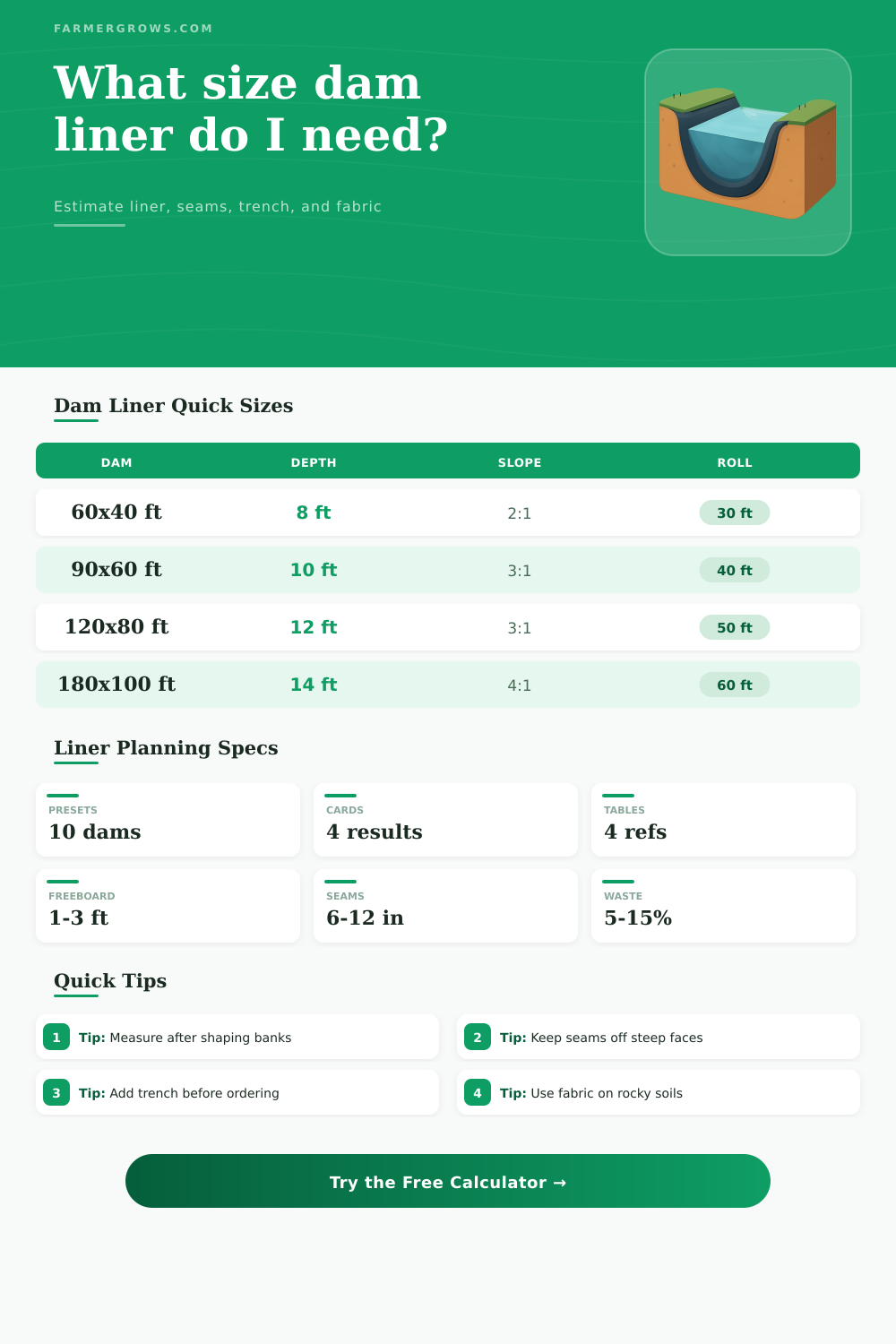
| 60 x 40 ft stock dam | 28 x 12 ft | 8 ft at 2:1 | 72 x 56 ft plus trench |
| 90 x 60 ft holding dam | 50 x 20 ft | 10 ft at 2:1 | 100 x 72 ft plus trench |
| 120 x 80 ft irrigation dam | 60 x 24 ft | 12 ft at 3:1 | 132 x 94 ft plus trench |
| 150 x 90 ft fire reserve | 70 x 30 ft | 14 ft at 3:1 | 164 x 106 ft plus trench |
| 180 x 100 ft freeform dam | 85 x 32 ft | 14 ft at 4:1 | 196 x 120 ft plus trench |
Order from the cleaned excavation, not the sketch. A wider crest, deeper sump, or added anchor trench can change the liner order quickly.
Place unavoidable seams where the bank is flatter and accessible. Use underlayment under wrinkles, rocks, pipe penetrations, and traffic areas.
A dam liner are a large commitment of material for the dam liner, and the size of the dam liner will determine whether the project remain within budget or whether the dam project becomes an expensive scramble. The primary difficulty in dam liner placement is not the dam liner itself but in the translation of the three-dimension shape of the basin into a flat sheet of dam liner. The excavated basin has a specific shape that includes specific bank slopes and specific requirements as to the amount of allowance required for the edges of the basin.
These three-dimensional features of the basin must be translated into a flat sheet of dam liner to ensure that the dam liner will fit into the basin when it is laid out on the site. The dam liner calculator will handle the calculation of the amount of dam liner required once you have entered the dimension of the basin, the depth of the water, and the depth of the planned freeboard. This parameter is essential because the dam liner must extend from the floor of the basin to the freeboard.
How to Measure and Order the Right Dam Liner
A two-to-one bank to the terrain may appear gentle on the drawing, but it can create challenges with the freeboard. The freeboard is essential to allow water to not crest over the edge of the dam during stormy weather. You must also enter the depth of the dam liner and the width of the trench for the dam liners anchor into the calculator since the dam liner will disappear into the trench for the anchor; this can easily be forgotten when purchasing the liner.
The calculator will show the difference between the finished size of the dam liner that will be cut and the area of the dam liner that will be purchased. The area to be purchased will have to account for the cuts of the dam liner panels and any waste in the cutting of the panels. The roll width and length of the panels will determine how many panel will be required and where the seams on the panels will be placed.
You should not place the seams on the steep area of the dam liner or in any areas that are likely to be frequented by vehicle to reduce maintenance issues in the future. Adjustments must also be made to account for underlayment fabric and trim allowances for any rocky soil in which the dam liner will be placed. The choice of slope to be used on the dam will affect the amount of liner that is required for placement.
Steeper slope will require less dam liner than gentler slope. However, steeper slopes may pose a challenge to the stability of the terrain under the dam liner. A gentler slope will allow for even distribution of the dam liners load and will make inspection of the liner more easy.
However, the gentler slopes will require more dam liner and more excavation to complete the dam building project. The calculator can be used to determine the amount of dam liner that will be required in constructing both steep and gentle slopes on the dam. The material to be used for the dam liner will affect the order of the dam liner required but is independent of the calculations of the project.
Polyethylene liner are lightweight but high-density polyethylene liners require heat-welded seam. The weight of the dam liner will affect the number of helper or the use of mechanical equipment to position the dam liner, especially if constructing large basin for various use. The calculator will record the type of dam liner chosen for estimating its weight.
Many people make mistake when measuring the excavation. These measurement are often taken before the site is completely shaped. The crest of the dam may have widened, or the depth of the sump may have deepened during excavation.
People may also underestimate the amount of liner needed for the anchor trench. When placed into the trench, the dam liner will disappear into the trench. Additionally, many people do not provide enough freeboard.
For small pond, a freeboard of one foot may be sufficient. However, in area exposed to the wind or inflow of rainwater, a freeboard of only one foot may be insufficient to allow the water level to not overtop the dam. The calculator will produce an estimate of the volume that will be created with the dam.
The volume of the dam will help to determine whether the finished dam will fulfill the use that was intended for it. The use of the dam may be to hold stock water, water for irrigation, or water for fire supply. If the calculated volume of the dam is too low for the use that the dam will create, then the dimension of the dam can be adjusted before the dam liner is ordered.
By adjusting the dimension before the dam liner is ordered, the person constructing the dam will avoid having to make any change to the dimension once the dam liner is ordered. Ordering the dam liner is the process of ensuring that the physical reality of the site matches with the limitation of the dam liner available on the roll of the manufacturer. When these two parameter match, the dam liner will settle into place and the dam will hold the required amount of water.