Soil Test Fertilizer Calculator
Turn soil N, phosphorus, potassium, organic matter, manure credits, crop yield goals, product analysis, efficiency, and split timing into a field-rate fertilizer plan.
Load a crop scenario, then adjust your lab ppm, yield target, manure credits, fertilizer grade, and application efficiency for the field being planned.
Fertilizer Recommendation
Recommendations will appear after the calculator runs.
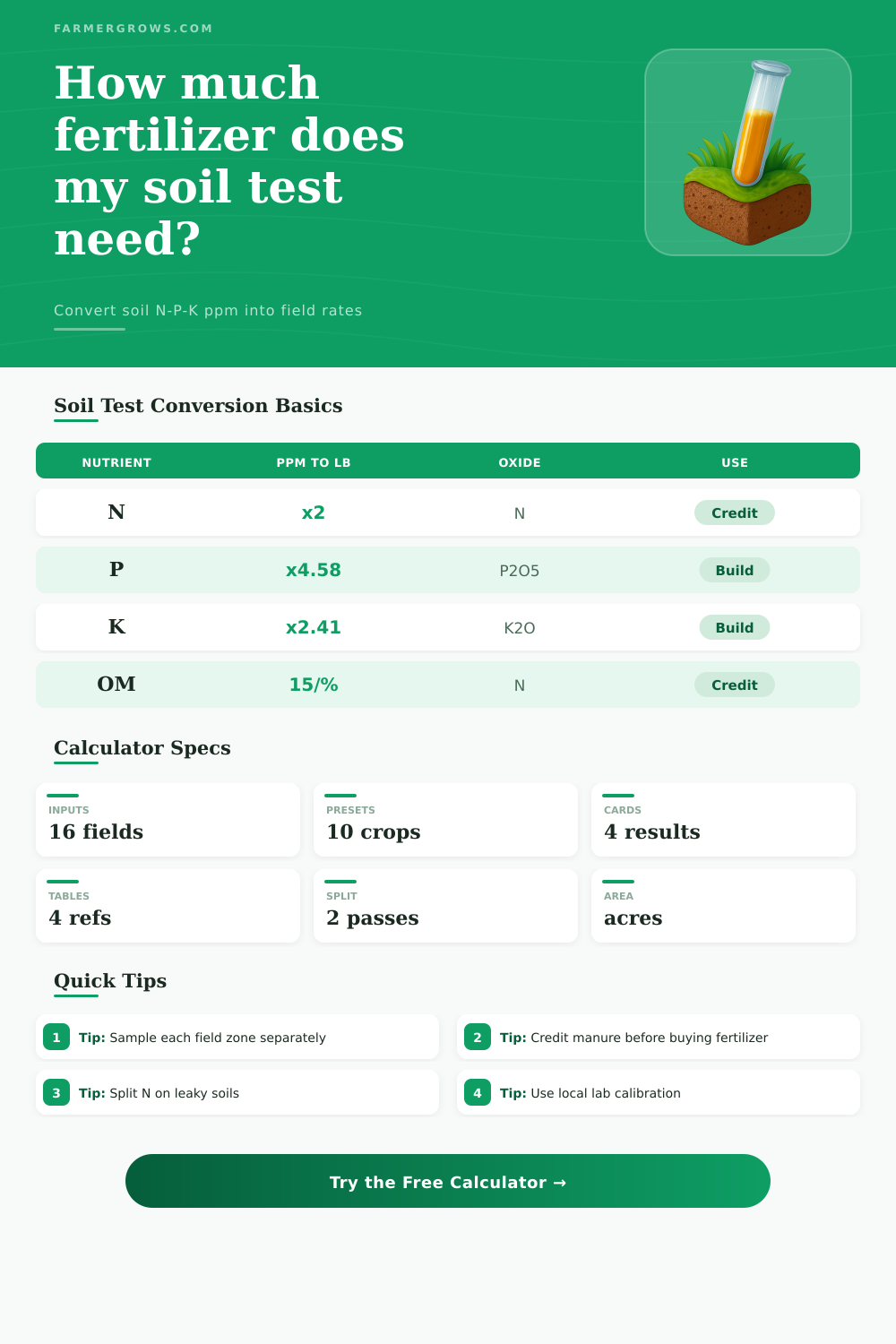
| Nutrient conversion | Formula used | Calculator role | Field note |
|---|---|---|---|
| Nitrate-N ppm | ppm x 2 x depth / 6 | Soil N credit in lb/ac | Best matched to the sampled depth and timing |
| Phosphorus P ppm | ppm x 2 x 2.291 | P2O5 equivalent display | Use the same lab method each season |
| Potassium K ppm | ppm x 2 x 1.205 | K2O equivalent display | Texture and CEC influence interpretation |
| Organic matter | OM percent x credit rate | Mineralized N credit | Adjust with local extension guidance |
| Crop | Yield unit | N guide | P2O5 removal | K2O removal |
|---|---|---|---|---|
| Corn grain | bu/ac | 1.10 lb/bu | 0.37 lb/bu | 0.27 lb/bu |
| Soybeans | bu/ac | Usually none | 0.80 lb/bu | 1.40 lb/bu |
| Winter wheat | bu/ac | 1.20 lb/bu | 0.55 lb/bu | 0.34 lb/bu |
| Alfalfa hay | tons/ac | Usually none | 12 lb/ton | 55 lb/ton |
| Grass hay | tons/ac | 45 lb/ton | 12 lb/ton | 50 lb/ton |
| Fertilizer grade | N percent | P2O5 percent | K2O percent | Typical use |
|---|---|---|---|---|
| Urea 46-0-0 | 46 | 0 | 0 | High-analysis dry nitrogen |
| UAN 32-0-0 | 32 | 0 | 0 | Liquid nitrogen program |
| DAP 18-46-0 | 18 | 46 | 0 | Phosphorus plus ammonium N |
| MAP 11-52-0 | 11 | 52 | 0 | Starter phosphorus source |
| Muriate potash 0-0-60 | 0 | 0 | 60 | Potassium maintenance and buildup |
| Timing approach | Best fit | Efficiency idea | Watch point |
|---|---|---|---|
| Preplant broadcast | P, K, lime-compatible dry blends | 70% to 90% | Incorporation improves contact |
| Starter band | Early P on cool soils | 80% to 95% | Mind salt near seed |
| Side-dress nitrogen | Corn, sorghum, vegetables | 80% to 95% | Weather can delay the pass |
| Topdress hay or wheat | Grass hay and small grains | 70% to 90% | Apply ahead of rain if possible |
Soil test tip: Keep sample depth, lab method, and field zones consistent. A recommendation is only as strong as the sample that drives it.
Credit tip: Subtract realistic manure and organic matter credits before sizing purchased fertilizer, then confirm rates with local nutrient management rules.
A soil test will provides data regarding the nutrient that are currently present within a field. Additionally, a soil test can also provide data regarding the nutrients that the field will need in order to support the crop that are to be planted within that field. The soil test will result in a series of number that indicate the nutrient levels within the soil.
These numbers will need to be entered into an fertilizer plan. The fertilizer plan will require the use of a calculator to determine the amount of fertilizer that should be purchased and spread within that field. A person must first understand the numbers that are represented within the soil test results.
Using Soil Tests and a Fertilizer Calculator
The soil test will report the nutrients in the soil in parts per millions. However, the fertilizer recommendations are in pounds per acre. The person will need to convert the parts per million values to pounds per acre in order to make fertilizer recommendation for that field.
Different nutrient (such as nitrogen, phosphorus, and potassium) move differently through soil. Additionally, the depth of the soil sample will also impact the nutrient values that are represented. A calculator will convert the parts per million values to pounds per acre for the person, and it will do so so that the person doesnt have to remember these conversion factor or adjust them according to different depth in soil sampling.
Organic matter and manure that is within the soil can provide some of the nutrients to the crops that are to be grown within that field. Organic matter will contribute to the soils nitrogen level. Manure that has been added to the field during the previous planting season will also contain nutrients that can be contributed to the crops.
Including the organic matter and manure values into the fertilizer plan will ensure that the field does not be provided with too much fertilizer. If these values are not accounted for in the fertilizer plan, the person may end up purchasing too much fertilizer for that field. The yield goal for the crops within that field will also factor into the fertilizer plan.
The yield goal will determine how many nutrient will be removed by the crops from the soil. Fields with higher yield goal will require more nutrient to be supplied to the crops. Therefore, higher recommendation for fertilizers will be made.
A calculator will use the rate at which different crops will remove nutrients from the soil in order to calculate how many pounds of phosphorus and how many pounds of potassium should be supplied to the soil. Additionally, the calculator will determine if the soil test values are low enough to require additional phosphorus and potassium to be applied to the soil to meet those rates of removal of those nutrients by the crops. The determinant of whether the fertilizer will be required to only replace the nutrients that are removed by the crops is another way that a fertilizer plan and calculator will prevent over-applying fertilizer to the soil.
Another factor that will be considered is the efficiency of the fertilizer application process. Not all of the fertilizer that is applied to the field will be taken up by the crops. Therefore, if the application efficiency is low, more fertilizer will have to be applied to the field.
The fertilizer calculator will account for this application efficiency of the fertilizer. The consideration of application efficiency will help the person understand why some field may require more fertilizer than others, even with similar soil test values. Split application can be used to apply nitrogen to the fields in more than one application.
Some nitrogen fertilizer are more efficient applied when the crops are actively grow. A fertilizer calculator will determine the amount of nitrogen to be applied to the field during the first application of fertilizer and during the second split application of fertilizer. The split application of nitrogen will allow for the farmer to plan in what portion of the field the fertilizer should be applied.
The reference table included within the fertilizer calculator can be used to compare the different type of fertilizers to one another. These reference tables can help the farmer understand what fertilizer contain what nutrients. These reference tables will be of use to the farmer in the case that fertilizers change price or become difficult to find.
Because fertilizers contain different amount of each nutrient, the farmer will need to adjust according to a reference table. Overall, the use of a calculator will remove the guesswork for the farmer regarding the amount of fertilizer to apply to the field. Using a calculator will ensure that the field will not be under-fertilized and that the farmer will not over-apply fertilizer to the field.
Soil test are only helpful if the fertilizer recommendations are realistic to the crops, soil, and fertilizer product that will be used within the field. Therefore, the calculator is a tool that consider each of these variable and allows the plan to be made into a fertilizer plan.