Water Evaporation Rate Calculator
Estimate open-water evaporation from water surface area, temperature, relative humidity, wind, solar exposure, pond or container type, splash or aeration factor, rainfall, and time period.
Load a real farm or garden water scenario, then adjust the surface area, weather, exposure, aeration, rainfall, and time period.
Water Evaporation Results
Results update when the water area, weather, rain, or time period changes.
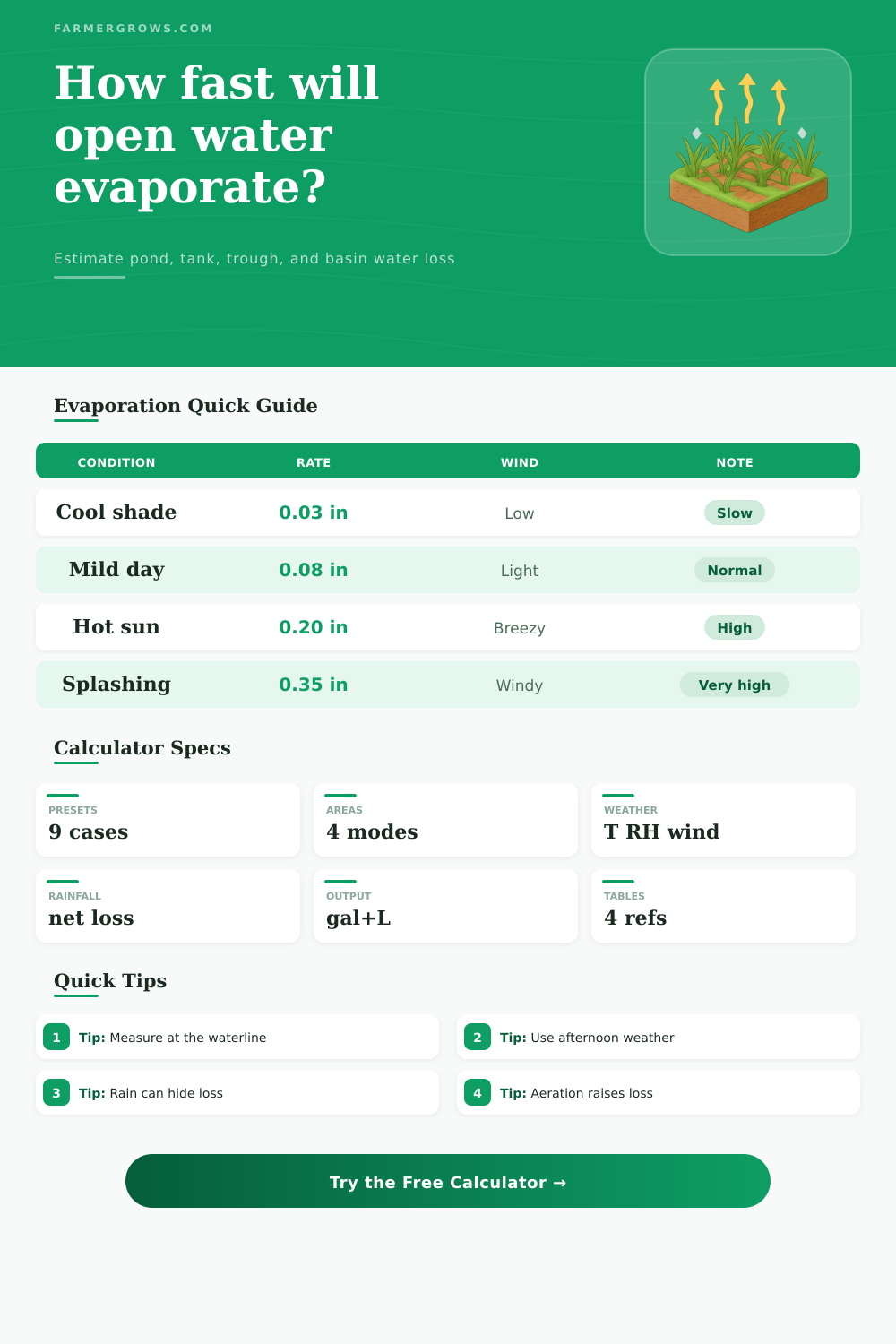
Use this grid to sanity-check the selected container or pond type. Multipliers are applied after weather, wind, sun, and splash inputs.
| Water or air condition | Typical VPD range | Evaporation tendency | Field note |
|---|---|---|---|
| Cool water, humid air | 0.2 to 0.7 kPa | Low | Rainy, foggy, or covered sites may lose very little water. |
| Mild water, moderate humidity | 0.7 to 1.4 kPa | Moderate | Common for spring and fall ponds with light wind. |
| Warm water, dry air | 1.4 to 2.5 kPa | High | Summer afternoons can drop small tanks quickly. |
| Hot water, very dry air | 2.5 kPa plus | Very high | Use measured refill records when water supply is tight. |
| Modifier | Low setting | Normal setting | High setting |
|---|---|---|---|
| Wind speed | 0 to 3 mph, sheltered | 4 to 9 mph, light breeze | 10 mph plus, exposed banks |
| Solar exposure | 0.65x heavy shade | 1.00x mixed sun | 1.32x full reflective sun |
| Splash factor | 1.00x calm surface | 1.10x small aerator | 1.40x waterfall or animals |
| Container type | 0.65x sheltered barrel | 1.00x garden pond | 1.25x shallow tray |
| Water surface area | Gallons per 0.10 in | Gallons per 1 in | Use case |
|---|---|---|---|
| 25 sq ft | 1.6 gal | 15.6 gal | Propagation tray, small barrel opening, or mini pond. |
| 100 sq ft | 6.2 gal | 62.3 gal | Stock tank, courtyard pond, or greenhouse sump. |
| 500 sq ft | 31.2 gal | 311.7 gal | Backyard pond, duck pond, or small lined basin. |
| 2,500 sq ft | 155.8 gal | 1,558 gal | Market farm reservoir or small irrigation pond. |
| 10,000 sq ft | 623.4 gal | 6,234 gal | Large open farm pond or stormwater basin. |
| Period input | Days used | Rainfall handling | Planning use |
|---|---|---|---|
| Hours | Hours divided by 24 | Rainfall is total rain over those hours | Short heat waves, transport tanks, or events. |
| Days | Entered days | Rainfall is total rain over the same days | Weekly top-off planning and field checks. |
| Weeks | Weeks x 7 | Use measured weekly rain total | Dry spell monitoring and irrigation reserve checks. |
| Months | Months x 30.44 | Use monthly rain total, not daily rain | Seasonal pond balance and long-range planning. |
A small change in exposed surface area can change gallons lost more than a small depth error. Measure the actual wet surface after freeboard, shelves, plants, and bank slope.
This calculator is a field estimate. If a pond loses more than the model predicts after rain is counted, check leaks, overflow, animal splashing, wicking edges, and pump plumbing.
This calculator estimates open-water evaporation for planning. Local weather, water temperature, salinity, vegetation, liners, leaks, seepage, overflow routing, and measurement timing can change actual results.
Water evaporation is a process in which water change from a liquid to a gaseous state. Water evaporation occur for specific environmental factors. If you have ever gone to a pond, or to a stock tank to provide water for an animal, you have likely noticed the decrease in the amount of water in those containers over time.
Such loss of water from these containers occurs due to factors like the temperature of the water, the humidity around the water, the amount of wind around the water, the amount of sun that the water is exposed to, and the movement of the water itself. Each of these factor can be entered into the calculator so that the calculator can calculate the amount of water that will evaporate over time. This calculator, therefore, eliminates the need for individuals to manually calculate the amount of water that will evaporate.
How Water Evaporates and How the Calculator Helps
One of the factors that can affect the rate at which water evaporates from a container is the area of the container that is in contact with an air. The rate at which water evaporates from the water is limited to the boundary between the water and the air; the greater the area of that boundary, the more fast the water will evaporate from the container. For example, a trough that is long and narrow will lose water at a different rate than a round tank of the same volume of water; the trough has a greater area of water expose to the air.
The calculator allows individuals to either enter the square footage of the container directly, or to enter the length and the width of the container so that the calculator can mathematically determine the area of the container. The temperature of the water, as well as the humidity of the surrounding area, affect the rate of water evaporation due to the concept of “vapor pressure deficit.” Warm water can hold more moisture in the air than cold water. Humidity rates in the air affect the ability of the air to hold moisture; high humidity rates will contribute to a decrease in the rate of evaporation, but low humidity rates will increase the rate at which water evaporates from that container.
Additionally, the rate at which water evaporates will increase with the rate at which the wind blow around the container; moving air will replace the humid air that contacts the water with dry air from other locations in the area. The calculator will calculate each of these factors to determine the amount of water that will evaporate. The amount of sunlight that the container receives will contribute to the rate of evaporation; containers with dark liners will absorb more sunlight than light-colored containers, raising the temperature of the water and increasing the rate at which the water evaporates.
Containers that are shaded or sheltered from the sun will tend to lose less water than those that are not shaded. Additionally, shallow trays will warm up to the sun faster than deep ponds, and will lose water at a higher rate than deep ponds. Each of these factors will be accounted for in the water evaporation calculation.
Rainfall will counteract the evaporation of water from the containers; while an individual may notice that the water level in a container has not decreased due to a rain shower, the rate of evaporation is still occurring. The amount of rainfall that will be added to the container will be subtracted from the total amount of gross evaporation to calculate the net loss in the amount of water in the container. If the amount of water that evaporates is offset by the amount of water that falls from the rain shower, then no additional water will need to be added to the container.
The aeration or splashing of water will result in an increase in the evaporation rate; small fountains will lose water at a higher rate than ponds with no aeration systems. The same is true of animals jumping into the container; the more water that splash will increase the rate at which water evaporates. The water evaporation calculator can account for the splash rate so that individuals can determine the amount of water that evaporates due to splashing; this factor can aid in the decision of whether the evaporation of water is worth the effort of providing water to a container.
Finally, it is important to recognize that the data calculated by the calculator may not directly reflect the amount of water that evaporates from containers in the same way that the mathematical calculation reflect the evaporation rate. Factors such as leaves landing on the water, plants that cover portions of the water container, and vegetation that blocks the wind will affect the evaporation of water from those containers. The same is true of the water leaking from the container; individuals will have to manually measure the amount of water to determine if the loss of water is due to evaporation or the container leaking.
However, the calculator will calculate the amount of water that will evaporate from containers under ideal condition, but actual containers may not always reflect these conditions. Therefore, individuals should also manually measure the amount of water in their containers each day. The calculator will help individuals to prepare for the worst possible week of evaporation of water, rather than preparing for the average amount of evaporation for a given month.
If the water evaporation calculator reveals that a pond, for instance, will lose a specific amount of water per day, those individuals can prepare a schedule to refill that pond each week. This will help to ensure that the level of water in the container does not drop too low; low levels of water can lead to stress for the fish that live in those containers, or the plants that live within them. Thus, the same calculations can be performed for containers of water that contain animals in pastures, or even for greenhouse trays.
The data that is gathered from the water evaporation calculator will allow individuals to recognize patterns in the evaporation of water over time. Each time that individuals use the calculator, they can begin to recognize when the wind is low or when the humidity levels in the air are high; each of these factor will allow them to understand how often they should refill their containers of water. The calculator will mathematically calculate these different factors to reveal in gallons the amount of water that will evaporate; this data can help individuals to determine whether a partial cover of the container is a cost-effective way of reducing the evaporation of water from those containers.
Water will continue to evaporate from the containers, but the evaporation calculator will help individuals to understand how much water will evaporate from their containers over time.