Round Pond Volume Calculator
Estimate round pond gallons, acre-feet, cubic yards, liner diameter, shelf volume, freeboard adjustment, and effective depth for flat, bowl, sloped, or shelf-style pond profiles.
Load a circular pond scenario, then adjust diameter, radius, freeboard, depth profile, shelf width, slope, and liner allowance.
Round Pond Volume Result
Results update as dimensions change.
Depth profile changes volume because a round pond rarely holds a perfect cylinder of water from edge to bottom.
Uses your measured average depth across shallow shelves, side slopes, and central basin.
Uses maximum depth across the waterline area, useful for tanks and vertical-walled ponds.
Approximates a rounded basin with shallow edges and a broad deeper middle.
Approximates a simple cone-like excavation that tapers steadily to one low point.
Separates shallow shelf area from the deeper middle before converting to gallons.
| Waterline diameter | Average depth | Cubic feet | Gallons | Acre-feet |
|---|---|---|---|---|
| 6 ft | 1.5 ft | 42.4 cu ft | 317 gal | 0.0010 acre-ft |
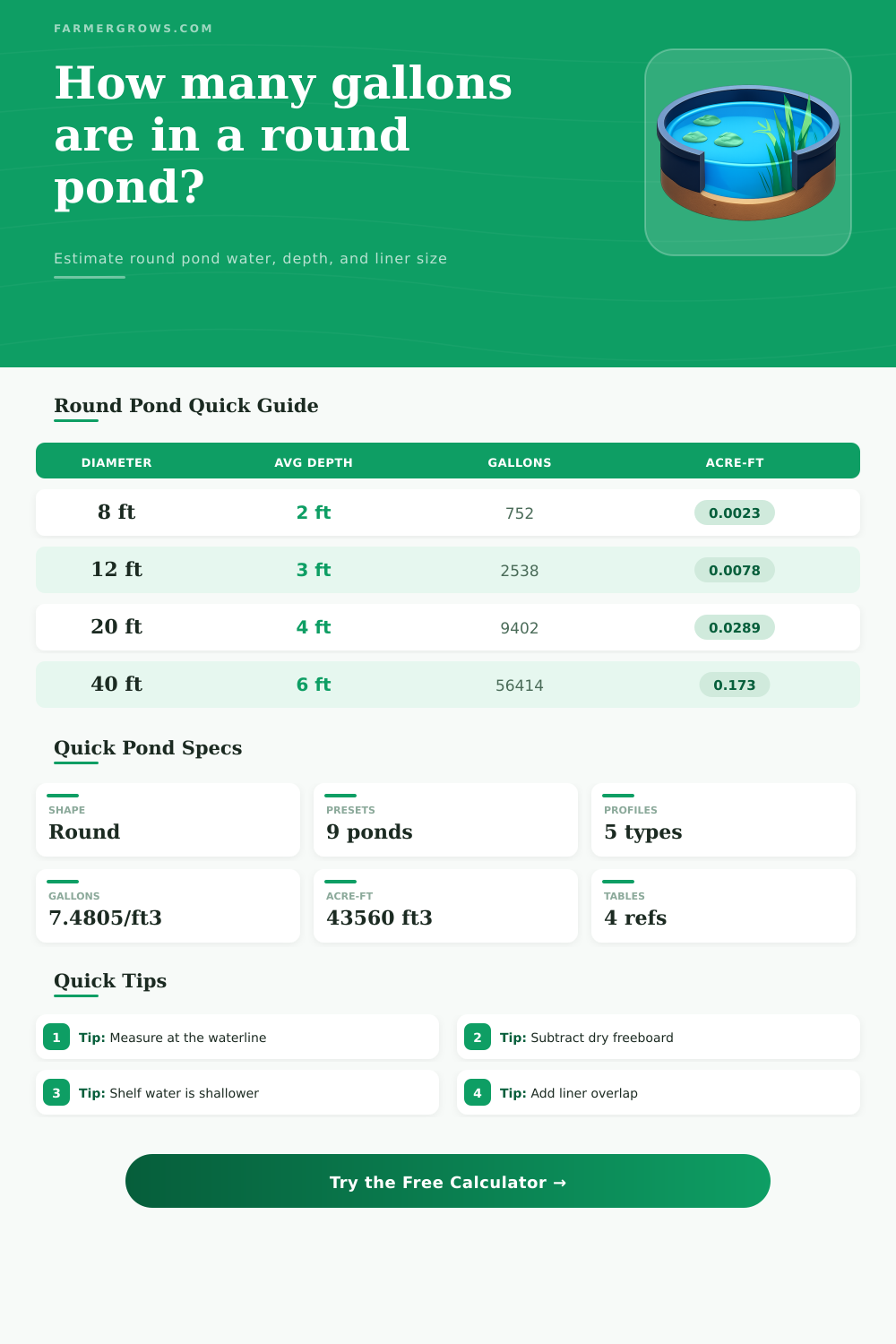
| 8 ft | 2 ft | 100.5 cu ft | 752 gal | 0.0023 acre-ft |
| 12 ft | 3 ft | 339.3 cu ft | 2,538 gal | 0.0078 acre-ft |
| 20 ft | 4 ft | 1,256.6 cu ft | 9,402 gal | 0.0288 acre-ft |
| 40 ft | 6 ft | 7,539.8 cu ft | 56,414 gal | 0.1731 acre-ft |
| Profile | Volume method | Best use | Typical effect |
|---|---|---|---|
| Entered average depth | Surface area x measured average depth | Measured ponds and as-built basins | Most direct if average depth is reliable |
| Flat bottom | Surface area x maximum depth | Round tanks, vertical walls, formal ponds | Highest volume for the same diameter |
| Smooth bowl | Surface area x 55% of maximum depth | Rounded wildlife or garden ponds | Moderate volume with shallow edges |
| Sloped cone | Surface area x 33% of maximum depth | Simple cone-shaped excavation | Lower volume than a bowl |
| Shelf with basin | Shelf area x shelf depth plus basin area x profile depth | Koi shelves, plant ledges, stepped ponds | Depends heavily on shelf width |
| Top diameter | Max depth | Overlap each side | Base blank diameter | With 10% allowance |
|---|---|---|---|---|
| 8 ft | 2 ft | 1 ft | 14 ft | 15.4 ft |
| 12 ft | 3 ft | 1.5 ft | 21 ft | 23.1 ft |
| 16 ft | 4 ft | 1.5 ft | 27 ft | 29.7 ft |
| 24 ft | 5 ft | 2 ft | 38 ft | 41.8 ft |
| 40 ft | 6 ft | 2 ft | 56 ft | 61.6 ft |
| Pond use | Typical diameter | Typical depth | Volume planning note |
|---|---|---|---|
| Patio wildlife pond | 4 to 8 ft | 1 to 2.5 ft | Small gallon changes matter for pumps and winter depth. |
| Backyard koi circle | 10 to 18 ft | 3 to 5 ft | Measure shelf width carefully because shelves reduce gallons. |
| Duck or livestock pond | 18 to 35 ft | 3 to 6 ft | Use acre-feet and gallons when checking refill needs. |
| Irrigation storage pond | 30 to 80 ft | 5 to 10 ft | Freeboard and side slope can remove meaningful storage. |
| Round farm reserve | 60 ft plus | 6 ft plus | Surveyed average depth is better than guessing a cylinder. |
If the pond has freeboard and sloped banks, the actual water surface can be smaller than the excavated top diameter. This calculator subtracts that difference before volume is estimated.
For an existing pond, take several depth readings from shelf, mid-slope, and center zones. The entered average depth mode is usually better than assuming a perfect bowl.
Calculating the volume of a round pond is a necessary step in the planning processes, as the volume of the pond will determine the size of the pump that must be used to manage the water in the pond and the depth to which the pond must be dug to permit winter survival by the fish that may live within it. The volume calculation should account for the volume of water that will be within the basin of the pond after accounting for the bank, shelves, and freeboard of the pond. Failure to accurately calculating the volume that will be within the pond will result in either too shallow of a pond or a pond that requires more water to fill then was anticipated during the planning process.
Because round pond often have banks and shelves that slope into the water, the ponds are not simple cylindrical shapes whose volumes could be easily calculate. The diameter of the pond at the waterline will often be smaller than the diameter of the excavation site of the pond. In calculating the volume of the pond, these variable must be accounted for in the calculation.
How to find the volume of a round pond
A calculator can assist in determining the volume of the pond, as the calculator can ask for the top diameter of the pond, the depth of the shelves, the height of the freeboard, and the slope of the banks of the pond. The calculator may also ask for the type of bottom of the pond, and different depths of water may be entered into the calculator so that it can calculate the volume of the pond in gallons, acre-feet, or cubic yard. An additional variable that must be accounted for in the calculation of the volume of the pond is the measurement of the freeboard of the pond.
Freeboard is the amount of dry wall or liner of the pond that sit above the normal depth of the water in the pond. Typical freeboard measurements are six or twelve inches of the pond liner that remain dry and non-submersed in the pond; this protects the liner from the UV light of the sun, and accommodates for natural water level changes within the pond. However, because the banks of the pond are often sloped, the depth of the waterline is smaller than the depth of the excavation site of the pond.
Calculators allow the user to enter the horizontal-to-vertical ratio of the slope of the banks to automatically calculate the area of the pond at the waterline instead of the excavation site of the pond. Another potential component of a round pond is the presence of shelves within the banks of the pond. These shelves are built into the banks of the pond to provide resting areas for plant and for amphibians like frogs to rest on.
However, because these shelves occupy some of the banks of the pond, the volume of the pond is reduced in comparison to a pond without these area. A pond volume calculator allows the user to enter the depth of these shelves as a percentage of the total depth of the pond; the calculator will then split the area of the ponds surface into the shallow shelf area and the deeper area of the pond surface. The depth of the ponds can be changed with the calculator to determine how much volume of the pond will be lost by create these shelves at particular depths within the banks of the pond.
Beyond calculating the volume of the pond, it is also necessary to calculate the size of the liner that will be used to line the pond. Calculating the size of the liner includes the same parameter as the volume calculation of the pond: the depth of the pond, the depth of the shelves, and the depth of the freeboard. In addition to these dimensions, the liner size calculation also includes an allowance for the folds in the liner.
Calculators will provide the user with the size of the round metal blank liner that will be required for the pond, as well as the size of the square sheet of liner that will be required for the pond. These values are calculate with the same parameters as the volume calculations; both calculations use the width of the pond at the waterline. Sometimes, round ponds are not dug to create perfectly-shaped ponds whose dimensions are consistent throughout the pond area.
If the bottom of the pond is not flat, and if the deepest point of the pond is not of the same depth as the shallowest point of the pond, then the average depth of the pond may be calculate with the pond volume calculator. The depth of the pond may be measured at multiple points within the pond, from the shallowest shelf to the deepest part of the pond. The average depth of the pond may be selected on the calculator to be used in calculating the volume of water that will be required to fill the pond to its maximum depth.
The calculator that is used to calculate the volume of the pond may also allow the user to convert the measurement of the pond from one unit to another. For instance, the dimensions of the pond may be entered in feet (imperial units), but the user may wish to view the measurement of the pond in meters (metric units). Both units are represented within the calculator, and selecting one unit will automatically change all length measurement to that unit.
These reference tables show the number of gallons that are represented by a given number of acres and feet of depth. These tables may be referenced by the designer of the pond to provide a quick orientation to the different possible dimension of ponds of various sizes. Once the dimensions of the pond have been calculated, those dimension may be associated with the purpose of the pond.
For instance, the depth of a pond may need to be calculated to determine how deep the pond should be to allow frog to survive the winter months; the volume of a koi pond will be different than the volume of the wildlife pond. An irrigation pond will require accurate calculations of how many acre of water the pond will contain; the volume of the pond will have to be calculate to ensure that the refill schedule for the irrigation pond will remain accurate. Thus, the calculator will calculate the volume of the pond, but the designer must ensure that the volume of the pond is sufficient for the plants, animals, and purpose of the pond.
If the actual volume of the pond is the same as the volume that was calculate, then the plan for the pond was successful.