Soil Volume Calculator
Estimate soil volume for rectangular beds, circular planters, triangular corners, or direct area entries with depth, bulk density, settling, moisture weight, bag size, bulk units, and overage.
Load a common soil job, then fine tune the dimensions, shape, depth, soil type, density, settling, moisture, and order units.
Soil Volume Results
Your soil volume estimate will appear here after calculation.
These density ranges are planning estimates for loose, purchased materials. Actual weights vary by moisture, screening, organic matter, and supplier.
| Soil Depth | Sq Ft per Cubic Yard | Sq M per Cubic Meter | Typical Use | Planning Note |
|---|---|---|---|---|
| 1 in | 324 sq ft | 12.0 sq m | Compost topdress | Good for lawn or bed refresh |
| 2 in | 162 sq ft | 6.0 sq m | Soil improvement | Often raked into existing beds |
| 3 in | 108 sq ft | 4.0 sq m | New planting layer | Common calculator default |
| 4 in | 81 sq ft | 3.0 sq m | Deep top-up | Useful after erosion or settling |
| 6 in | 54 sq ft | 2.0 sq m | Bed refill | Half-depth raised bed fill |
| 12 in | 27 sq ft | 1.0 sq m | Full raised bed | One cubic yard covers 27 sq ft |
| Unit | Volume | Units per Cubic Yard | Coverage at 3 in | Best Fit |
|---|---|---|---|---|
| 25 liter bag | 0.88 cu ft | 30.6 bags | 3.5 sq ft | Small containers |
| 40 liter bag | 1.41 cu ft | 19.1 bags | 5.7 sq ft | Planters and top-ups |
| 1.5 cu ft bag | 1.50 cu ft | 18.0 bags | 6.0 sq ft | Easy carry bag |
| 2 cu ft bag | 2.00 cu ft | 13.5 bags | 8.0 sq ft | Common soil bag |
| 3 cu ft bag | 3.00 cu ft | 9.0 bags | 12.0 sq ft | Large bag refill |
| Bulk cubic yard | 27.00 cu ft | 1.0 yard | 108 sq ft | Large beds or delivery |
| Project | Area | Depth | Cubic Yards Before Overage | 2 Cu Ft Bags |
|---|---|---|---|---|
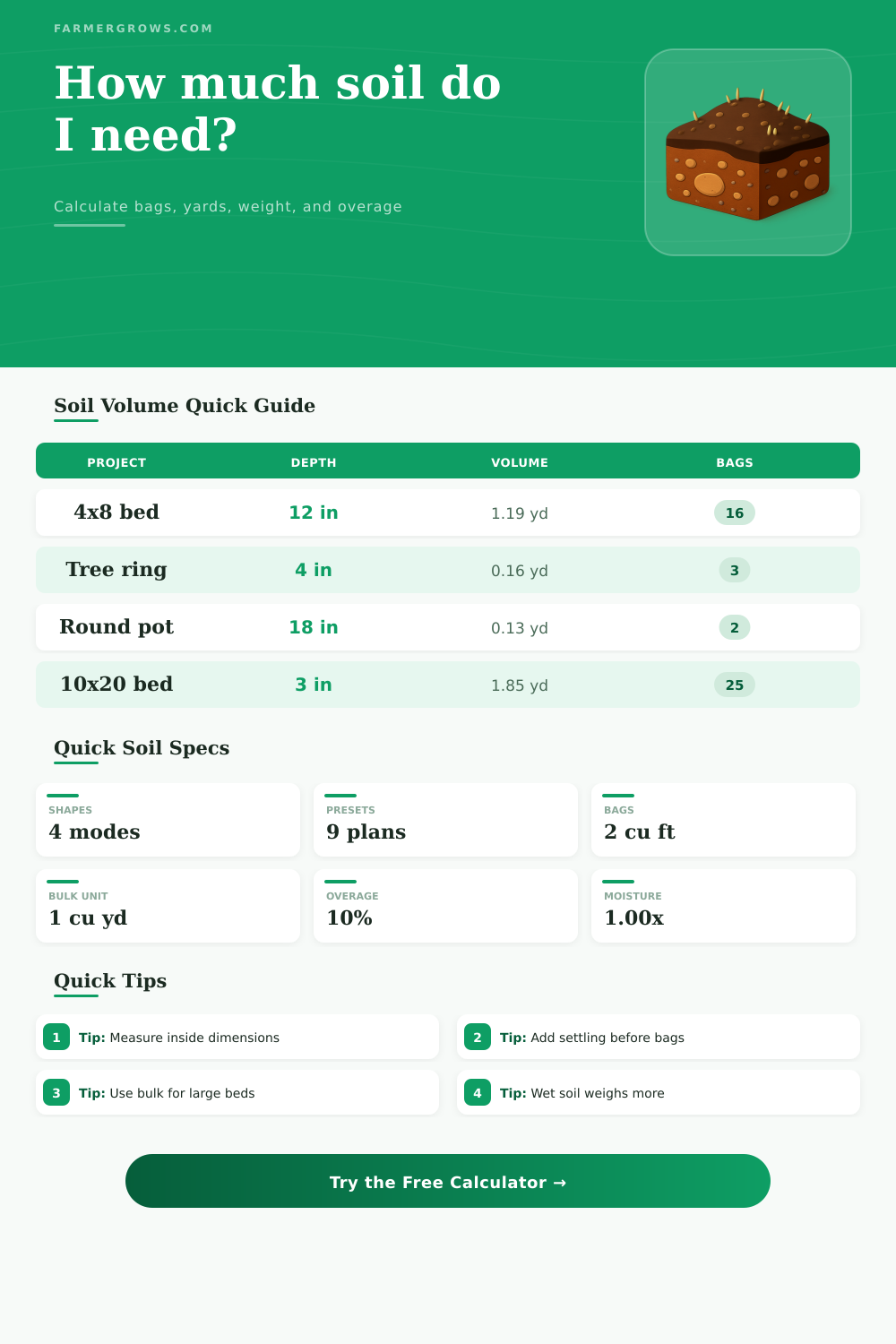
| 4 x 8 raised bed | 32 sq ft | 12 in | 1.19 yd | 16 bags |
| 3 x 10 root bed | 30 sq ft | 15 in | 1.39 yd | 19 bags |
| 8 ft tree ring | 50 sq ft | 4 in | 0.62 yd | 9 bags |
| 10 x 20 garden | 200 sq ft | 3 in | 1.85 yd | 25 bags |
| 15 x 15 bed block | 225 sq ft | 6 in | 4.17 yd | 57 bags |
| 600 sq ft lawn | 600 sq ft | 1 in | 1.85 yd | 25 bags |
| Condition | Adjustment | Use When | What It Changes | Calculator Setting |
|---|---|---|---|---|
| Dry light mix | 0.90x weight | Bagged potting soil is dry | Lower hauling weight | Very dry mix |
| Field-moist soil | 1.00x weight | Normal delivered soil | Default estimate | Loose field-moist |
| Damp compost | 1.15x to 1.30x | Material clumps in hand | Higher load weight | Damp or wet soil |
| Loose raised bed fill | 5% to 10% settling | Fresh fluffy mix | More order volume | Compaction field |
| Compost-heavy mix | 10% to 20% settling | High organic matter | Extra refill allowance | 15% overage |
| Uneven grade | 10% to 20% overage | Depth varies across area | Reduces shortage risk | Overage buffer |
Use inside bed dimensions, not outside lumber dimensions. For irregular spots, split the area into rectangles, circles, and triangles, then add the totals as a custom area.
Loose soil settles after watering, and wet material can be much heavier than dry bag labels suggest. Add settling before rounding bags or bulk yards.
Calculating the correct amount of soil for a garden project require attention to several factor. Many peoples order too much soil or too little soil for they project. If people orders too much soil, they will have leftover soil that they will have to store.
However, if they order too little soil for the project, they will have to go back to a supplier to order more soil. To determine the proper amount of soil to order for a garden project, a person will have to calculate the dimension of the garden to determine the volume of soil that will be required for the project. Additionally, they will also have to account for the settling of the soil and the weight of the soil.
How to Calculate the Right Amount of Soil for a Garden
When someone places soil in a garden and waters it, the soil will settle. The more organic the soil is, the more it will settle than mineral soil. If someone were to simply calculate the length, width, and depth of the garden, they will find that the amount of soil required are too small.
They would have to add the settling allowance of the soil to calculate the total volume of soil that will be required for the garden. They would also have to add an overage to the total amount of soil to account for any uneven ground in the garden. The density of the soil will determine how much the soil will weigh.
Potting mixes will be the lightest soil as they need to be well aerate for the plants roots. Screened topsoil and clay loams will be the heaviest soil because they contain more of the dense earth needed to produce crops for farmer. The weight of the soil will also change with the moisture content of the soil.
Dry soil will weigh less than wet soil because of the water that will be contain in the soil. Therefore, if someone is purchasing soil for a project, they will have to make sure that they pick the correct type of soil and the correct moisture content setting in the soil calculator. The shape of the garden will determine the type of mathematical formula that will be used to calculate the total volume of soil that will be required for the garden project.
For rectangular gardens, a person can measure the length and width of the garden and the depth of the soil to determine the total volume of soil require. For circular and triangular gardens, a different formula will have to be used to calculate the area of the garden. For irregularly shaped gardens, the area can be divided into separate shape and their individual volumes calculated so that the person can determine the total volume of soil required for that garden.
The depth of the soil also has a significant effect on the total volume of soil that will be required for that garden. A depth of one inch is much different than twelve inches in the amount of soil that will be required for the project. The decision of whether to purchase soil in bags or bulk soil will affect the cost of the soil for the project.
Soil in bags is convenient because it is easier to transport to the garden. However, bagged soil will cost more per cubic foot of soil than bulk soil. Bulk soil is better for larger project but requires a place to store the bulk soil and tool to move the soil.
Using a soil calculator will allow a person to determine how many bags of soil will be required to complete the project compared to the bulk soil units that will be required to complete the same project. Many people make mistake in calculating the amount of soil that they will order for their gardens. One of the most common mistakes that many people make is using the outside measurement of the garden rather than the inside measurements of the garden.
Using the outside measurements will provide a wrong calculation of the amount of soil that is required for that garden. People also often forget to add the settling allowance for the soil. Additionally, many people will choose a soil density for the project that does not match the type of soil that they will actualy purchase.
When creating a soil calculation for a project, people must remember that as the soil fills the garden and the plant are planted into it, the surface of the soil will dropp. Therefore, soil should of be ordered in such a way that accounts for these change in the soil. To calculate the amount of soil that will be required for a project, a person will have to measure the area that will be covered by the soil.
Additionally, they will have to calculate the correct type of soil and the settling and overage of that soil. Finally, they will also have to calculate how much soil will be required in bags or in bulk soil unit.