Raised Bed Soil Mix Calculator
Estimate the soil volume, topsoil, compost, peat or coir, perlite, vermiculite, amendments, settling allowance, and bag counts needed to fill raised garden beds.
Load a named raised-bed recipe, then adjust the ratios, bag sizes, and amendment rate for your actual bed depth and number of beds.
Soil Mix Results
Your raised bed soil recipe will appear here after calculation.
Good default for annual vegetables when compost is mature and topsoil is screened.
Uses compost, fiber, and aeration with no mineral topsoil in the main recipe.
Compost-forward for tomatoes, peppers, squash, and other hungry crops.
More pore space for rosemary, thyme, sage, and beds that stay damp.
Lower bulk density helps carrots, beets, radishes, and parsnips size evenly.
For topping or rebuilding beds that already contain usable mineral soil.
Leans toward peat or leaf mold and skips lime unless testing says otherwise.
Extra aeration helps deeper boxes drain and avoids a dense lower layer.
| Inside bed size | 6 in fill | 10 in fill | 12 in fill | 18 in fill |
|---|---|---|---|---|
| 3 ft × 6 ft | 9.0 cu ft | 15.0 cu ft | 18.0 cu ft | 27.0 cu ft |
| 4 ft × 4 ft | 8.0 cu ft | 13.3 cu ft | 16.0 cu ft | 24.0 cu ft |
| 4 ft × 8 ft | 16.0 cu ft | 26.7 cu ft | 32.0 cu ft | 48.0 cu ft |
| 4 ft × 12 ft | 24.0 cu ft | 40.0 cu ft | 48.0 cu ft | 72.0 cu ft |
| 5 ft × 10 ft | 25.0 cu ft | 41.7 cu ft | 50.0 cu ft | 75.0 cu ft |
| Mix type | Topsoil | Compost | Aeration and fiber | Best use |
|---|---|---|---|---|
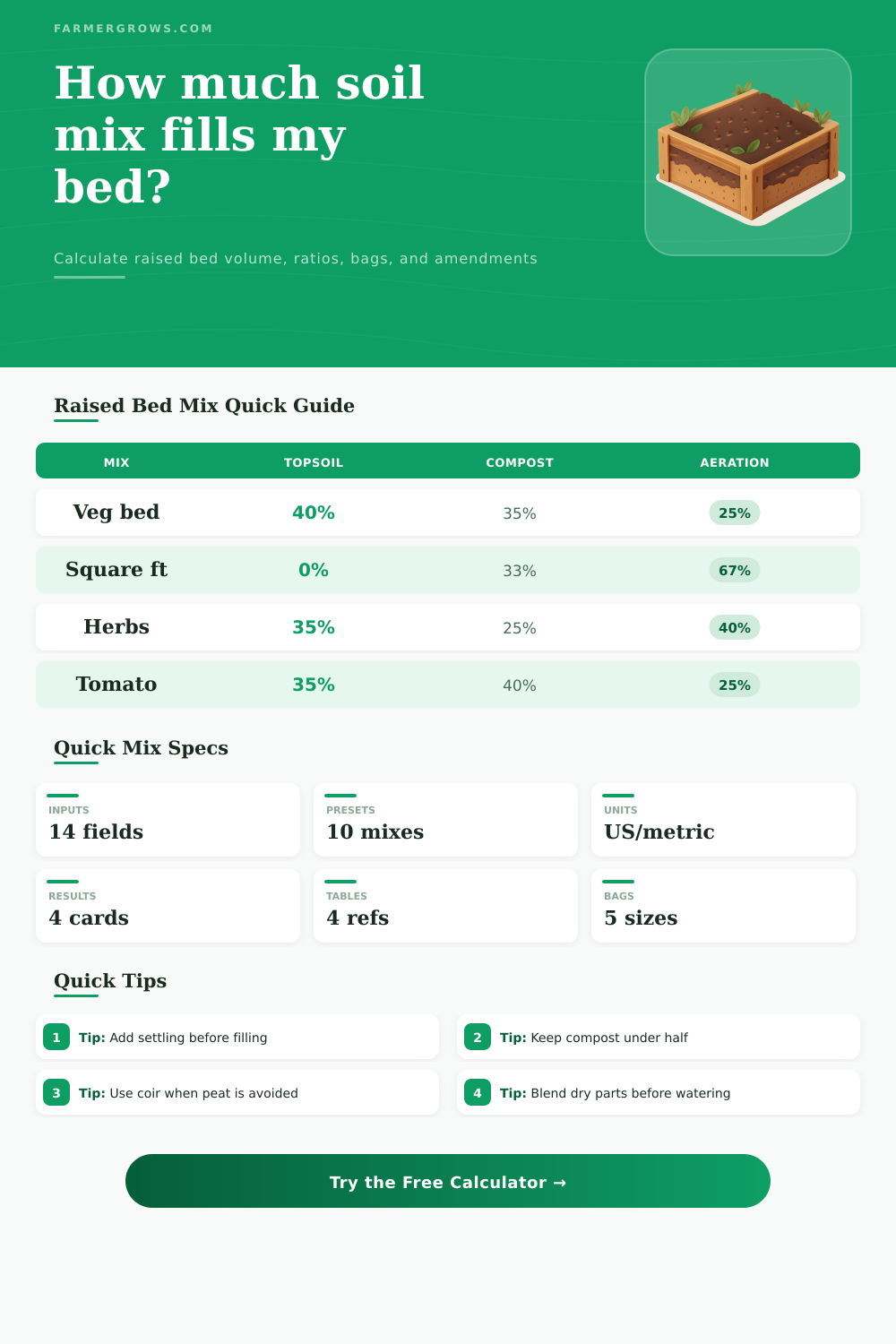
| Balanced vegetable bed | 40% | 35% | 25% | General tomatoes, beans, cucumbers, greens, and mixed beds |
| Square foot garden style | 0% | 33% | 67% | Light beds using compost, peat or coir, and coarse drainage media |
| Fast-draining herb mix | 35% | 25% | 40% | Herbs and beds with slow drainage or frequent rainfall |
| Native soil refresh | 55% | 30% | 15% | Refreshing existing beds with mineral structure already present |
| Acid berry bed | 20% | 35% | 45% | Blueberries and other acid-leaning crops after soil testing |
| Bag label | Cubic feet | Cubic yards | Liters | Coverage at 12 in |
|---|---|---|---|---|
| Small soil bag | 0.75 cu ft | 0.028 cu yd | 21.2 L | 0.75 sq ft |
| Standard compost bag | 1.00 cu ft | 0.037 cu yd | 28.3 L | 1.00 sq ft |
| Common topsoil bag | 1.50 cu ft | 0.056 cu yd | 42.5 L | 1.50 sq ft |
| Compressed coir bale | 2.00 cu ft | 0.074 cu yd | 56.6 L | 2.00 sq ft |
| Large aeration bag | 4.00 cu ft | 0.148 cu yd | 113.3 L | 4.00 sq ft |
| Profile | Dry blend rate | Lime or buffer | Use note |
|---|---|---|---|
| Balanced organic starter | 0.50 cup per cu ft | 1.5 tbsp per cu ft | General annual vegetable bed with coir or peat included |
| Heavy feeder vegetable | 0.75 cup per cu ft | 1.5 tbsp per cu ft | Tomatoes, peppers, squash, corn, and long-season crops |
| Light herb and greens | 0.30 cup per cu ft | 1.0 tbsp per cu ft | Herbs, lettuce, spinach, and shallow seasonal plantings |
| Acid-loving berry bed | 0.40 cup per cu ft | 0 tbsp per cu ft | Skip lime unless a soil test calls for correction |
| Mineral-only recharge | 0.20 cup per cu ft | 1.0 tbsp per cu ft | Light annual refresh for beds that already test fertile |
Volume tip: Measure the inside of the bed after lumber, blocks, or liners are installed. A 10% to 15% settling allowance is usually more realistic than filling exactly to the rim.
Recipe tip: Keep compost mature and crumbly, then blend dry parts evenly before soaking. Perlite adds drainage while vermiculite holds more moisture.
When you build a raised bed, you must fill the raised bed with a specific type of soil mix in order to ensure that the plants will grows effectively within that raised bed. A soil mix contain three different components: mineral content, organic matter, and aeration material. The mineral content and the organic matter provides the soil with the nutrients that the plants will require to grow, but the aeration materials prevents the soil from becoming too dense with those minerals and too wet with the organic material.
If the soil contains too much organic material, it may become too wet for the plants root. However, if the soil contains too little organic material, the plants may not receive enough nutrients to produce healthy plant. To ensure that the soil within the raised bed is of the proper composition, you can use a soil calculator.
How to Use a Soil Calculator for Raised Beds
You will need to enter the dimension of the raised bed and the depth of the soil within the raised bed to determine the total volume of soil that will be required for your bed. In addition, you should account for the settling of the soil; soil will shrink in volume when wet. It may appear that you have enough soil to fill your raised bed, but the soil will be more less when wet.
Because different plants has different requirements for nutrients within the soil, the soil within your raised bed may need to have different components different than another raised bed. For instance, plants like tomatoes and squash require soil that contains a higher percentage of compost to provide them with the nutrients that they require to grow. Herbs prefers soil with high drainage capability to ensure that there roots do not sit in too much water.
Root crops, like carrots and parsnips, require soil with a loose structure to allow for the roots to grow in the soil. The soil calculator will offer options to preset the soil to accommodate these different types of plant, or you can manually adjust the setting for each component of the soil. The soil calculator will tell you how many bag of each component will be required for your raised bed.
Most soil bag are sold in whole bags, so the calculator will round the numbers up to the nearest bag to ensure that you will not run out of soil for your raised bed. The calculator will separate the number of bags of the aeration materials from the number of bags of the compost and topsoil. This is because the aeration materials, compost, and topsoil may come in different bag size.
By knowing how many bags of each material will be required for your raised bed, you can plan your trip to the gardening store. By knowing how many bags of each component you need to buy, you can ensure that you do not purchase too much of an expensive soil component. Other materials, known as amendments, can also be added to the soil to change its chemistry.
The amount of amendments that you should add to the soil can be calculated according to the total volume of the soil. The soil calculator will apply the proper rate of amendments to the total volume of soil that will be created for your raised bed, so that you dont have to manually calculate how much bone meal, compost, or pH buffer to add. These value can be found through reference tables, but the most accurate method for determining the type and amount of amendments to add is through a soil test.
The quality of the soil component will also affect the soil mixture that is prepared for your raised bed. Soil that contains a high amount of wood chip will behave differently than soil that contains only compost. Topsoil that contains clay will behave differently than screened topsoil.
Because of the potential for differences in the quality of the components, many gardeners will mix the soil components together on a tarp and allow the soil mixture to sit for one day before placing it into the raised bed. During this day, you can observe the mixture to determine whether the soil drain properly; if it does not, you can add more perlite to the mixture before placing it into the raised bed. Using a soil calculator will enable you to treat the soil that will be within your raised bed as a planned component of your raised bed structure.
By calculating the components of the soil in advance, you can be sure that you will not have to make repeated trip to the store to purchase soil for your raised bed. By planning in advance for the components of the soil within your raised bed, you will ensure that the soil will effectively support the growth of your plant. You should of used a calculator to avoid mistakes.
Its better to be prepared.