Five Sided Lot Acreage Calculator
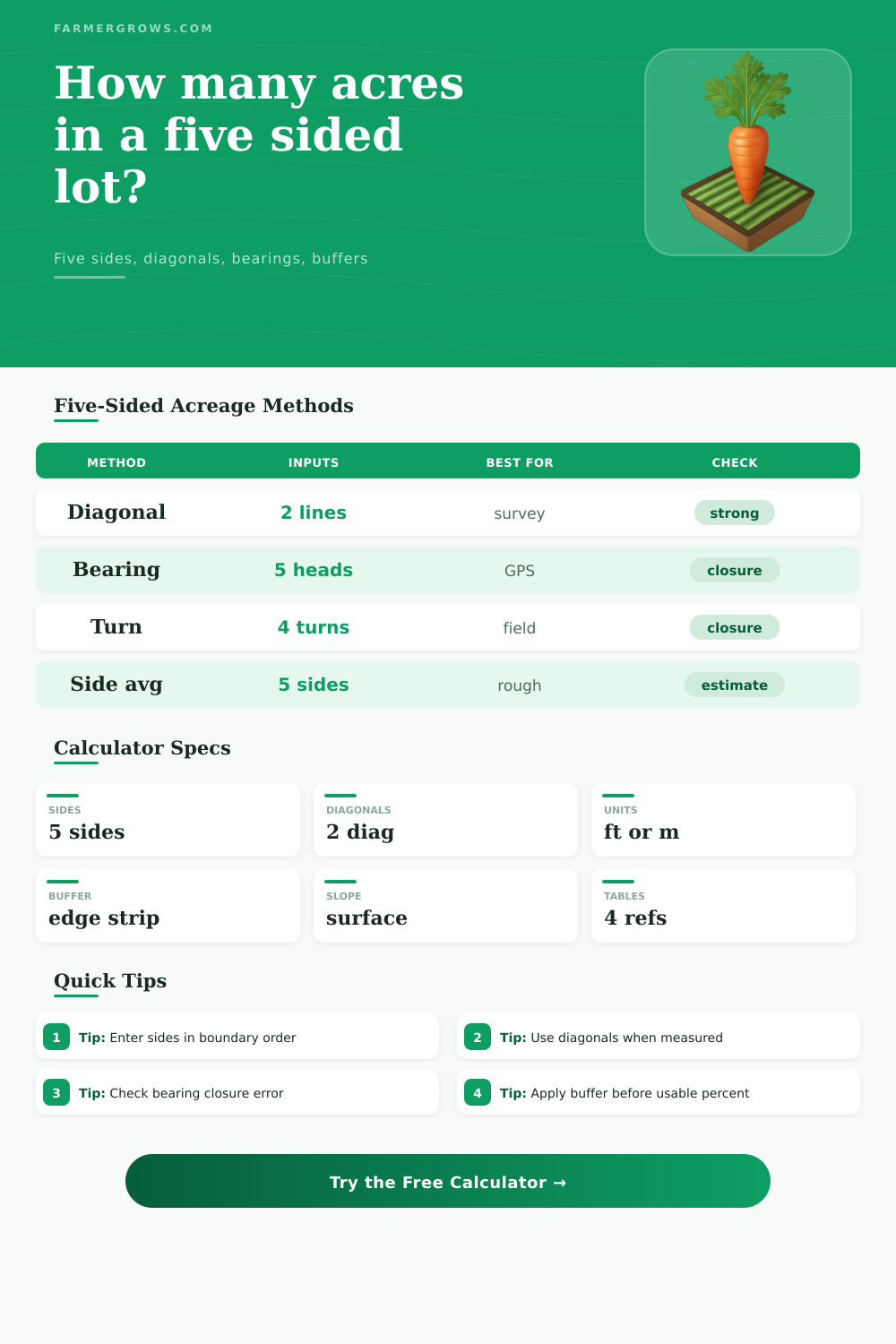
Estimate a pentagon or five-boundary farm parcel from five side lengths, measured diagonals, compass bearings, turn-angle estimates, perimeter buffer strips, slope grade, and usable-area percent.
Enter the boundary sides in walking order around the lot. For the diagonal method, diagonal 1 spans vertex 1 to vertex 3, and diagonal 2 spans vertex 1 to vertex 4, creating three triangles.
Five-Sided Lot Results
Calculated acreage will appear here.
| Triangle | Uses These Lines | Best Field Check | Why It Matters |
|---|---|---|---|
| Triangle 1 | Side A, side B, diagonal 1 | Measure vertex 1 to vertex 3 | Locks the first corner into a real shape. |
| Triangle 2 | Diagonal 1, side C, diagonal 2 | Measure vertex 1 to vertex 4 | Connects the center band of the lot. |
| Triangle 3 | Diagonal 2, side D, side E | Check the far closing corner | Completes the five-sided parcel. |
| All triangles | Heron's formula from three sides | Each triangle inequality must hold | Invalid triangles signal a bad diagonal or side order. |
| Unit | Square Feet | Square Meters | Common Use |
|---|---|---|---|
| 1 acre | 43,560 sq ft | 4,046.86 sq m | Farm parcel reporting in the United States. |
| 1 hectare | 107,639 sq ft | 10,000 sq m | Metric land records and larger blocks. |
| 0.25 acre | 10,890 sq ft | 1,011.71 sq m | Small lot, garden, or homestead section. |
| 1,000 sq m | 10,764 sq ft | 1,000 sq m | Metric paddock or nursery layout block. |
| Buffer Width | Approx Area Removed | Best Use | Watch For |
|---|---|---|---|
| 5 ft | perimeter x 5 | Fence mowing strip or narrow setback. | Small parcels feel this more than large ones. |
| 10 ft | perimeter x 10 | Headland, access strip, ditch, or hedge. | Wide corners may be over-subtracted. |
| 20 ft | perimeter x 20 | Equipment turn space or spray setback. | Confirm with a mapped offset for final plans. |
| Metric buffer | perimeter x meters | Hectare workflows and GIS checks. | Calculator converts meters to feet internally. |
| Method | Confidence | Required Inputs | Field Check |
|---|---|---|---|
| Measured diagonals | High for planning | Five sides plus two diagonals | Both diagonal triangles must be valid. |
| Compass bearings | Medium | Five sides and five headings | Closure error should stay small. |
| Turn angles | Medium-low | Five sides, start bearing, four turns | Useful when headings were not recorded. |
| Side-only regular | Low | Five side lengths only | Use as a placeholder until angles are known. |
Diagonal tip: If you can measure only one extra line, choose the longest clear corner-to-corner diagonal first. A second diagonal turns the five-sided lot into three checkable triangles.
Bearing tip: Bearing and turn-angle methods are estimates. If the closure error is large, recheck side order, compass direction, and whether a heading was recorded as the opposite bearing.
A five-sided lot is a plot of land with five straight boundaries. These plots often form due to old roads, creeks, or land that was left behind from homestead additions. For these types of plots, determining the acreage can be difficult due to the fact that the standard equations for calculating the area of a rectangle do not applies to five-sided lots.
Additionally, five-sided lots has angles that do not often make for easy measurement. Because of these difficulties, five-sided lot acreage calculators is of significant use to those trying to calculate the size of there five-sided plots of land. A five-sided lot acreage calculator asks for the length of each of the five sides of the five-sided lot.
How to Find the Acreage of a Five-Sided Lot
There are several methods within the acreage calculator that determine the area of these lots. For instance, if the diagonals of the five-sided lot are known, the five-sided lot can be divided into three separate triangles. Using the triangle formulas that surveyors use, the acreage calculator can calculate the acreage of each of these three triangles and add them to find the area of the entire five-sided lot.
If only the compass bearings of the sides of a five-sided lot are known, the acreage calculator can plot the five-sided lot on a map based off these bearings and the acreage calculator can calculate the distance between the starting corner and the last corner of the five-sided lot. If the five-sided lot only contains turn angles, the acreage calculator can start at any point and heading for the five-sided lot, then apply each of the turn angles to determine the five-sided lots shape. If only the five sides of the five-sided plot are known, the acreage calculator can use a side-only method to calculate the area.
This method averages each of the sides to form a regular pentagon, but is only a rough estimate of the area of the five-sided lot since it assumes that each of the five angles of the five-sided plot are equal. The method that the acreage calculator uses will introduce some uncertainty into the measurement of the five-sided lot. Methods that calculate the diagonals introduce the highest level of confidence in the measurement of the five-sided lot, while methods that use bearings or turn angles will introduce a closure error into the measurement.
The closure error is the distance that the bearings miss the original spot from which they began plotting the five-sided lot on the map. Calculations that use only the side lengths of the five-sided lot have the highest level of uncertainty; they assume that each of the angles of the five-sided lot are equal, which may not necessarily be true. In addition to calculating the acreage of a five-sided lot based upon the five side measurements, there are additional factors that must be considered before determining how many acres are actualy usable within the five-sided lot.
One factor is the acreage that is lost due to the buffer that surrounds the five-sided lot; this buffer cannot be used for crop planting. Additionally, the acreage can be adjusted according to a percentage that indicates how much of the calculated acreage will be usable; some five-sided lots may contain wet corners or rocks that cant be used for farming. The slope of the land also plays a significant role in the area of the five-sided lot; the distance from the top of a slope to the bottom is always greater than the distance that is represented on a flat map.
A four percent slope will have a minimal effect upon the acreage measurement, but a twelve percent slope will have a significant effect on measurements of how much seed is needed to cover the five-sided lot. Finally, an allowance percentage for errors in the measurement of the five-sided lot introduces a range to the acreage; errors can be introduced in the measurement of the sides and angles of the five-sided lot using tape measures, GPS technologies, and the accuracy of the bearings that are taken of the five-sided lot. There are several reference tables within the acreage calculator that assist in the verifying of the calculations of the acreage of the five-sided lot.
One table displays the relationship of the three separate triangles that the five-sided lot creates if the diagonals of the five-sided lot are used in the calculations; the triangle inequality is satisfied by these measurements. The acreage can be represented in another unit of measurement, such as hectares or square feet; reference tables display these measurements. Additionally, the acreage calculator can calculate the acreage of the buffer that surrounds the five-sided plot; the reference table allows an individual to determine if the width of the buffer is realistic to that five-sided lot.
Accuracy tables allow for the four different methods to be compared with one another in order to determine the accuracy of the measurements of the five-sided lot according to the precision of the measurements of its sides and angles. Many individuals will use the five-sided lot acreage calculator after having walked the perimeter of the five-sided lot and written the length of each side into a notebook. In these cases, it is likely that the angles of the five-sided lot were not measured, making it impossible to use the angle-based methods within the acreage calculator.
Additionally, the numbers for the sides of the five-sided lot can be entered into the acreage calculator at a fast rate. However, the output from the acreage calculator will help an individual to determine if the acreage of the five-sided lot is sufficient for the plans that are to be made for the land within the five-sided lot. Thus, the acreage calculator will help to prevent an individual from making costly purchases of items like seed or fencing based upon the gross acreage of the five-sided lot.
Finally, an individual will need to interpret the results that emerge from the five-sided lot acreage calculator. The five-sided lot acreage calculator will calculate the acreage of a five-sided lot and provide for the individual the range of usable acres within the plot. The usable acreage will help an individual to make decisions regarding the fence line for the five-sided lot, the crop that will be planted into each of the five-sided lot’s acres, or even how many farming equipment tools will be needed to treat the acres within the five-sided lot.
Thus, the acreage calculator helps to remove the guesswork of the acreage calculations of a five-sided lot, but still requires the individuals judgment to determine the significance of these calculated acreages for their land.