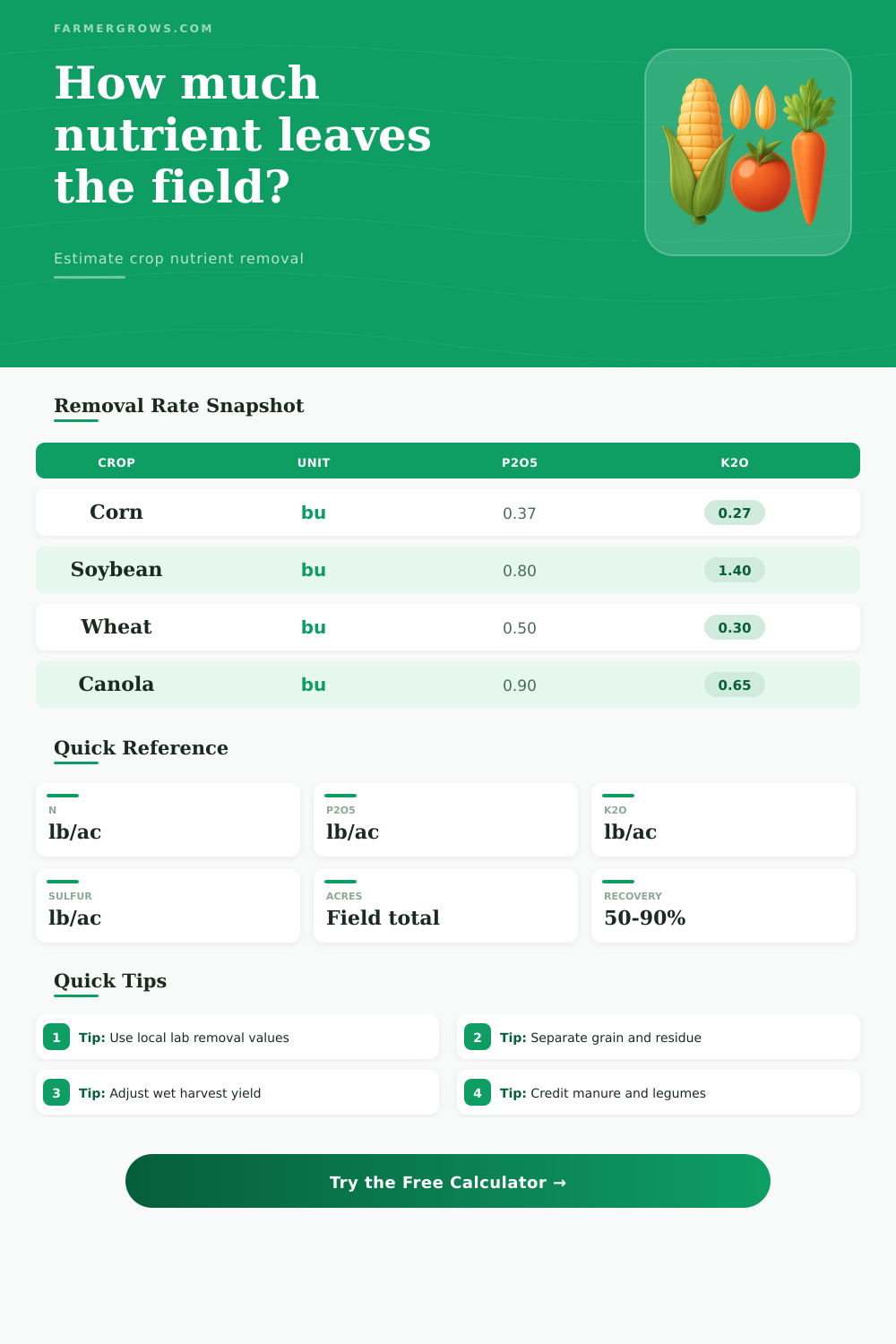
Crop Nutrient Removal Calculator
Estimate nitrogen, phosphate, potash, and sulfur removed by harvested crop yield, grain share, stover or straw removal, harvest moisture, field acres, and fertilizer recovery.
Removal values are planning estimates. Local lab reports, university extension tables, and soil-test recommendations should override the default rates when you have them.
Nutrient Removal Result
Corn grain estimate on 80 acres.
| Crop | Yield unit | N | P2O5 | K2O | S |
|---|---|---|---|---|---|
| Corn grain | bushel | 0.67 | 0.37 | 0.27 | 0.08 |
| Soybean | bushel | 3.80 | 0.80 | 1.40 | 0.18 |
| Wheat | bushel | 1.20 | 0.50 | 0.30 | 0.10 |
| Grain sorghum | bushel | 0.85 | 0.40 | 0.30 | 0.08 |
| Rice | cwt | 1.25 | 0.55 | 0.32 | 0.08 |
| Canola | bushel | 2.90 | 0.90 | 0.65 | 0.30 |
| Alfalfa hay | ton | 55.00 | 12.00 | 50.00 | 5.00 |
| Corn silage | ton | 8.00 | 3.50 | 8.00 | 0.80 |
| Crop residue | Basis | N | P2O5 | K2O | S |
|---|---|---|---|---|---|
| Corn stover | per bu grain at 100% stover removal | 0.45 | 0.15 | 1.10 | 0.08 |
| Soybean residue | per bu seed at 100% residue removal | 1.00 | 0.20 | 0.85 | 0.08 |
| Wheat straw | per bu grain at 100% straw removal | 0.50 | 0.16 | 1.70 | 0.12 |
| Sorghum stalks | per bu grain at 100% stalk removal | 0.45 | 0.14 | 0.95 | 0.08 |
| Rice straw | per cwt grain at 100% straw removal | 0.65 | 0.18 | 1.45 | 0.10 |
| Canola residue | per bu seed at 100% residue removal | 0.80 | 0.22 | 1.20 | 0.18 |
| Crop | Measured moisture | Standard moisture | Yield factor | How to read it |
|---|---|---|---|---|
| Corn grain | 20.0% | 15.5% | 0.947 | 200 wet bu/ac becomes about 189.4 standard bu/ac |
| Soybean | 14.5% | 13.0% | 0.983 | 62 wet bu/ac becomes about 60.9 standard bu/ac |
| Wheat | 15.0% | 13.5% | 0.983 | 90 wet bu/ac becomes about 88.4 standard bu/ac |
| Canola | 11.0% | 10.0% | 0.989 | 55 wet bu/ac becomes about 54.4 standard bu/ac |
| Recovery band | Typical use | Removed nutrient | Recovery-adjusted application |
|---|---|---|---|
| 90% | Very efficient placement or available nutrient credit | 100 lb | 111 lb nutrient equivalent |
| 75% | Common planning midpoint for replacement budgeting | 100 lb | 133 lb nutrient equivalent |
| 60% | Lower efficiency, timing risk, or mixed sources | 100 lb | 167 lb nutrient equivalent |
| 50% | Conservative planning or uncertain availability | 100 lb | 200 lb nutrient equivalent |
Keep replacement separate from recommendation: Nutrient removal is a budget line. Final fertilizer decisions should also account for soil test level, manure credits, legume credits, yield goal, pH, timing, and local guidance.
Track residue harvest carefully: Baling stover or straw can remove much more K2O than grain alone. If only headlands, lodged areas, or partial windrows are removed, enter the actual residue share.
Every time a farm harvests a crop, it removes nutrient from the field. These nutrients leave the fields along with the harvested crops. If the person is harvesting the crop, the person removes the grain from the field and transport to an elevator, hay is harvested and stacked, and the stover may be removed from the field for use as bedding for livestock or as fuel for burn.
Along with the grain, hay, or stover that the farmer harvests, the fields also lose nutrients like nitrogen, phosphate, potash, and sulfur. The amount of these nutrients that are removed from the fields has to be calculate for each field for planning purposes for the upcoming season. The yield of the fields is commonly measured in bushels or tons of the crop that are grown.
How Harvesting Removes Nutrients from the Field
However, the nutrient content of those crops isnt always account for in those yield measurements. Corn contains a different amount of nutrient than soybeans, and the stalks that are left behind in the fields contain potassium. If the farmer intends on removing those stalks, then the potassium that is contained within those stalks will also be removed.
Additionally, the moisture levels of the crops at the time of harvest will impact the weight of the grain that are removed from the fields. The calculator that is available accounts for these variables so that farmers does not have to guess at the various coefficients that may impact the nutrient calculation of those fields. The difference between removing only the grain from the fields compared to the removal of the entire plants become significant for nutrients like potassium.
The stover that corn produces contains four times as much potassium as the corn grain itself. If the farmer chooses to leave the stover in the field, then the nutrient of potassium will remain within the field. However, if the farmer bales the stover, that additional nutrient will leave the fields with the harvested stover.
The same is true for wheat straw and canola residue, but with different ratio of the nutrients that are removed with the harvesting of those crops. The moisture levels of the crops that are harvested from the fields will have an impact upon the calculations of the removal of nutrients. Fields that are harvested at 20% moisture will have a different weight than fields that are harvested at 15.5% moisture levels.
The amount of nutrients that are removed from the fields must be factored in according to moisture. If this calculation is skip, the nutrient removal calculations will be inflated. The calculator accounts for moisture percentage automaticly.
Another calculation that must be made is the percentage of the nutrients that the plants grown on the fields recover. The percentage of nutrients that the plants remove is a fixed number. However, the amount of fertilizer that is required to replace these nutrients is dependent upon the percentage of nutrients that are recovered by the plants.
A 75% percentage value is commonly used for planning fertilization of fields. Fields with compaction or sandy soil may have a different percentage. The calculator accounts for the percentage of nutrients that the plants recover.
Fields that contain alfalfa or corn silage will differ in how much nutrient is removed from the fields compared to grain crops. There is no need to enter the percentage of residue that is removed from fields that contain alfalfa or corn silage because the harvest contains the stems and leaves of the alfalfa or corn silage. Additionally, because the entire plant is removed from fields that contain alfalfa or corn silage, the removal of nutrients like nitrogen and potassium will be higher.
These nutrients will need to be replaced from outside source to ensure that the alfalfa or silage fields maintain their growing yields. A common mistake with these calculations is assuming that the calculated removal of nutrients equals the amount of fertilizer that should be applied to the fields. Nutrient removal is just one component of the fertilizer budget.
Other factor in the budget include the soil test levels, the presence of legumes in the fields, manure that will be applied to the fields, and the budgeting of the fertilizer for the growing season. Fields with high levels of potassium will remove more potassium than the fields receive each year and maintain those yield for several growing seasons. It is also common for farmers to only remove a fraction of the residue that grows on the fields.
In some cases, only the headlands of alfalfa or only certain area of the fields may be chopped or baled. In these instances, 100% residue removal should not be entered into the calculator. This will result in inflated numbers of nutrients like potassium and sulfur.
The percentage of the fields that have residue removed can be set in the calculator to match the amount of residue baled. Sulfur removal from fields is another calculation that is becoming more prominent in fertilizer budgeting. Canola and alfalfa contain sulfur in their roots and require these nutrients to be available in the fields.
Additionally, corn silage that is high yielding may contain enough sulfur to create a deficiency the following year. The amount of sulfur that is removed from fields is accounted for in the same budgeting calculator as nitrogen, phosphate, and potassium. The numbers that are provided from the calculator are planning numbers only.
However, the actual percentage of nutrients that are removed from fields is more accurately determine by the local soil testing labs, universities, and soil tests. These numbers will be entered into the calculator to ensure accuracy in planning.