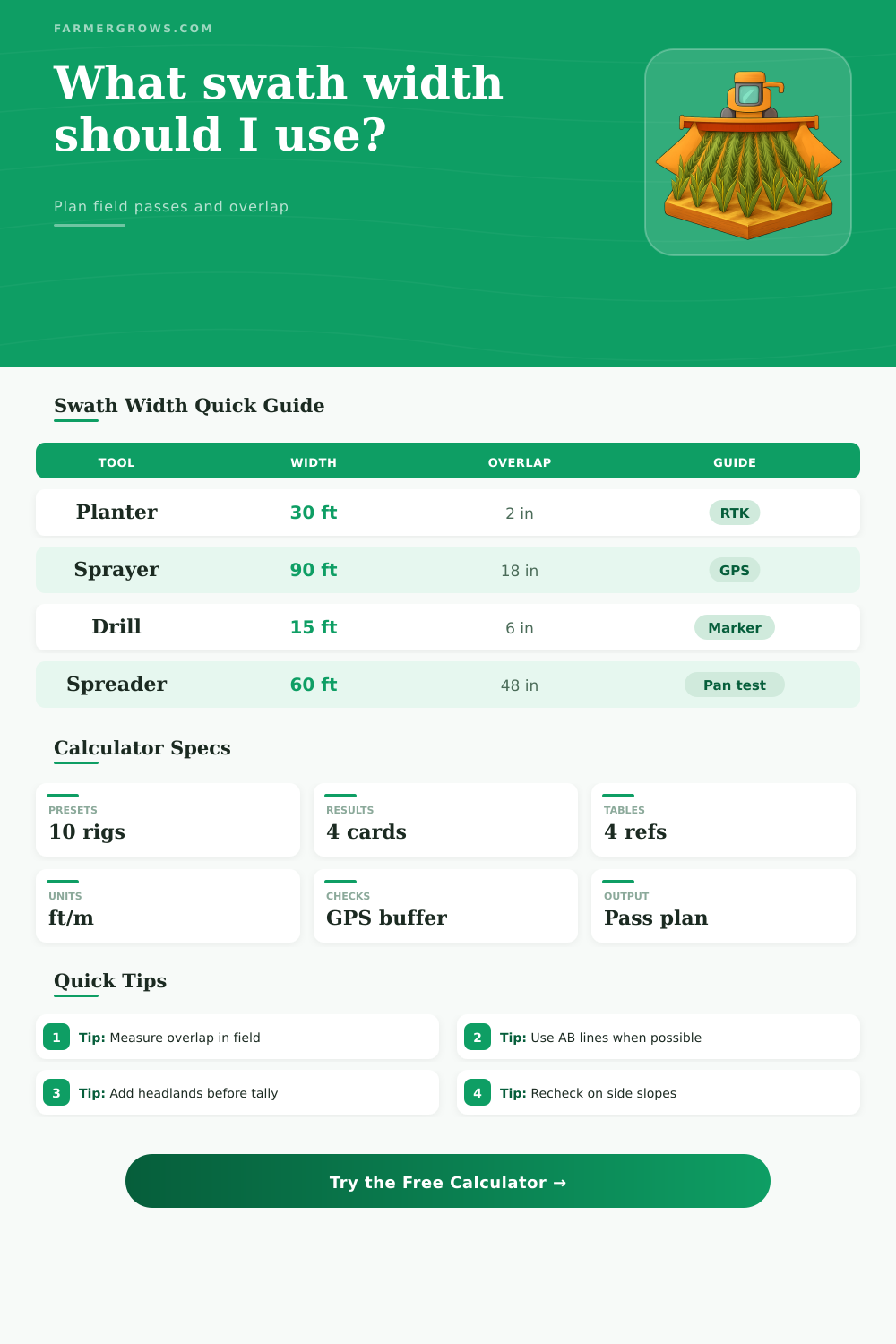
Swath Width Calculator
Plan effective implement width from nominal width, planned overlap, GPS accuracy, row spacing, pass count, field width, turn allowance, and slope or contour correction.
Use this planner before spraying, seeding, spreading, mowing, cultivating, or laying out parallel passes. The output is a field-planning estimate; set final overlap from product labels, nozzle pattern tests, seed meter checks, and actual guidance performance.
Effective swath should snap to full row multiples so the pass matches seed, fertilizer, or cultivation rows.
Use boom width minus intentional overlap and guidance drift, then verify spray pattern and shutoffs.
The tray or pan test matters because the practical swath can be narrower than the advertised throw.
Visible cut or marker lines can run tighter overlap, but slope and contour work still need a buffer.
Swath Plan Results
Adjust overlap, GPS allowance, or row spacing until the pass plan matches the field.
| Implement | Common nominal width | Typical overlap | Planning note |
|---|---|---|---|
| Row-crop planter | 6 to 24 rows | 0 to 4 in | Snap swath to row spacing and verify marker or guidance offsets. |
| Boom sprayer | 45 to 120 ft | 6 to 24 in | Use nozzle pattern, boom height, section control, and guidance drift. |
| Grain drill | 10 to 45 ft | 3 to 12 in | Overlap enough to avoid skips at openers and field edges. |
| Spinner spreader | 30 to 80 ft | 24 to 72 in | Use a tray test because the outside pattern usually tapers. |
| Mower conditioner | 9 to 30 ft | 2 to 12 in | Visible cut lines allow tighter overlap than fertilizer or spray. |
| Guidance level | Pass-to-pass allowance | Suggested overlap | Best use |
|---|---|---|---|
| Manual foam or marker | 6 to 18 in | 12 to 36 in | Small sprayers, drills, mowing, or occasional work. |
| WAAS GPS | 4 to 12 in | 8 to 24 in | Broadacre spraying where slight overlap is acceptable. |
| Subscription correction | 2 to 6 in | 4 to 12 in | Planting, spraying, and fertilizer passes with repeatable AB lines. |
| RTK steering | 1 to 2 in | 1 to 6 in | Row crop planting, strip till, cultivation, and controlled traffic. |
| Row spacing | Rows in 15 ft | Rows in 30 ft | Common use |
|---|---|---|---|
| 7.5 in | 24 rows | 48 rows | Small grain drills and cover crops. |
| 15 in | 12 rows | 24 rows | Soybeans, cereals, and narrow-row crops. |
| 20 in | 9 rows | 18 rows | Narrow corn, beans, and specialty crops. |
| 30 in | 6 rows | 12 rows | Corn, cotton, vegetables, and row-crop equipment. |
| 40 in | 4 rows | 9 rows | Cotton, peanuts, and some bedded systems. |
| Usable field width | 15 ft swath | 30 ft swath | 60 ft swath |
|---|---|---|---|
| 120 ft | 8 passes | 4 passes | 2 passes |
| 180 ft | 12 passes | 6 passes | 3 passes |
| 300 ft | 20 passes | 10 passes | 5 passes |
| 660 ft | 44 passes | 22 passes | 11 passes |
| 1320 ft | 88 passes | 44 passes | 22 passes |
Tip: For sprayers and spreaders, set overlap from a pattern check rather than from the advertised implement width alone.
Tip: On row-crop passes, make the effective swath a whole-row multiple so the next operation lines up with the planted rows.
Choosing a swath widths can impact how a person manage that season. If the swath is too narrow, then a person will waste fuel and time due to extra passes. If the swath is too wide, then a person will either leave some strips behind or create to much overlap in those rows which cost money and cause additional problems during that season with row alignment.
Many people finds it difficult to properly calculate the swath width due to the various inputs for that calculation including the machine, guidance, field and weather. A dedicated farmer can utilize a dedicated planter to account for all these variables in one location. The swath width that is entered into the planter is the working width.
How to Choose the Right Swath Width
The working width isnt the same as the folded or transport width of the planter. For a planter, the toolbar can easy determined the working width. For spray applications using a sprayer or spinner spreader, it is more difficult to determine this value.
The nominal swath width is entered into the calculator along with the overlap and guidance allowance. The result of this calculation will produce an effective swath that reflect the swath width of the machine under the current operation conditions. This calculation prevents a farmer from assuming that the machine will travel at the same rate as the swath width listed for that manufacturer machine.
The overlap between each pass is created for a few different reason. First, because the nozzles do not typically extend to the edge of the spray pattern. Second, to account for drifting in the spray pattern due to variable slope of the field.
Third, to account for the fact that spray patterns is rarely perfect. Finally, the allowance for GPS accuracy is necessary. This GPS allowance is not the same as the safety margin for overlap between passes.
For WAAS systems on sprayers, the GPS allowance will be a small number. For manual steering using foam markers, the GPS allowance will be a larger number. Row spacing is another consideration for planning the season for that farm.
The next operation must line up with the rows that the planter planted. A planter and strip till rig will have specific multiple of row spacing that the effective swath must land upon. If it does not land on those multiples, then the following operation will not line up with the crop rows.
The row spacing is programmed into the planter and will account for row spacing automatic. The row calculations will make adjustments to ensure that the swath lands on the proper row multiples even if the field is sloped. The third factor to consider is the slope or the contour of the field.
People often easy overlooked this factor as this factor is not directly observed on the machine itself. For rolling fields, the ground distance is greater than distance on the map. The projected swath width times the contour factor will calculate the actual field distance that the machine will traveled.
A gentle slope may only add three percent to the projected distance yet steep slopes may add ten percent or more. Field width and turn allowance will impact how wide the swath of work can be. The field width can be determined by the area to be treated minus headlands, ditches and any other area that cannot be treated in straight passes.
The planner can determine this value by subtracting twice the turna llowance from the total field width. The result is the distance that will be traveled in straight passes with the machine. Any deviation between the planned distance and the distance that is actualy traveled will be flagged by the planter software to allow the farmer to make any adjustments prior to entering the field.
Tables is provided within the planter software that indicate the overlap for various types of equipment. For instance, a spinner sprayer will require a wider overlap than a mower due to the fading spray pattern of a spinner. Boom sprayers with section control will have a different overlap requirement than those that do not have such control.
These are only starting points, not rules for planning a crop. Some of the most common mistakes made by farmers include using the wrong inputs into the planter. One of the most common is entering the transport width instead of the working width of the machine.
Another mistake is treating the overlap and GPS allowance as separate factor when they should of been added together. Finally, the third most common mistake is the ignoring of the contour of the field altogether. Each of these mistakes will produce an incorrect effective swath width.
Using the planter with the correct variables will help to reveal these mistakes prior to beginning work in the field. The output of the planter will provide a planning estimate for swath width calculations. However, the output is not a final prescription for swath width.
The user must still verify the prescription by checking the spray pattern and the seed meter. The value of the swath calculation will provide a starting point for planning for the season rather than making adjustments after each tank of fuel. By understanding the various variables that can impact the outcome of the swath calculation, a farmer can make an informed decision for swath width which will allow that season to proceed without issues.