Combine Grain Loss Calculator
Estimate harvest loss from field seed counts, sample area, crop conversion factors, header width, machine speed, separator setting, and your acceptable bu/ac target.
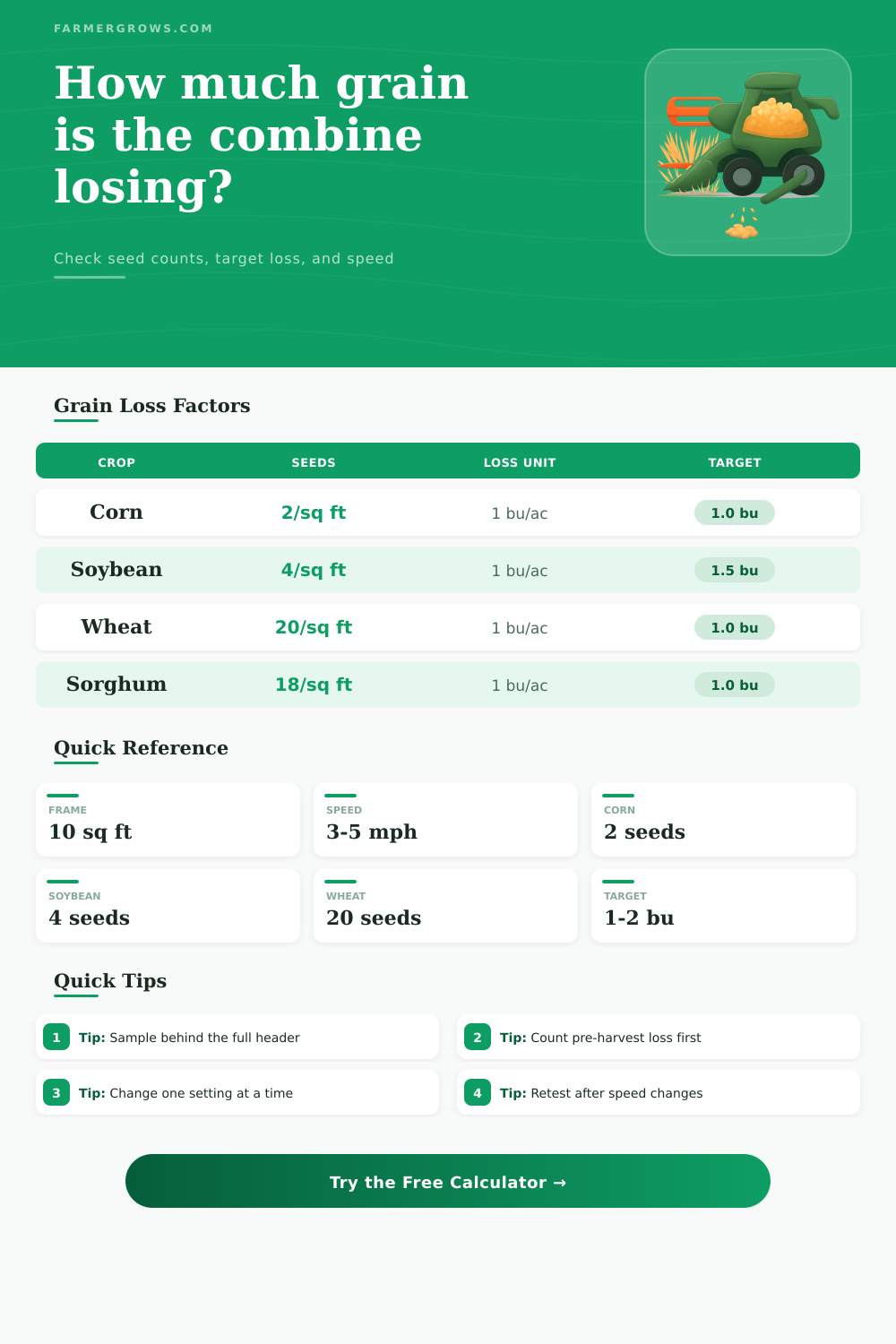
Choose a preset or enter your own counts from a frame placed behind the combine. For the cleanest check, count pre-harvest field loss separately, then count losses behind the machine across the full cut width.
Combine loss estimate
Corn estimate using the selected sample count and combine setup.
| Crop | Approx seed count equal to 1 bu/ac loss | Standard bushel weight | Practical note |
|---|---|---|---|
| Corn | 2 kernels per sq ft | 56 lb/bu | Large kernels make small count differences meaningful. |
| Soybean | 4 beans per sq ft | 60 lb/bu | Check header shatter, loose beans, and uncut pods separately. |
| Wheat | 20 kernels per sq ft | 60 lb/bu | Use several frame drops because kernels are small and uneven. |
| Barley | 24 kernels per sq ft | 48 lb/bu | Light grain and straw load can change shoe loss quickly. |
| Sorghum | 18 seeds per sq ft | 56 lb/bu | Late-day moisture swings often show up as threshing loss. |
| Oats | 32 kernels per sq ft | 32 lb/bu | Low bushel weight makes volume loss look different than mass loss. |
| Rice | 20 grains per sq ft | 45 lb/bu | Use local mill or extension factors when marketing by hundredweight. |
| Canola | 120 seeds per sq ft | 50 lb/bu | Tiny seed requires a clean mat and repeated samples. |
| Sample step | Where to measure | What to count | Why it matters |
|---|---|---|---|
| Pre-harvest loss | Standing crop before the combine enters | Loose grain already on the soil | Keeps storm, lodging, or shatter loss out of machine loss. |
| Header loss | Area between standing crop and combine residue | Shattered seeds, missed heads, dropped ears, or cut pods | Points toward reel, deck plate, sickle, draper, or header speed changes. |
| Separator loss | Behind the combine after straw and chaff discharge | Free kernels plus grain in heads or pods | Points toward rotor, cylinder, concave, fan, sieve, and shoe load changes. |
| Full machine loss | Multiple drops across the full harvested swath | All machine-related grain after subtracting field loss | Best value for comparing against the acceptable target. |
| Result versus target | Status | First check | Next action |
|---|---|---|---|
| 0% to 75% of target | Comfortable | Confirm sample is representative | Keep harvesting and retest when crop or speed changes. |
| 75% to 100% of target | Close | Watch slope, moisture, and green material | Try a second sample before changing settings. |
| 100% to 150% of target | High | Separate header loss from separator loss | Change one setting, harvest a short pass, and resample. |
| More than 150% of target | Critical | Check overload, concave, fan, sieve, and travel speed | Slow down or reset before running many more acres. |
| Header width | 3 mph | 4 mph | 5 mph | Use case |
|---|---|---|---|---|
| 20 ft | 7.3 ac/hr | 9.7 ac/hr | 12.1 ac/hr | Small grain platform or compact corn head. |
| 30 ft | 10.9 ac/hr | 14.5 ac/hr | 18.2 ac/hr | Common grain platform or medium corn setup. |
| 40 ft | 14.5 ac/hr | 19.4 ac/hr | 24.2 ac/hr | Wide platform where shoe load can rise quickly. |
| 45 ft | 16.4 ac/hr | 21.8 ac/hr | 27.3 ac/hr | Large platform or draper that needs frequent loss checks. |
Throw the frame after the machine is fully loaded, avoid headland turns, and repeat in light, average, and heavy crop zones.
Speed, rotor or cylinder speed, concave clearance, fan, and sieve changes interact. Make one change, harvest a short pass, then count again.
This calculator uses common field-check conversion factors. Local seed size, crop moisture, bushel weight, and extension guidance can refine the result for your region.
Harvest checks are performed to determine if a combine is losing grain. Grain can be lost into the straw through the combine or grain can be left on the ground as the combine pass over the fields. Harvest checks are performed to determine how much grain is being lost during the harvest process.
If the amount of grain lost during the harvest is too great, it indicates that the combine is not earning its keep. Many combine operators are knowledgeable of the basic method for perform a loss check. Loss checks involve dropping a frame behind the combine and counting the number of kernels or beans within the frame.
How to Check Grain Loss from a Combine
The operator compares the count of kernels within the frame to a target number. However, the crops will vary in their requirements and methods for loss checks. For example, corn kernels are relatively large and easy to count.
However, wheat kernels are small and often hidden within the chaff that the combine produces. Thus, the operator often takes several samples of wheat from different areas within the combine and the average of those samples are used for determining the grain loss rate. The total number of grain loss units that are counted behind the combine can include several different components of grain loss.
For example, the total loss can include the grain loss that occurs during the header stage of the combine, the loss that occurs within the separator stage of the combine, and any grain that may have been lost prior to the combine enter the field to be harvested. The grain that is present on the ground can be counted prior to the combine entering the field. By counting that grain prior to entering the field, the amount of grain lost that is never touched by the combine can be subtracted from the total loss measurement behind the combine.
Any grain that is lost during the header stage of the combine occurs between the standing crop and the first row of residue that the combine encounters. Grain loss during the separator stage can be found within the chaff and the straw that is passed behind the combine. Both of these areas must be inspected to separate the loss during each of these separate stages of the combine.
Another variable that may change quickly that can contribute to the loss of grain is the speed of the combine. The speed of the combine can be easily overlooked yet has a great deal of impact upon the rate of grain loss. For instance, increasing the speed of the combine by as little as half a mile per hour can cause the shoe or the rotor of the combine to move past the point at which the combine effectively cleans the corn from the cob.
Thus, the speed at which the combine moves through the field can have an impact upon the number of acres per hour that the combine can harvest and the loss of grain that can occur during that process. For this reason, the calculator that is described in this document includes a field for determining the speed of the combine. If the number of grain losses increases after changing the speed at which the combine operates, it is possible that either the combine is overloaded or that one of the settings of the combine need to be changed.
By changing only one variable at a time and re-performing the loss check after each change, the combine operator can isolate each potential cause for the loss and remedy each issue. The settings of the combine can also have an impact upon the loss of grain. For instance, adjusting the concave to a gentle angle and adjusting the rotor to an open setting will allow for the grain quality to be preserved during the harvesting process.
However, these same settings may result in the loss of any kernels that were attached to the heads of the corn plants. Similarly, adjusting the concave to a tighter setting and increasing the speed of the rotor will increase the ability of the combine to effectively clean the corn that passes through the combine. However, excessive cleaning of the corn may result in the kernels becoming cracked and the shoe becoming overloaded with the corn that the combine processes.
If the result of the loss check returns a number that is below the target number for the combine, the settings of the combine are likely adequate. However, if the number of kernels lost during the harvest is above the target number for the combine, it is possible to determine the cause of the increased loss of grain. Another method of evaluating the loss of grain by the combine is to measure the percentage of the total yield that is lost.
For instance, losing one bushel of grain in a field that yields 40 bushels of grain is different than losing one bushel of grain in a field that yields 180 bushels of grain of corn. The calculator that is described in this document will calculate both the bushel-per-acre rate of yield of the fields that are to be harvested by the combine as well as the percentage of the total yield that is lost during the harvesting process. Percentages of yield lost in fields with high yields of corn or wheat can result in significant loss of earnings for the farm.
Thus, high percentages of loss may be unacceptable in high-yield fields. Another factor that may impact the loss check is the size of the seed that is grown in the field. For instance, the number of corn kernels that are grown in the field can have an impact upon the number of units of loss that are measured behind the combine.
Thus, the divisor that is used to calculate the total loss of grain behind the combine will also impact the loss check results. For instance, fields that contain canola or other small-seeded crops will require more samples of grain to be taken behind the combine. In addition, different mats may be required to be used behind the combine to ensure that small seeds are not easily hidden within the harvested residue.
Field capacity is determined by the speed of the combine and the width of the header of the combine. These two factors will determine the number of acres that can be harvested each hour by the combine. For instance, it is possible to calculate the theoretical number of acres per hour that can be harvested by the combine.
However, the actual number of acres per hour that can be harvested will factor in the number of turns and stops that the combine will have to make within the field. Thus, a figure of 75-percent field efficiency is used in the calculator in the field for estimating the percentage of grain loss. It is necessary for those performing loss checks to be consistent in the location at which the samples are taken and the time at which the samples are taken.
For instance, the sampling frame can be thrown only after the combine is fully loaded with corn. The combine should avoid the headlands of the field where the combine is turning. Instead, the frame should be thrown in areas of the field that are light in area, average in area, and heavy in area to account for the entire field.
The goal of performing a loss check is not to attempt to lower the total loss of grain to zero. Instead, the goal is to ensure that the result of the loss check falls within the target for the type of crop and field that is being harvested. To accomplish this goal, the operator can isolate the cause of the loss of grain and only one variable can be adjusted.
By performing this procedure of isolating the cause of the loss of grain and adjusting only one variable at a time, the combine operator can ensure that the grain is kept within the combine and not lost to the ground.