Body Condition Score Calculator
Estimate score gap, target weight change, daily energy allowance, and feed adjustment for cattle, horses, sheep, goats, dogs, and cats using species-specific BCS scales.
Choose a realistic starting point, then edit the current score, target score, weight, life stage, energy density, days, and maintenance factor for the animal in front of you.
Body Condition Plan
Enter an animal profile and calculate the target score plan.
Target BCS - current BCS, adjusted by selected goal.Body weight x species % per BCS point x score gap.Species kcal x kg^0.75 x life stage x reproduction x activity.Daily Mcal target / feed Mcal per lb as fed.| Species | BCS scale | Common target | Approx. body weight per point | Useful scoring area |
|---|---|---|---|---|
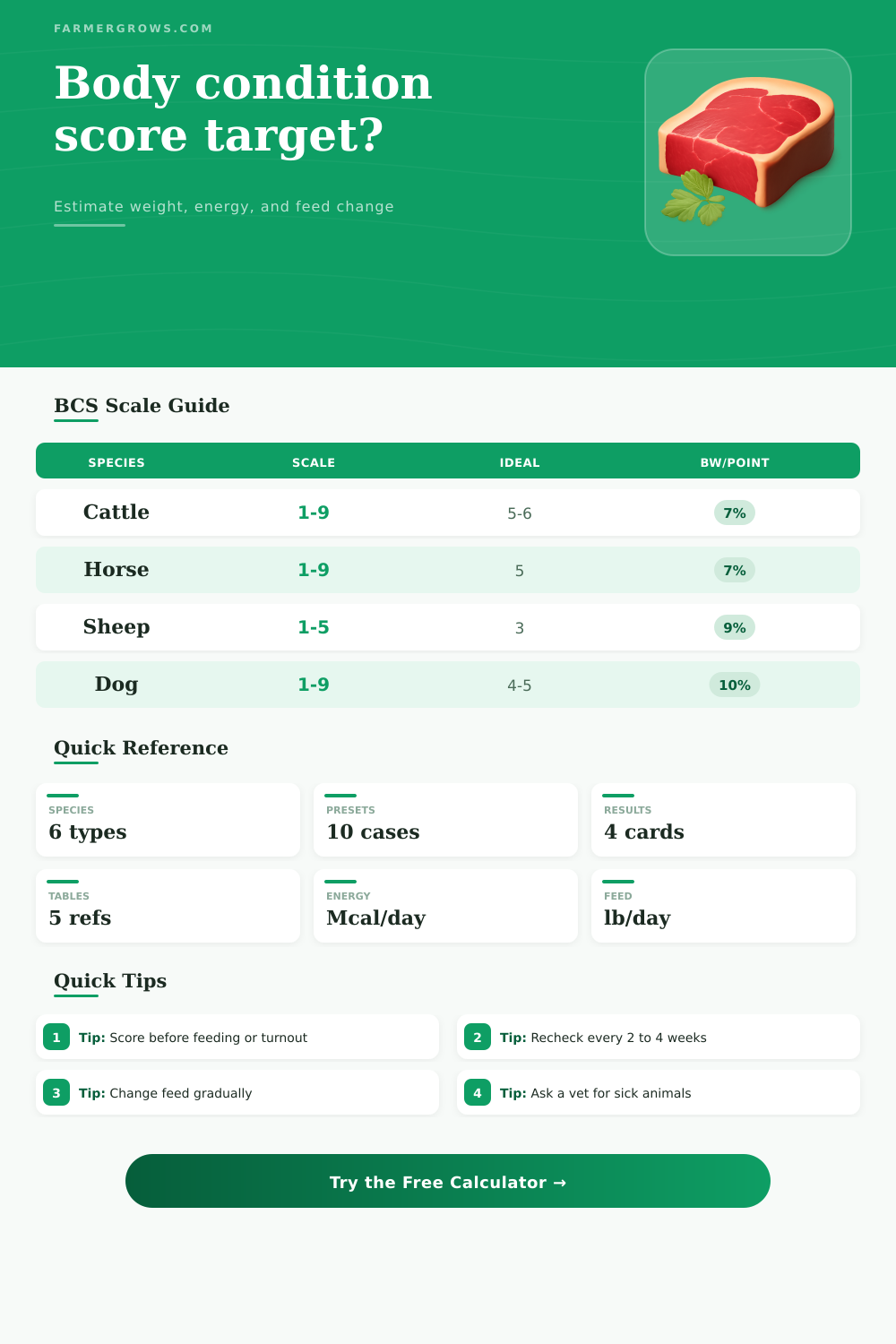
| Cattle | 1 emaciated to 9 obese | 5 to 6 for mature cows before breeding | About 7% of body weight per point | Ribs, spine, hooks, pins, tailhead, brisket |
| Horse | 1 poor to 9 extremely fat | 5 for most mature horses | About 7% of body weight per point | Neck, withers, ribs, loin, tailhead, shoulder |
| Sheep | 1 very thin to 5 very fat | 3 around breeding and lambing for many flocks | About 9% of body weight per point | Backbone and short ribs felt through fleece |
| Goat | 1 very thin to 5 very fat | 2.5 to 3.5 for many does | About 9% of body weight per point | Loin, ribs, sternum, tailhead, pins |
| Dog | 1 very thin to 9 obese | 4 to 5 for most adult dogs | About 10% of body weight per point | Ribs, waist, abdominal tuck, lumbar fat |
| Cat | 1 very thin to 9 obese | 4 to 5 for most adult cats | About 10% of body weight per point | Ribs, waist, abdominal pad, spine cover |
| Animal type | Conservative gain pace | Conservative loss pace | Reason to slow down | Review interval |
|---|---|---|---|---|
| Mature cattle | 0.4% to 0.8% of body weight weekly | 0.3% to 0.6% weekly | Late pregnancy, harsh weather, poor forage | Every 30 days |
| Horses | 0.3% to 0.6% weekly | 0.25% to 0.5% weekly | Metabolic history, laminitis risk, poor teeth | Every 2 to 4 weeks |
| Sheep and goats | 0.5% to 1.0% weekly | 0.4% to 0.8% weekly | Late gestation, parasite pressure, lactation | Every 2 to 3 weeks |
| Dogs | 0.5% to 1.0% weekly | 0.5% to 1.5% weekly | Senior pets, orthopedic issues, endocrine disease | Every 2 weeks |
| Cats | 0.5% to 1.0% weekly | 0.5% to 1.0% weekly | Rapid loss can be dangerous; use veterinary oversight | Every 2 weeks |
| Feed or ration | Typical Mcal/lb as fed | Best use in this calculator | Adjustment note |
|---|---|---|---|
| Average grass hay | 0.75 to 0.95 | Cattle, horses, sheep, goats | Use forage test values when available. |
| Legume or good mixed hay | 0.90 to 1.10 | Higher quality forage plans | Protein and minerals may change with maturity. |
| Grain or concentrate mix | 1.25 to 1.65 | Adding condition to livestock | Introduce slowly to protect digestive health. |
| Dry dog food | 1.45 to 1.90 | Dog maintenance or weight plans | Check the kcal per cup and convert to Mcal/lb if known. |
| Dry cat food | 1.55 to 2.05 | Cat maintenance or weight plans | Small weighing errors matter for cats. |
| Input choice | Multiplier used | When to use it | Watch point |
|---|---|---|---|
| Mature adult | 1.00 | Average mature animal at normal upkeep | Adjust activity if weather or workload changes. |
| Growing | 1.18 | Young stock, adolescent pets, or frame growth | Growth needs protein and minerals, not energy alone. |
| Senior | 0.93 | Easy keepers or lower activity older animals | Dental disease can reverse this assumption. |
| Working | 1.15 | Ranch dogs, ridden horses, travel, or rough pasture | Hard work may need more than this base factor. |
| Late pregnancy | +0.18 | Final gestation stage for most species | Avoid crash diets during late pregnancy. |
| Heavy lactation | +0.65 | Peak milk output or nursing litter | Energy, water, protein, and minerals all rise. |
| Score band | Livestock feel | Dog or cat appearance | Common next step |
|---|---|---|---|
| Very thin | Sharp spine or ribs, little padding, weak muscle fill | Ribs, spine, and pelvis obvious with minimal fat | Check health, teeth, parasites, pain, and diet access. |
| Lean | Ribs easily felt, hooks or short ribs still prominent | Ribs easy to see or feel with a strong waist | Add energy gradually while monitoring manure and appetite. |
| Ideal | Ribs felt with light pressure, smooth muscle cover | Ribs felt under light fat cover, waist visible | Hold intake and recheck after weather or work changes. |
| Fleshy | Ribs hard to feel, fat around tailhead, brisket, or loin | Waist reduced, abdominal pad or lumbar fat increasing | Reduce energy density and increase safe activity. |
| Obese | Heavy fat deposits, movement or heat tolerance affected | No waist, ribs difficult to feel, heavy fat cover | Use a supervised reduction plan and regular weigh-ins. |
Use the same handler, lighting, posture, and scoring points when possible. Livestock should be checked by feel, especially sheep and goats with fleece or heavy hair.
This estimate focuses on condition and calories. Protein, minerals, fiber, water, disease status, teeth, parasites, and veterinary guidance still decide whether the plan will work.
This calculator is a planning estimate. For pregnant animals, lactating animals, cats on weight-loss plans, sick animals, or animals with metabolic disease, confirm the target and rate with a veterinarian or nutrition professional.
Body condition scoring works because body condition scoring transforms that visual and tactile assessment into an tool that a person can use for planning. When a person look at an animal and performs the body scan for ribs, spine, or fat deposits, a person can calculate the animals body condition score. This score indicates to the individual if the animal has enough fat reserve to last through the upcoming season.
For example, while the difference between a body condition score of four and five may seem small, a body condition score of four and five for some animals indicate whether the animal will have enough fat reserves to weather the winter months ahead. Each of the inputs into a body condition calculator allow the individual to determine the different variables regarding the animals weight. The species of the animal is one of these variable because each species of animal stores fat in different locations and at different rates.
How to Use Body Condition Scores to Plan Animal Care
For instance, cattle and horses is scored on a nine-point scale; sheep and goats on a five-point scale due to their body shape and coats; and dogs and cats on a nine-point scale with different ideal body condition scores due to the small body frame of these species. Additionally, another variable is the weight change goal for the animal. For example, if an animal is to gain a certain number of pounds, the individual can calculate the total number of pounds that must be gained.
The timeline will determine on how many day the animal should gain those pounds. The life stage and reproductive status of the animal are variables that effect the animals energy need before applying any desired change in body condition score. For example, growing animals require more body fuel than animals of the same age and species that are not growing in size.
Yet, the energy needs of animals that are aging are less than young animals of the same species due to the differences in activity of those animals. Similarly, the bodys energy needs increase during both late pregnancy and lactation due to the fetus and milk production requirement of the animal. The energy targets that can be established for an animal will influence the amount of feed that will be required for that animal.
For instance, there are different amount of calories contained within different types of hay, grain, and commercial diets. Thus, different amounts of feed will be required to achieve the target amount of calories. Yet, another output of the body condition calculator will be the difference between the animals current body condition score and its target score.
Additionally, the calculator will also display the calculated weight change for the animal to the individual. Thus, the weight change can be translated into the amount of pounds of feed that will be required daily to achieve the target body condition score. Despite the thoroughness of the calculator, there are still a number of variables regarding real animals that the calculator does not account for.
For instance, body condition score do not account for the presence of intestinal parasites, the dental condition of the animal, the rank of the animal within the group, or the change in weather. For example, an animal with poor dental condition may not consume enough of the calculated amount of feed. While body condition scoring can be used to create a plan for an animal to gain body condition, it is also essential to use the same scoring system to prevent the development of the opposite problem.
For instance, animals with too much body condition can develop fertility problems (in farm animals) or joint problems (in dogs and cats). Additionally, the body condition calculator scores the animal for body condition loss just as easy as it scores the animal for weight gain. Yet, the body condition loss score for animals like cats may result in health problems like hepatic lipidosis.
Thus, body condition loss plans for animals should be slower in rate then body condition gain plans. It is important that the individual performs the body condition scoring system in the same way each time. For instance, the same individual should examine each animal during body condition scoring.
Additionally, the same body landmarks and pressures should be used each time. Variables like lighting and the posture of the animal can impact the body score. Additionally, the body condition score may be altered if the animal has just been fed or exercised.
Yet, keeping notes on the body condition score, date, conditions, and observations regarding the animal will allow the individual to account for these variables. Despite the fact that a body condition calculator can account for the various variables of an animals body condition, the calculator is still not a means of replacing the care and feeding of an animal by an individual. For instance, an individual will still need to monitor the animals body condition, and will still need to adjust the care for that animal based on the body condition score and any health complications that emerge with the animal.
Yet, by using this calculator, the user will eliminate the guesswork in setting the body condition score for an animal.