Stocking Density Calculator
Estimate safe farm stocking from usable floor area, air volume, species class, live weight, welfare allowance, ventilation, service space, and growth buffer.
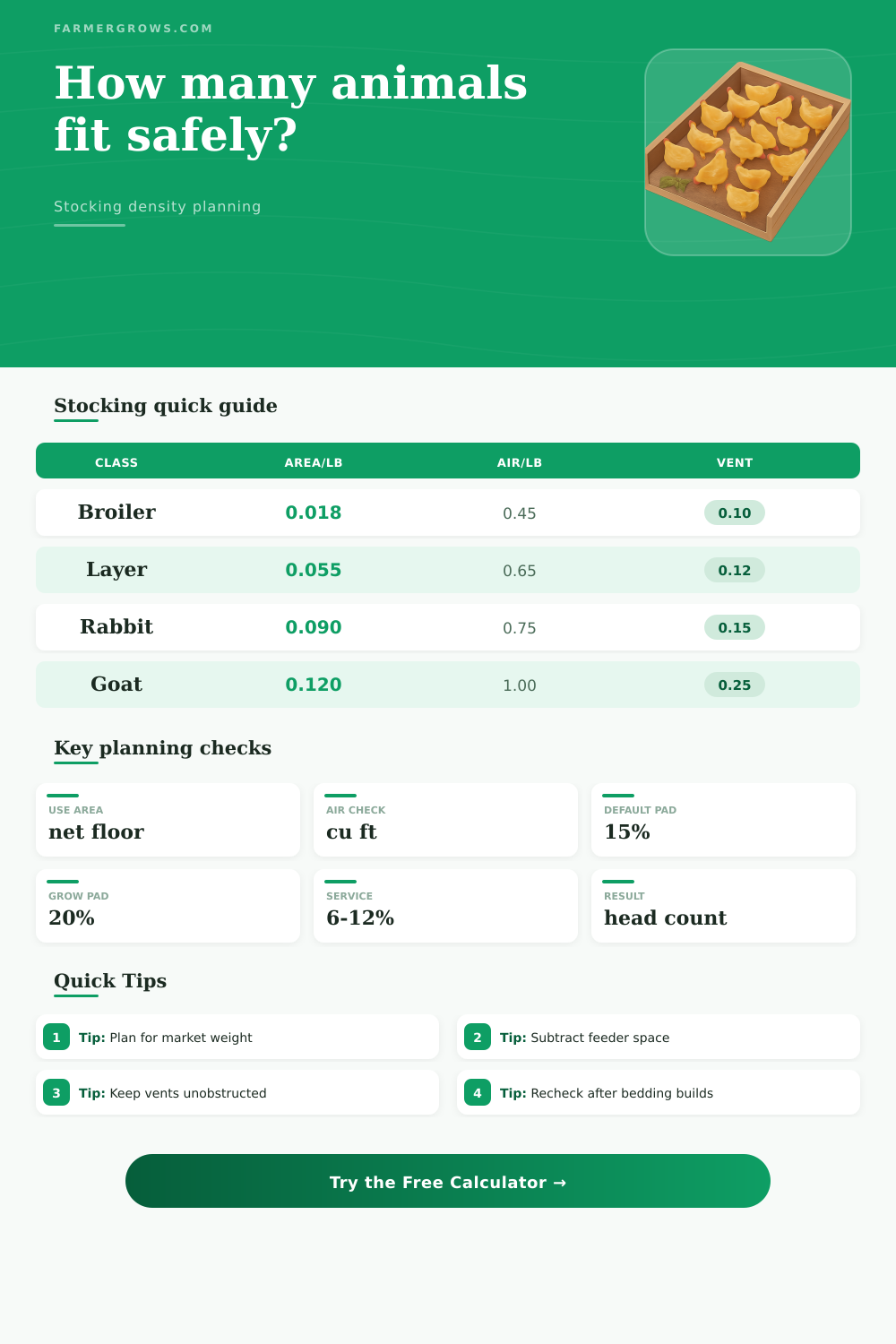
| Species class | Base floor factor | Air volume factor | Ventilation baseline |
|---|---|---|---|
| Broiler chickens | 0.018 sq ft per lb | 0.45 cu ft per lb | 0.10 cfm per lb |
| Laying hens | 0.055 sq ft per lb | 0.65 cu ft per lb | 0.12 cfm per lb |
| Ducks | 0.070 sq ft per lb | 0.85 cu ft per lb | 0.16 cfm per lb |
| Turkeys | 0.040 sq ft per lb | 0.70 cu ft per lb | 0.14 cfm per lb |
| Rabbits | 0.090 sq ft per lb | 0.75 cu ft per lb | 0.15 cfm per lb |
| Goats | 0.120 sq ft per lb | 1.00 cu ft per lb | 0.25 cfm per lb |
| Sheep | 0.100 sq ft per lb | 0.90 cu ft per lb | 0.22 cfm per lb |
| Calves | 0.105 sq ft per lb | 1.10 cu ft per lb | 0.25 cfm per lb |
| Grower pigs | 0.085 sq ft per lb | 0.80 cu ft per lb | 0.20 cfm per lb |
| Group | Common weight input | Best use | Planning note |
|---|---|---|---|
| Broilers | 4 to 7 lb | Grow-out house | Use finish weight when birds leave the pen. |
| Layers | 4 to 6 lb | Coop or colony | Allow extra room around nests, perches, and feeders. |
| Ducks | 6 to 10 lb | Bedpack pen | Moist bedding needs more air and service space. |
| Turkeys | 15 to 35 lb | Grower shelter | Large birds need generous turning and heat relief space. |
| Rabbits | 4 to 10 lb | Colony or grow-out | Separate breeding does, kits, and market groups as needed. |
| Goats | 60 to 140 lb | Night shelter | Yard access can reduce indoor crowding pressure. |
| Sheep | 80 to 180 lb | Lambing or holding pen | Wool, bedding, and wet weather increase space needs. |
| Calves | 120 to 350 lb | Group pen | Plan for growth and dry resting area. |
| Grower pigs | 40 to 250 lb | Indoor bay | Use final sale weight for capacity checks. |
| Allowance | Typical range | What it covers | When to increase |
|---|---|---|---|
| Welfare allowance | 10% to 30% | Movement, bedding, flock behavior, inspection margin | Longer housing periods or valuable breeding stock |
| Growth buffer | 10% to 35% | Weight gain before sale, weaning, or turnout | Young animals entering a fixed pen |
| Service area | 5% to 18% | Drinkers, feeders, gates, alleys, and wall clearances | Many troughs or awkward pen shapes |
| Ventilation reserve | 10% to 40% | Heat, moisture, dust, manure gases, litter drying | Hot weather, deep bedding, or enclosed housing |
| Mixed group margin | 10% to 25% | Uneven size, dominance pressure, sorting space | Mixed ages or mixed sexes in one space |
| Check | Calculator output | Why it matters | Field adjustment |
|---|---|---|---|
| Minimum fresh air | cfm estimate | Controls moisture and air quality | Raise reserve in hot or humid seasons |
| Air volume | cu ft available | Shows how quickly air quality can change | Use clear height, not storage loft space |
| Service footprint | sq ft removed | Drinkers and feeders reduce resting floor | Keep paths open and avoid corner crowding |
| Water frontage | factor percentage | Accounts for extra space around drinking points | Add more if animals queue or spill bedding |
| Current load | lb per sq ft | Compares group pressure against usable floor | Reduce head count if bedding stays wet |
Stocking density are a measurement of the number of animal in a specific amount of space within the pen. The stocking density of a pen can impact the grow of the animals within the pen as well as the quality of an air in the pen. If the stocking density is too highly for the pen, the animals will be crowded and the quality of the air within the pen will decrease.
If the stocking density is too low for the pen, the individual will waste some of the usable areas of the pen. Therefore, the stocking density have to be calculated correctly for the animals to gain the expected amount of weight and for the ventilation system to be able to handle the amount of air that the animal require. To calculate the stocking density for the pen, you has to measure the total floor area of the pen.
How to Calculate Stocking Density for Animal Pens
The area that the equipment within the pen uses must be subtracted from the total area. The area that is use by the feeders has to be subtracted. Additionally, the area that is used by the water line and walkways has to be subtracted.
The area that is left after these subtraction is the total usable area of the pen. The usable area divided by the number of animals that will live in the pen is the stocking density in terms of floor area. The area that each animal need can be calculated based off the expected weight of the animals.
Additionally, different species require different amount of space. For instance, broilers will have a higher stocking density than animals like goats because broilers will use the pen in different ways then goats do. Goats require more space to lie down and move around in the pen than broilers do.
Beyond the stocking density for the floor area of the pen, stocking density also relate to the volume of air within the pen. The height of the ceiling of the pen impact the stocking density of the pen. Pens with lower ceilings and deeper bedding will have a decrease in air quality more quick than pens with higher ceilings.
Additionally, stocking density must also take into account the weight of the animals in the pen. The stocking density may be low for young animals when the pen is first construct, but the stocking density will increase as the animals gain the weight that they require to be market animal. Therefore, a growth buffer has to be calculated into the stocking density calculation for the animals to have enough space when they reach market weight.
Finally, the ventilation system for the pen must be planned for stocking density. Ventilation reserve must be calculated for the ventilation system to handle changes in the environment within the pen. For example, if the temperature within the pen increase or the humidity within the pen increase, the animals will require more air.
Additionally, if the bedding becomes deep within the pen, the animals will require more air to maintain a healthy environment. A person who does not include a ventilation reserve in the stocking density calculation may find that the ventilation system does not supply enough air for the animals when the weather become hot. Thus, it is necessary to include a ventilation reserve in the stocking density calculation to ensure that the air within the pen remains clean and fresh, even with change in the weather.
Another factor to consider is the service area for the pen. The service area for the pen include the area that is taken up by the pen’s gates, feeders, and water lines, as well as the area that the animals use to access their feeders and water lines. If a person does not subtract the area that the service area takes up from the total area of the pen, the stocking density calculation will likely be too high.
For instance, a pen may have 800 sq. Feet of total area, but if the service area take up 12% of that total area, then the usable area for the animals is less than 800 sq. Feet.
The stocking density calculation should use this usable area to calculate the number of animal that will be used in the pen. The third factor to consider in stocking density calculation is the different needs of the different species of animals. For instance, rabbits require certain areas within their pens for escape and sorting from other rabbit, thus requiring a different type of stocking density calculation than other species.
Additionally, animals like pigs tend to produce more heat and moisture than species like turkeys, meaning that the stocking and ventilation density for pigs will be different from other species. Reference table can be used to determine the base coefficient for each of these species. Many people make mistake when calculating stocking density.
One of the most common mistake is using the total area of the pen to calculate stocking density, while failing to subtract the area that is taken up by storage corner within the pen. Another common mistake is calculating stocking density according to the starting weight of the animals, rather than the final weight of the animals when they will be fully grown. Finally, stocking density calculation often get incorrectly set to a ventilation system that does not account for the seasonal change within the area where the animals will live, or the depth of the bedding in the pen.
Stocking density calculation should be performed before the animals arrive in the pen. Performing stocking density calculation before the animals arrive allow for any potential problem in the pen to be fixed before the animals arrive and before the cost of fixing those problem increases. For instance, it is more cost effective to move a feeder or install a vent prior to the arrival of the animals, than after they have arrive in the pen.
Additionally, calculating stocking density for each pen allow for stocking density calculation to be performed and compared to the stocking density within each pen as the animals are residing within each pen. Finally, stocking density should be continually monitored after the animals have become established in the pen.