🐄 Livestock Judging Calculator
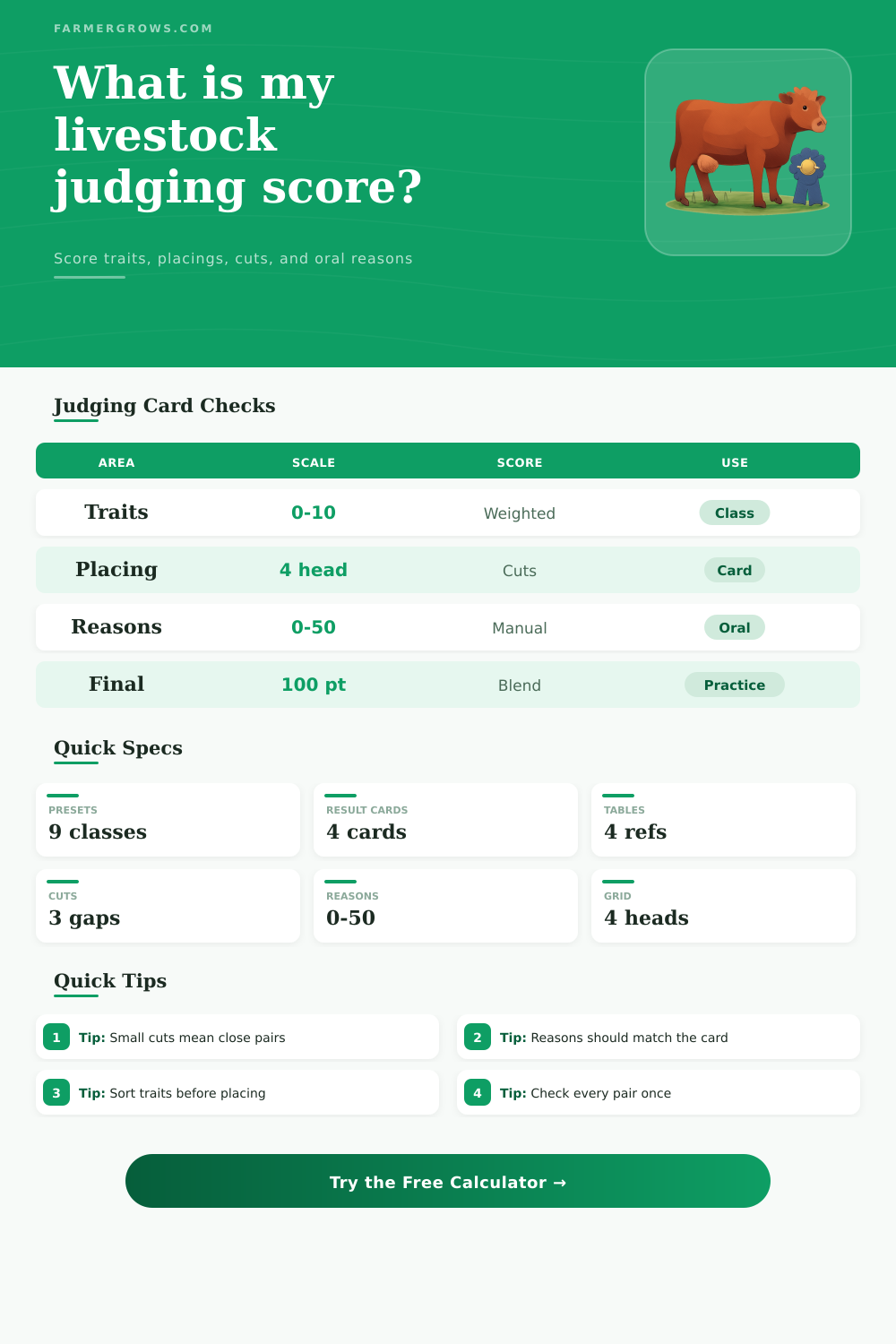
Score a livestock judging card with species and class priorities, four animal trait scores, oral reasons, official placings, and cut deductions for each pair.
Choose a realistic practice setup, then adjust the class, placings, cuts, animal scores, and oral reasons to match your judging card.
Judging Score Summary
Your score will appear here after calculation.
Score each animal from 0 to 10. The grid uses the selected species weights to build a calculated trait placing and compare it with the official placing.
This comparison grid updates after calculation and shows the animal total, grid rank, official rank, and the leading trait based on the selected class type.
| Trait | Market Beef | Breeding Beef | Market Hog | Horse Halter |
|---|---|---|---|---|
| Structure | 18% | 25% | 16% | 28% |
| Muscling | 24% | 16% | 28% | 8% |
| Balance | 18% | 18% | 16% | 26% |
| Finish | 16% | 8% | 18% | 8% |
| Capacity | 12% | 18% | 10% | 12% |
| Correctness | 12% | 15% | 12% | 18% |
| Cut Pattern | Class Read | Best Use | Scoring Note |
|---|---|---|---|
| 1-1-1 | Very close | Beginner drills | Small penalties; pair logic matters. |
| 2-3-4 | Normal spread | Most livestock cards | Bottom pair may carry more separation. |
| 4-2-1 | Top split | Dominant class winner | Protect the top pair first. |
| 1-5-2 | Middle break | Two-pair classes | Crossing the middle pair is costly. |
| Species/Class | Primary Priority | Secondary Priority | Common Watchout |
|---|---|---|---|
| Market steer | Muscle and finish | Balance | Overfinished cattle can lose trimness. |
| Breeding heifer | Structure | Capacity and correctness | Do not ignore maternal body dimension. |
| Market hog | Muscling | Finish and balance | Heavy muscled hogs still need soundness. |
| Dairy heifer | Frame and correctness | Capacity | Reward clean neck, openness, and feet. |
| Reasons Area | High Score Cue | Mid Score Cue | Low Score Cue |
|---|---|---|---|
| Accuracy | Matches official pairs | Some pair confusion | Claims fight the placing |
| Terminology | Specific livestock terms | Some generic words | Vague or repeated wording |
| Organization | Top, middle, bottom pairs | Uneven pair flow | No clear pair structure |
| Delivery | Confident and concise | Minor pauses | Long pauses or reading |
A small cut means the official pair is close, so focus your reasons on precise comparative terms instead of broad claims.
If your grid ranking disagrees with your placing, revisit the top-weighted traits for that species before practicing oral reasons.
This practice tool is for judging study and class analysis. Official contest scoring may use contest-specific rules, tie breakers, or reasons rubrics.
Livestock judging require you to explain why one animal is the better animal than the other animal, and then prove that to the other livestock judging competition observers through your score. While it is true that an experienced coach may walk through a livestock judging competition in ten minutes, it is difficult for the competitor to find the perfect placement for each of the livestock animals in the competition. Should an error occur with one of the pairs of livestock animals, it is possible for that competitor to drop out of the top ten placements for the competition.
Furthermore, because the difference between any two animal is usually small, a competitor must understand how to weigh each of the different categories of the animals, and be able to defend their placement of the middle pair of animals during their oral reason. For these reasons, using practice tools that allow for comparison between the placement of the animals and the official cuts for each category is important for those who wish to improve in the area of livestock judging. While competitors are to memorize the shapes of the ideal livestock animals, the difficulty in livestock judging is actualy found in the understanding of what each of the official cuts for each competition represent.
Improve Your Livestock Judging with a Calculator
For instance, a cut of two between the top pair of animals indicates that those two animals were nearly identical in their merit, while a cut of five in the top pair of animals may indicate that the top animal was significantly better than the second animal in that pair. By placing the animals in an online calculator to determine the cut for each of the pairs of animals, it is possible to recognize which of the placements are incorrect. These incorrect placements will be the same whether the animals are market steer or breeding ewes.
Another of the more difficult components of livestock judging is correctly scoring each of the animals. Many beginner to livestock judging tend to only consider a single trait of the animals that they personally enjoy the most. However, the beginners should weight each of the traits according to how livestock species reward those specific traits.
For instance, market hogs score higher in the muscling and finish of the animal, while dairy heifers score higher in the frame of the animals. Should the competitors correctly weight each of the traits of the animals (structure, muscling, balance, finish, capacity, and correctness), the calculated ranking of the animals may be different than the ranking based on the visual inspection of the animals. This difference in ranking between visual inspection and calculated ranking is the topic to be covered in the topic of oral reasons.
The connection between the trait grid and the official placing of the animals is a connection to pay attention to in the livestock judging competition. The two rankings will be the same or they will be different. Should they be different from one another, a competitor must decide whether their scoring of the animals was incorrect, or if they allowed one of the traits of the animal to become more important than the official placing of the competition.
The calculator will reveal this difference in ranking, allowing the competitor to make such a decision as to which placing they believe in before standing up to deliver their oral reasons. Another reason that official cuts are used is to teach competitors to use precise language when describing the animals in the competition. The official cuts between any two animals will be small, and this small cut will prevent the competitor from making broad statements about the animals.
For instance, if the cut between the top two animals is a cut of one, it would not be appropriate for a competitor to state that one of the animals is bigger than the other. A more precise statement would be required, and this is another reason why the cuts are used for livestock judging competitions. This skill is useful in all of the classes during the livestock judging competition.
Lastly, both placing scores and oral reasons scores will often reveal the same information. A high placing score does not ensure that an individual will score high in their oral reasons for the livestock competition, as well as an individual could have high oral reasons scores yet have a low placing score for the competition. For instance, an individual may have placed all of the animals in the competition correctly, yet when standing up to deliver oral reasons, struggle to describe each of the animals correctly.
Thus, all three of these categories should be treated as one process within the competition, not three separate contests to compete in. Similarly, another of the most common mistakes between competitors is to treat each of the classes in the same way. For instance, market classes require a focus on the product traits of the animals, while breeding classes place more importance on skeletal correctness and capacity of the animals.
Because skeletal correctness and capacity are relevant throughout the life of the animal, these traits are more important in the breeding classes. Within the preparation for the competition, each competitor should be familiar with the reference tables for market beef and dairy heifers to understand these differences, and to avoid applying the same importance to all of the livestock classes. Another of the mistakes that competitors may make is to ignore the impact that the placement of some of the pairs has on the remainder of the competition.
For instance, a small cut between the top two animals will result in a larger cut between the middle and bottom pairs of animals. Furthermore, reversing the top pair will cost more points than reversing a bottom pair of animals. These costs can be seen by each competitor when entering the competition, allowing each competitor to decide if they are confident in their placement of the animals to accept the cost of reversing the top pair.
One of the most important skills of a strong competitor in the livestock judging competition is the ability to check their placement of the animals against the official placing card. For many competitors, the lessons that will be learned from the classes in which they placed the animals correctly but earned less points for the placement is more valuable than the knowledge gained from any number of classes in which they placed each of the animals correctly. These small deductions from a competitor’s placing score reveal where their oral reasons were thin, and where they permitted one of the animal’s traits to become more important than the value of the rest of the animal.
Overall, time will reveal to each competitor an understanding of the process for livestock judging. For instance, each competitor will recognize other traits beyond the importance of muscling in animals with soundness. Each competitor will also be able to recognize that an animal’s muscle expression is only important if it also has soundness.
While the livestock judging calculator will never replace the coach or the time spent in the ring with the livestock animals, the calculator will reveal to each competitor a way to test their own observations. Thus, the calculator allows for the competitor to recognize which adjustments to their process will result in the best improvement to their score, indicating that the calculator does, in fact, create a feedback loop for each competitor looking to improve in the livestock judging competition.