🐄 Livestock Carrying Capacity Calculator
Estimate how many animal units or head your pasture can carry from acres, forage yield, utilization, animal unit equivalent, grazing days, rest period, rainfall class, pasture condition, and supplemental feed.
Choose a starting pasture profile, then adjust the acres, forage yield, rainfall, pasture condition, animal equivalent, grazing days, rest period, and supplemental feed for your actual farm.
Pasture Carrying Capacity Results
Capacity is estimated from pasture dry matter, expected use, animal demand, supplement, grazing days, and rest needs.
| Livestock class | Typical AUE | Daily DM demand | Planning note |
|---|---|---|---|
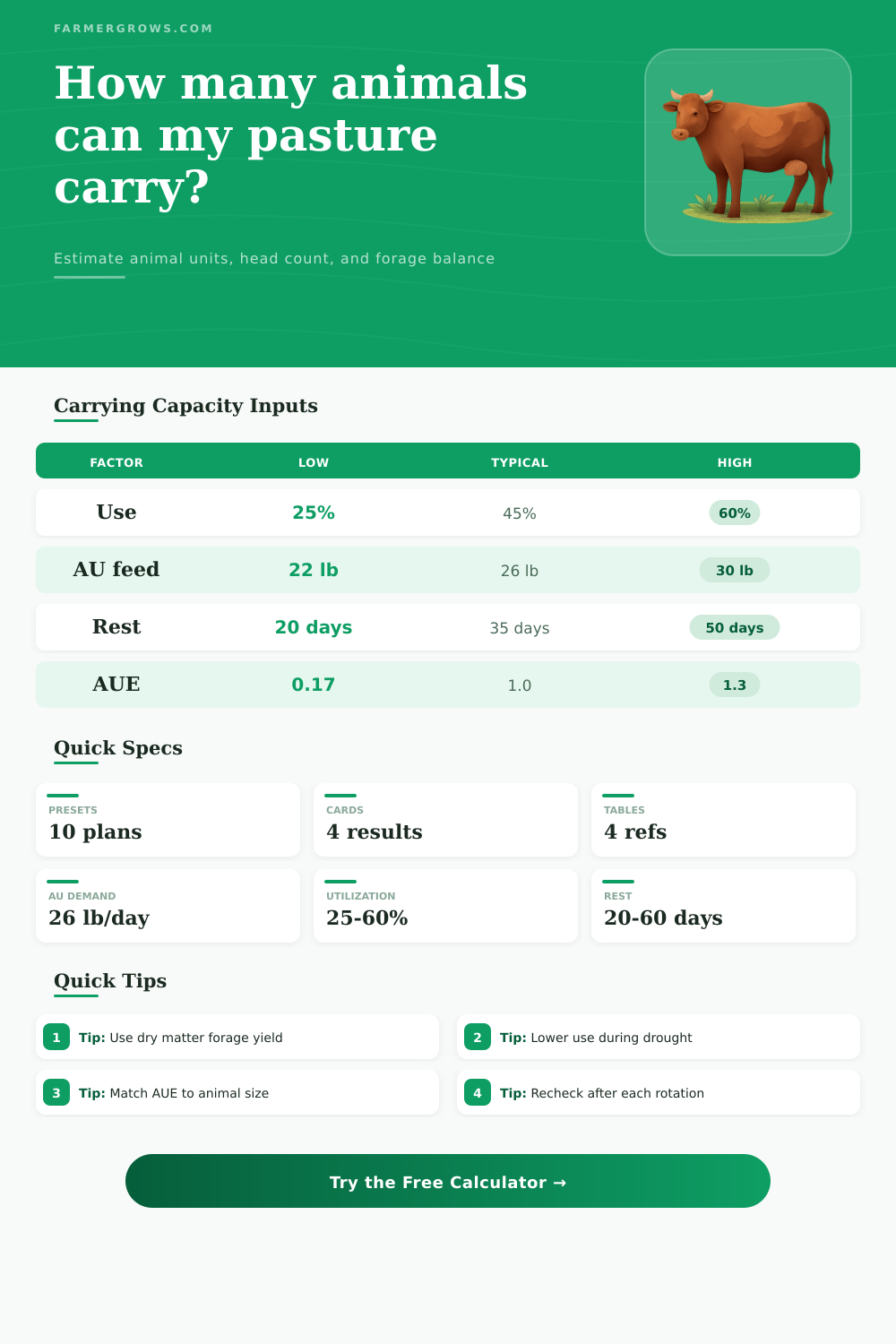
| Beef cow, 1000 lb | 1.00 | 26 lb/day | Baseline animal unit for many pasture budgets. |
| Cow-calf pair | 1.30 | 34 lb/day | Use during lactation or when calves are consuming forage. |
| Stocker calf, 600 lb | 0.60 | 16 lb/day | Good for growing cattle on summer grass. |
| Dairy cow | 1.40 | 36 lb/day | Higher intake; adjust for milk level and supplement. |
| Horse | 1.25 | 33 lb/day | Protect pasture cover; horses can graze close. |
| Ewe with lamb | 0.20 | 5 lb/day | Flock impact depends on parasite control and forage height. |
| Doe goat | 0.17 | 4 lb/day | Browse can shift pressure away from grass-only forage. |
| Alpaca | 0.15 | 4 lb/day | Lower intake, but still needs rest and clean forage. |
| Class | Calculator factor | When to use | Management signal |
|---|---|---|---|
| Drought or very dry | 0.70x rainfall | Severe moisture shortage or failed regrowth. | Reduce head count, shorten grazing, or feed more supplement. |
| Below normal rainfall | 0.85x rainfall | Dry year with slower recovery after grazing. | Use a longer rest period and lower utilization. |
| Average rainfall | 1.00x rainfall | Normal local season for the forage yield entered. | Use measured yield and adjust after each rotation. |
| Above normal rainfall | 1.15x rainfall | Good moisture without major flooding or trampling loss. | Can raise production, but watch maturity and waste. |
| Irrigated or high moisture | 1.30x rainfall | Reliable irrigation or humid improved pasture. | Higher growth still needs residual and rest protection. |
| Poor to excellent stand | 0.65x to 1.15x | Based on density, weeds, fertility, and legume content. | Improve weak fields before raising stocking rate. |
| Grazing system | Usual utilization | Rest period | Best use |
|---|---|---|---|
| Continuous grazing | 25% to 35% | Limited rest | Simple systems, lower carrying capacity, higher selectivity. |
| Slow rotation | 35% to 45% | 25 to 40 days | Several paddocks with moderate control and easier recovery. |
| Managed rotation | 45% to 55% | 30 to 50 days | Better forage allocation with moved water or fencing. |
| Strip or adaptive grazing | 50% to 60% | 35 to 60 days | High control systems where residual height is watched closely. |
| Drought reserve | 20% to 35% | 45 to 75 days | Conservative plan for slow regrowth and emergency forage. |
| Pasture example | Forage assumption | 90-day capacity | Notes |
|---|---|---|---|
| 10-acre fair dryland pasture | 1800 lb DM/ac, 35% use | 2 to 3 cow-calf pairs | Works only with conservative rest and backup feed. |
| 40-acre good mixed grass | 3200 lb DM/ac, 45% use | 20 to 25 beef cows | Close to the default preset in average rainfall. |
| 25-acre irrigated dairy paddock | 5600 lb DM/ac, 55% use | 45 to 55 stockers | Water, laneways, and residual height become limiting. |
| 6-acre sheep pasture | 3800 lb DM/ac, 50% use | 35 to 45 ewes | Parasite pressure can be the real limit before forage. |
| 15-acre stockpiled fall field | 2400 lb DM/ac, 60% use | 9 to 12 beef cows | Feed quality and weather loss matter late in the season. |
Fresh forage weight can be mostly water. Clip, dry, weigh, or use a local forage yield estimate so the calculator is working from actual feed dry matter.
If the forage balance is only slightly positive, lower utilization, add rest, reduce head count, or build a supplemental feed plan before pasture recovery is damaged.
Carrying capacity is a measurement of how many animal a piece of land can support for a specific amount of time. Carrying capacity isnt a measurement of how many animals can fit on a piece of land. Carrying capacity is a measurement of how much forage a piece of land can produce without destroying the grass on that land.
If no one give consideration to the carrying capacity of the land, it is possible that grass may be eaten into the ground. If the grass is eaten into the ground, hay may have to be purchased to feed the animals. Thus, understanding carrying capacity are essential to making stocking decisions for a pasture.
How to Find the Carrying Capacity of a Pasture
The first step in calculating carrying capacity is to determine the amount of forage yield in dry matter. The weight of the water in fresh grass is not representatively of the dry weight of the grass. The amount of dry matter that is produced per acre of land is measured.
After determining the amount of dry matter that the land produces, the farmer determines the utilization rate. The utilization rate is the percentage of the total forage that the grazing animals eat. If animals has continuous access to the pasture, the utilization rate will be lower than if the land is managed with rotational grazing.
With rotational grazing, animals will move frequent between pastures so that the grass in each pasture has time to regrow before the animals have access to that pasture again. High utilization rates will result in slow regrowth of the grass and bare soil in the pastures. Both rainfall and pasture conditions will act as multiplier of the total forage yield.
In years with low rainfall, the grass will grow at a reduced rate. Pastures with many weeds will produce less forage then pastures with a variety of plant species. These factors must be considered when calculating carrying capacity because plants requires root reserves of the pasture to allow them to regrow after the animals have eaten most of the leaves of the plants.
If the current condition of the pasture is ignored, a decision maker may use outdated information about the growth of the grass on the pasture. The second part of the carrying capacity equation is the demand of the animals that will utilize the pasture. Not all animals will eat the same amount of forage.
For example, a dry cow will eat a different amount of forage than a lactating cow or a calf. Additionally, horses will eat a different amount of forage than cows. The weight and condition scores of the animals should be observed to determine how much forage each herd will consume.
The difference between animals will accumulate over time to determine the total amount of forage that will be consumed within a 90- or 120-day period. Thus, the difference in each type of animal will have to be accounted for in calculating carrying capacity. Supplemental feed may have an impact on the amount of forage that is demand from the pasture.
If you provide hay or grain to the herd, each pound of hay or grain will reduce the demand on the grass. Many livestock farmers provide supplemental feed for their animals to reduce the demand on the grass. However, producers must calculate the cost of the supplement and determine whether the cost of the supplement is lower than the cost of overgrazing the pasture.
In cases in which the cost of hay or grain is lower than the cost of overgrazing, producers can provide a modest amount of hay or grain each day to preserve the pasture and the herds weight. The number of paddocks required for rotational grazing depends on the length of time the animals will be in one paddock. The longer the paddock rests, the more time the pasture grass can regrow, but the number of paddocks required to provide that long rest period.
The number of paddocks required will depend on the length of time the animals will be in one paddock and the length of time the grass will take to grow back to a sufficient level. The number of paddocks required will ensure that the grass reaches a residual height and that the animals maintain their weight. The forage balance model will calculate the supply of forage relative to the demand of the animals.
If the pastures have a forage surplus, there is an abundance of forage, and the farmer gains the flexibility to deal with a drought. If there is a forage deficit, the animals are consuming more of the pastures forage than can be provided. In this case, the farmer must reduce the number of animals or increase feed costs.
This calculation should of occur prior to the animals entering the pasture. Several factors will impact the carrying capacity of the pasture, specifically those that is specific to the site of the pasture. The access to water will impact the number of animals that can be in the pasture since the animals will tend to congregate around the water.
The slope of the land will impact the distance that the animals have to travel to find pastures of grass. Finally, soil type will impact the amount of forage that can be grown in the pasture. Each of these factors must be observed to determine the carrying capacity of the pastures since two pastures of the same area may have different carrying capacities.
The carrying capacity of the pasture