🐄 Calf Ration Calculator
Estimate milk replacer powder, liquid milk mix, starter grain, forage timing, protein balance, cold-stress energy, and weaning readiness from calf weight, age, starter intake, targets, and calf count.
Choose a realistic calf program as a starting point, then adjust the number of calves, body weight, age, milk replacer percentage, starter intake, protein, forage introduction, and cold stress.
Calf Ration Results
Your milk replacer, starter, protein, and weaning estimate will appear here after calculation.
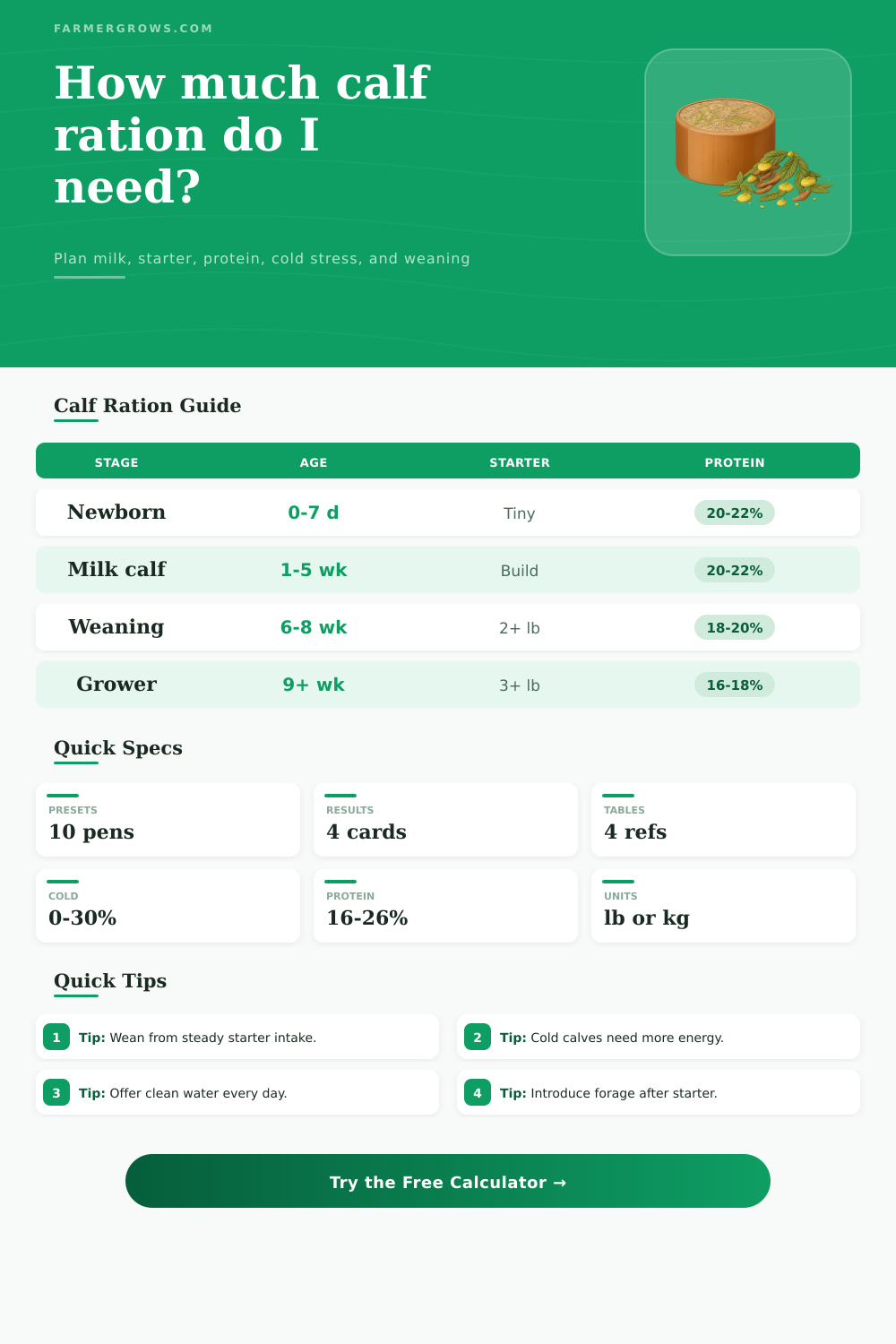
| Stage | Typical age | Main ration focus | Starter target |
|---|---|---|---|
| Newborn transition | 0 to 7 days | Colostrum follow-up, consistent milk, clean water | Taste and explore starter |
| Early milk calf | 1 to 3 weeks | Milk solids, health checks, fresh starter daily | Small but rising intake |
| Rumen development | 4 to 6 weeks | Starter intake, water, steady milk routine | Move toward 1 to 2 lb daily |
| Weaning transition | 6 to 8 weeks | Starter consistency before milk step-down | About 2 lb daily for several days |
| Post-weaned grower | 9 weeks and older | Starter or grower, water, measured forage | Often 3 lb or more daily |
| Mix style | Solids range | Best use | Watch point |
|---|---|---|---|
| Conservative bottle | 11 to 12 percent | Small calves or cautious starts | May limit gain if volume is low |
| Standard mix | 12 to 13 percent | Common twice-daily feeding | Keep powder weighing consistent |
| Higher solids | 14 to 15 percent | Growth or cold support | Check osmolality and water access |
| Accelerated program | 15 to 16 percent | Planned high-nutrition systems | Needs careful step-up and monitoring |
| Very rich mix | Above 16 percent | Specialist direction only | Digestive upset risk can rise |
| Starter intake | Ration meaning | Weaning signal | Management note |
|---|---|---|---|
| Less than 0.5 lb/day | Nibbling only | Not ready | Refresh starter and check water access |
| 0.5 to 1.0 lb/day | Rumen interest building | Too early for most calves | Keep milk consistent and starter fresh |
| 1.0 to 2.0 lb/day | Transition zone | Close but verify trend | Look for several steady days |
| 2.0 lb/day or more | Common weaning target | Ready if age and health fit | Step milk down rather than abrupt changes |
| 3.0 lb/day or more | Post-weaning support | Good grower intake | Introduce forage carefully if not already started |
| Cold setting | Calculator factor | Typical condition | Ration response |
|---|---|---|---|
| None | 0 percent | Dry bedding, mild weather | Standard milk and starter plan |
| Mild | 8 percent | Cool nights or light wind | Watch calves and avoid skipped feedings |
| Moderate | 18 percent | Cold snaps, young calves, damp pens | Add energy by plan, not guesswork |
| Severe | 30 percent | Deep cold, wind, wet bedding risk | Increase support and correct bedding fast |
Age matters, but calves should also be eating the target amount of fresh starter for several days before milk is removed.
Extra energy may be needed just to maintain body temperature, especially for small calves, wet bedding, wind exposure, or low nighttime temperatures.
This calculator is a planning estimate for calf ration review. Follow product labels, farm protocols, veterinarian guidance, and local extension advice for medicated feeds, disease, scours, or unusual growth patterns.
Because calf feeding change so rapidly during the first two months of the calf’s life, even a small mistake in the feeding of milk or starter can impact the entire pen of calves. The calf ration calculator is a tool that can help you to calculate the mathematical conversions necesary to determine the amount of each type of feed that calves will require during there life. Information such as the weight of the calf, the age of the calf, the rate at which the farmer should feed milk replacer to the calf, and the amount of starter that the calf should be eating can be input into the calculator to determine the amount of each type of feed that should be provided to the calf during the feeding period.
The calculator will save you from having to manually calculate these values while you are managing the calves in the barn. Milk replacer is one of the primary factors to consider in feeding calves. Milk replacer is used to provide the energy and protein that calves requires.
How to Use the Calf Feed Calculator
Because calves rely almost entirely upon liquid feed during the early stage of their lives, the amount of milk replacer and the solids percentage of that milk replacer will impact the amount of energy and protein that calves receive during that early period. The calculator will ask for the rate of milk replacer that will be fed to the calf as a percentage of the calf’s body weight. For instance, a 10% rate of milk replacer that will be fed to a 90 lb.
Calf will contain a different amount of food than if that same 10% rate was fed to a 140 lb. Calf. The calculator will calculate both of these values.
The percentage of solids within the milk replacer is another factor that calf farmers should consider. A higher percentage of solids will allow more dry food to be fed to the calf each day. However, the higher percentage of solids only works if the calves are drinking all of the milk replacer that is provided to them, and if the calves are not suffering from cold stress caused by the environment in which they live.
Starter intake is the second major factor that will be tracked with the calculator. Calves will develop their rumen by eating starter grain. An input within the calculator allows the farmer to set a target amount of starter that the calf should eat each day before the amount of milk that is provided to the calf is to be reduced.
Two pounds of starter per day is a common target for most farms. Two pounds of starter indicates that the rumen of the calf is active enough to begin processing forage. In addition to calculating the amount of starter that is being provided to each calf, the calculator will also calculate the age of the calf.
Age alone is not a good indication of how much starter a calf can eat. For instance, a 35-day-old calf may eat two pounds of starter, but may still be too young to be weaned from their mother’s milk. A 50 day old calf may only eat one pound of starter daily, meaning that the calf may require more milk than calves that eats more starter.
Cold stress is a separate factor in the calculator. Cold stress will impact the amount of energy that calves need each day, but will not impact the ingredients of the feed that must be provided to the calf. Each of the cold stress options will add a percentage of dry matter to the benchmark amount of dry matter that should be provided to each calf.
A table within the calculator can reference the level of cold stress that is present within the barn, and provide a description of the level of cold stress within that environment. For instance, the table can indicate the level of cold stress for conditions that include thermoneutral conditions, cold stress, wind stress, wet bedding stress, and severe wind and wet bedding stress. Calves that are losing too much heat to the environment will not be growing, so feed must be provided to those calves to compensate for the energy lost.
Forage timing is another separate factor within the calculator. If hay or straw is provided to calves at the wrong time, it will prevent calves from eating the starter that they require to develop their rumen. Providing forage too late will also prevent calves’ rumen from developing properly.
The calculator can calculate the day upon which forage will be introduced to the calves to allow other feeding factors to be adjusted accordingly. The protein percentage that is provided to calves is calculated based on the total dry matter that will be provided to the calf each day. The percentage of protein shifts based upon the amount of milk replacer and starter that is fed to the calf each day.
The main value of the calculator is to allow farmers to view the impact that each factor has upon each of the other factors. For instance, increasing the amount of milk replacer that is fed to calves will increase the growth of calves’ bodies, but will also increase the cost of feeding milk replacer to the calves each day, as well as the time that must spent mixing the milk replacer. Increasing the amount of starter that is provided to calves will allow calves to rely less upon milk replacer, but only if the calves eat all of the provided starter, and if the calves have access to water to allow them to mix the starter with water.
Adjusting for cold stress will be an important factor in feeding calves that are young or that are kept in pens with poor bedding. However, the best way to reduce cold stress upon calves is to provide better housing for the animals. Calves should be routinely checked to see if they are eating the amount of starter required of each calf.
Starter intake can change each day due to changes in the weather, or due to changes in the consistency of the starter that is mixed. Therefore, observations of starter intake should be made each day for several days in a row. The same principle can be applied to observations of cold stress.
Cold stress may not require changes to the ration for a single day, but will require adjustments in the ration if calves are suffering from cold stress for a period of several days in a row. The ration calculations should be made again whenever the average weight of the pen of calves changes by more than a few pounds. Because the rate at which the farmer should feed milk replacer is a percentage of the body weight of the calf, if the calves change in weight, the amount of milk replacer that must be fed to each calf will change.
In the same way, starter requirements can be recalculated for calves when they reach certain amounts of starter intake. Therefore, by frequently running the calculator, farmers will not make mistakes in feeding each calf in their barn. Calf feeding requires a great deal of consistency.
However, the calculator will allow farmers to gain insight into the feeding of the calves, as the feeding of fresh starter, water, and general routines within the barn will allow farmers to monitor the health of the calves.