🐄 Feedlot Ration Calculator
Estimate dry matter intake, total feed, grain and roughage split, crude protein, energy density, shrink-adjusted sale weight, and phase rations from entry weight to finish weight.
Pick a cattle class to load practical starting values, then tune the weights, ADG, days on feed, roughage level, grain energy, protein, feed conversion, and shrink.
Feedlot Ration Results
Enter cattle weights and ration assumptions to calculate the closeout.
| Item | Per head | Pen total | Planning note |
|---|---|---|---|
| Dry matter feed | -- | -- | Calculate to fill this row. |
| As-fed feed | -- | -- | Adjusted for ration moisture. |
| Grain DM | -- | -- | Based on finishing roughage percent. |
| Roughage DM | -- | -- | Includes hay, silage, or other forage fiber. |
| F:G scenario | DM / head | Daily DMI | Pen as-fed tons |
|---|---|---|---|
| Efficient | -- | -- | -- |
| Base plan | -- | -- | -- |
| Challenged | -- | -- | -- |
| High roughage drag | -- | -- | -- |
| Cattle program | Typical roughage | Crude protein | Common target |
|---|---|---|---|
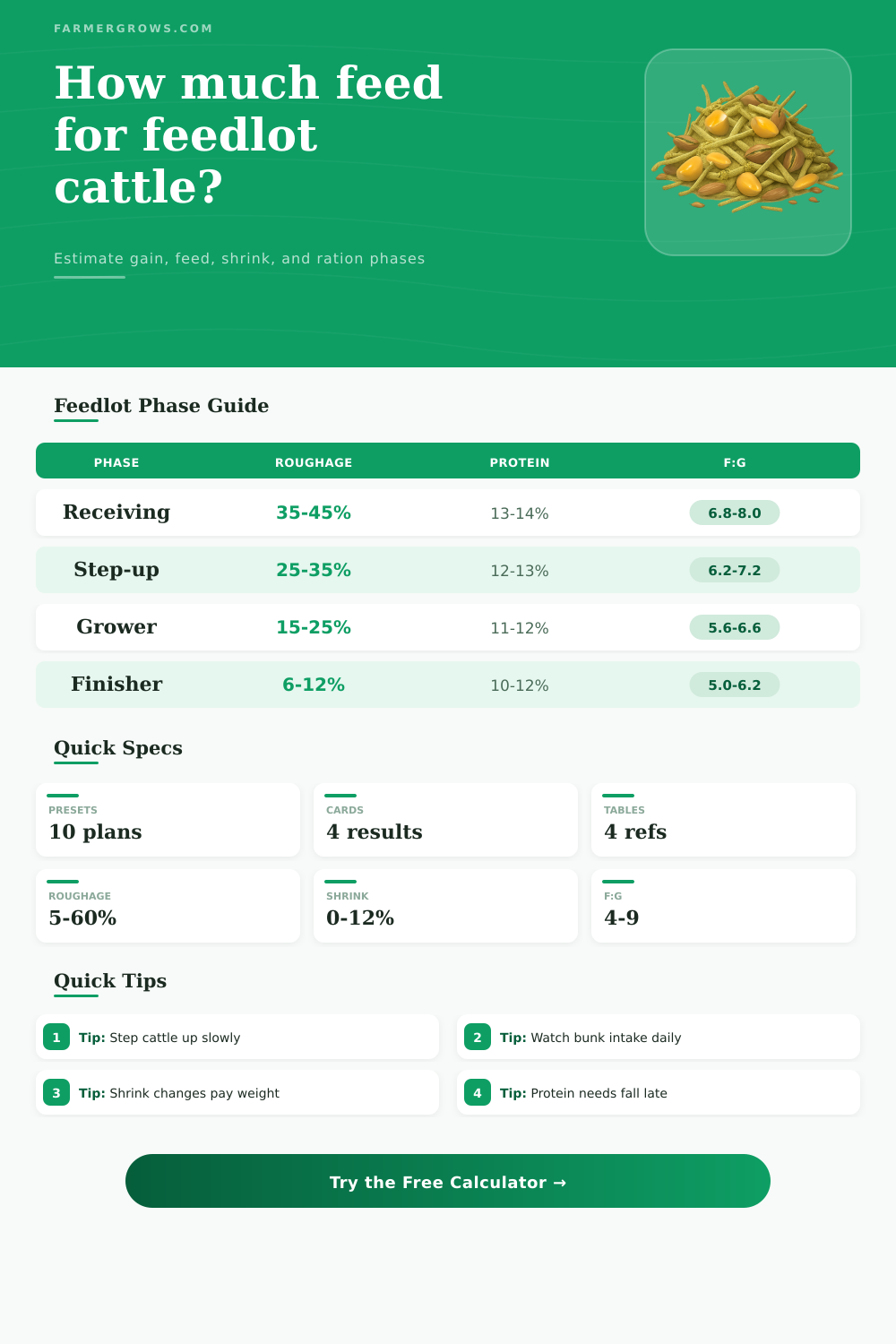
| Newly received calves | 35-45% DM | 13-14% | Intake recovery and health. |
| Step-up ration | 25-35% DM | 12-13% | Adapt rumen to more starch. |
| Growing ration | 15-25% DM | 11-12.5% | Frame gain with moderate energy. |
| Finishing ration | 6-12% DM | 10-12% | Energy-dense gain and finish. |
| Natural cattle | 8-14% DM | 11-12.5% | Slower, steadier gain targets. |
| Dairy-beef cross | 8-14% DM | 11-13% | Longer days and leaner frame. |
| Check | Usual range | What it changes | Management note |
|---|---|---|---|
| Arrival shrink | 2-8% | Starting pay or processed weight. | Separate arrival shrink from final marketing shrink. |
| Final shrink | 2-6% | Sale weight and closeout revenue weight. | Long hauls, sorting, and heat can raise shrink. |
| Dry matter error | 1-5 points | As-fed pounds and bunk calls. | Test silage or wet byproducts when moisture changes. |
| F:G change | 0.2-0.8 lb | Total feed needed per pound of gain. | Mud, heat stress, and health pulls worsen conversion. |
| Protein gap | 0.5-2 points | Gain early in the feeding period. | Light cattle usually need more protein than heavy finishers. |
Keep the ration math paired with daily bunk reading. The calculator estimates feed need, but sudden intake drops can signal weather stress, acidosis risk, or health problems before the closeout shows it.
Recheck dry matter when silage, wet distillers, or high-moisture grain changes. A few moisture points can move as-fed delivery enough to distort both energy supply and feed conversion.
Feedlot cattle finishing is a process that aims to maximize the weight gain of cattle while minimizing feed costs and health risk. A person must balance several factors when feeding cattle in the feedlot, including the level of roughage, the protein supply, the energy content of the feed, and the amount of feed that each cow consumes. Because the decisions regarding the roughage and protein levels in the feedlot can have an impact on the profit margin of the feedlot operator, many utilize a ration calculator to manage these variables.
The ration calculator allows the operator to test different feed costs against the weight gains of the cattle. Additionally, the tool allows the operator to understand how each of these variable will impact the cattle in the feedlot. Most cattle that enter the feedlot have already undergone the growing phase of their lives.
Using a Feedlot Ration Calculator
Additionally, all cattle has rumens that are utilized to consuming diets that are high in fiber. Because the cattle’s rumens are programmed to consume high amounts of fiber during the growing phase of the animal’s life, the change from a diet high in fiber to one high in grains must be managed properly. The level of roughage that is provided to the cattle is one of the primary factor that is considered during this transition.
The roughage levels have to be set to the correct amount for that particular feedlot and group of cattle. If there is too much roughage, the cattle will not gain enough weight to reach the target weights. If there is too little roughage, the cattle may develop acidosis and other health problem.
The ration calculator can be used to test different roughage levels and compare them to the target weights that is desired from the cattle. The protein requirement for the cattle change as the cattle grow in weight. The requirements for protein change according to the weight of the cattle.
Younger and lighter cattle require more protein than cattle that have higher weights. For instance, a diet that may be appropriate for a 750-pound steer may have too much protein for a steer that weigh 1,300 pounds. By adjusting the amount of crude protein that can be supplied to the ration calculator, the operator can determine how many supplement can be removed from the diet of the cattle to save money when feeding large numbers of cattle within the feedlot.
Feed conversion is the measurement of how much feed the cattle consume versus the weight that the cattle gain. The feed conversion ratio is one of the measurement that many individual within the feedlot closely watch. The feedlot ration calculator allows for adjustments to the base conversion factor according to the sex class of the cattle and the implants that are placed into the cattle.
For instance, the feed conversion for an implanted steer will be better than for an unimplanted heifer. The ration calculator helps to determine the amount of grain and forage that should be ordered for the feedlot. However, it is an estimation only and does not account for the actual performance of the cattle.
If the feed conversion performance of the cattle is worse than what was calculated in the ration calculator, the sensitivity table within that calculator can provide information regarding the increase in the total amount of feed that will be required for the feedlot to achieve its target weights. Another factor that impacts the final weight of the cattle is the shrink factor. The shrink in the weight of the cattle impacts the amount of money that is earned from the sale of that steer or cow.
Additionally, the marketing shrink will impact the sale weight of the cattle that are sold at the end of their feeding cycle in the feedlot. Factors like long hauls and sorting of the cattle at the plant can lead to shrink in the weight of the animals. If the amount of shrink in the weight of the cattle increase, the animals will weigh less when they are sold.
Because the ration calculator accounts for both the live weight of the cattle and the pay weight after shrink, it allows the operator to test different scenario within the feedlot. These scenarios will allow the operator to understand how much additional weight gain is needed from the cattle to compensate for the shrink in the weight of those animals when they are sold. Many feedlots utilize a step-up program for the cattle that are processed through the feedlot.
The step-up program is a process that gradually increases the amount of grain that the cattle consume and gradually decreases the amount of roughage that is supplied to the animals over a period of two to four week. If mistakes are made during the step-up phase, they can lead to poor feed conversion rate for the remainder of the feedlot cycle. One of the important task during this phase is to monitor the amount of feed that the cattle consume each day.
The ration calculator helps to determine the amount of feed that should be supplied during the finishing phase of the cattle, but there is a separate phase reference table that determines how long it will take for the cattle to reach the feedlot’s target weight. The moisture content of the feed that is delivered to the feedlot is one of the factor that must be considered in the feeding operation. Common ingredient for the feedlot include silage, wet distillers grains, and high-moisture corn, all of which have different moisture contents.
The change in the dry matter content of feed will impact the amount of pounds of as-fed feed that is delivered to the cattle. If dry matter content changes, the amount of as-fed feed will change. The ration calculator accounts for both dry matter and as-fed feed inputs.
Additionally, the ingredients should be re-tested for moisture content if there are any change in the weather or if a new supplier of feed is utilized. Re-testing the ingredients allows the feedlot manager to account for changes in the dry matter content of the feed. Additionally, the manager can ensure that the ration calculator’s calculation are accurate.
One of the benefit of using a ration calculator is that the manager can compare different feeding program side by side. For instance, the natural heifer feeding program will require a longer time period and require more feed than the implanted steer feeding program. The ration calculator makes it easy to compare these two feeding programs.
Furthermore, the ration calculator can be used to test the outcome of different scenario within the feedlot, such as what will happen if the daily gain of the cattle decreases. Additionally, the feedlot manager can use the ration calculator to test how increasing the roughage for the cattle impact the total ton of feed and protein that is supplied to the cattle in the feedlot. Despite the benefits of the ration calculator, it cannot account for all of the variable in the feedlot.
For instance, it cannot account for the effect of the weather on the feedlot, mud within the feedlot, or health issue of the cattle. Because the ration calculator does not account for these variable, it is only a budget for the feedlot. Additionally, if the actual performance of the cattle differs from the plan that was made with the ration calculator, the manager can use the ration calculator to determine whether the issue was related to the protein levels of the cattle, the energy density of the feed, or the number of day that the cattle were fed in the feedlot.
The ration calculator’s mathematical output can only be one aspect of the management of the feedlot; daily observation of the cattle are another essential aspect of the management of the feedlot. If the ration calculator indicates that the cattle should consume a certain amount of dry matter, but they dont consume that amount, those feeding observation are critical to understanding the reason for that difference in the weight of the cattle.