Puppy Feed Calculator
Estimate daily puppy calories, cups per day, cups per meal, and growth-stage adjustments from current weight, expected adult weight, age, breed size, activity, food energy, meal count, and body condition.
Use the result as a starting point, then adjust with weekly weigh-ins, stool quality, body condition, and veterinary guidance. Puppies with medical needs, giant-breed growth concerns, or rapid weight change need individualized feeding advice.
Puppy Feeding Estimate
Daily calories and food volume will appear here.
Often matures fastest. Watch for tiny-meal consistency and low blood sugar risk in very small pups.
Usually transitions toward adult portions earlier than large breeds, once body condition is steady.
Often sits near the middle of the growth curve, with meal count dropping as appetite stabilizes.
Needs controlled growth, steady body condition, and large-breed puppy food when recommended.
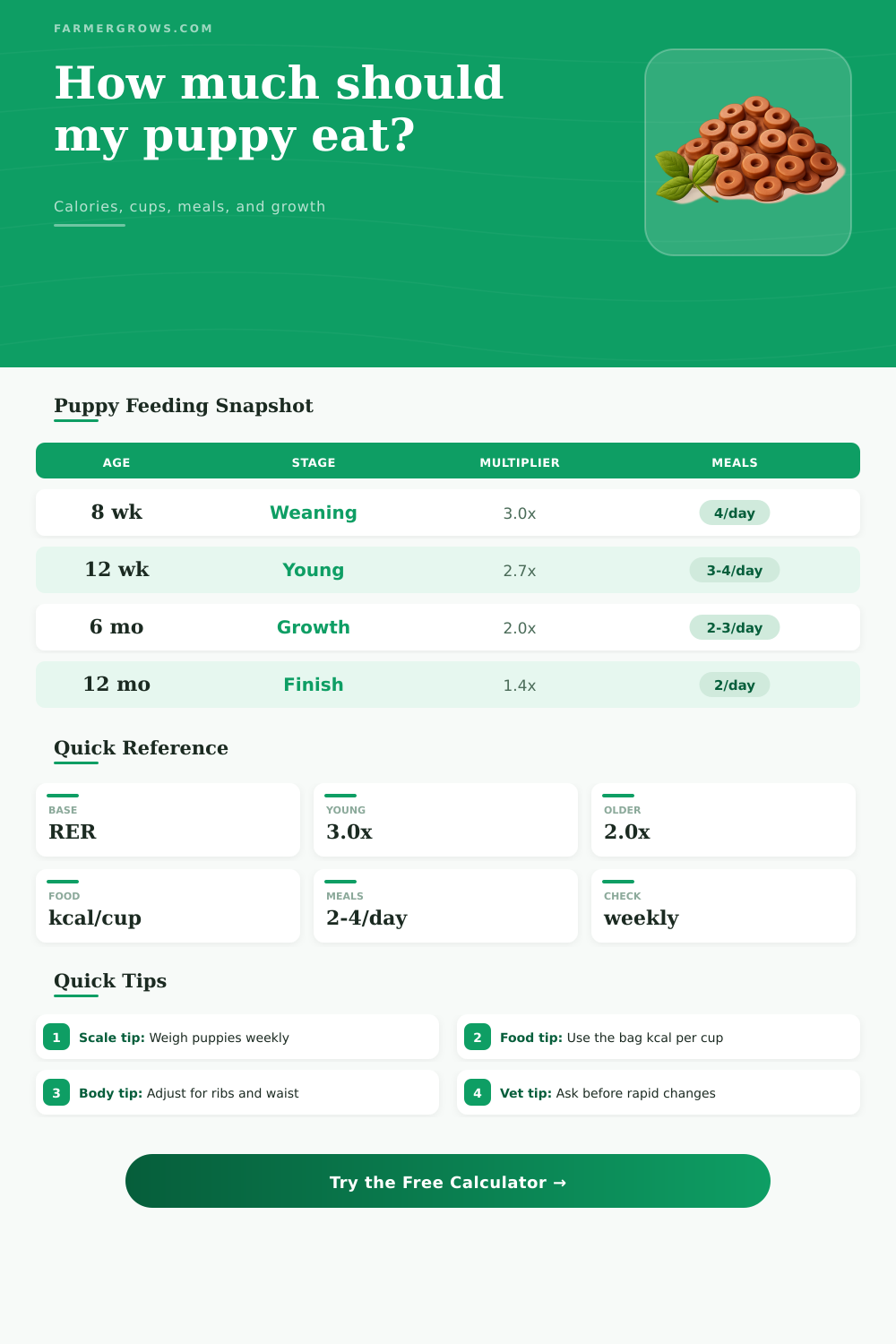
| Age band | Common multiplier | Meal pattern | Use note |
|---|---|---|---|
| 6-10 weeks | 3.0 x RER | 4 meals per day | Early growth, small meals, careful transition from weaning food. |
| 10-16 weeks | 2.6-3.0 x RER | 3-4 meals per day | High growth demand; adjust by weight gain and stool quality. |
| 4-8 months | 2.0-2.4 x RER | 2-3 meals per day | Most puppies begin moving toward steadier portions. |
| 8-14 months | 1.4-1.8 x RER | 2 meals per day | Multiplier often drops as maturity approaches, especially in smaller breeds. |
| Breed size | About 3 months | About 6 months | Feeding caution |
|---|---|---|---|
| Toy | 40-55% adult weight | 75-90% adult weight | Avoid long gaps between meals for very small puppies. |
| Small | 35-50% adult weight | 65-85% adult weight | Reduce multiplier gradually when growth slows. |
| Medium | 30-45% adult weight | 55-75% adult weight | Watch waist shape, not just appetite. |
| Large or giant | 25-40% adult weight | 45-65% adult weight | Keep growth controlled and ask about large-breed formulas. |
| Food kcal per cup | 800 kcal/day | 1200 kcal/day | 1600 kcal/day |
|---|---|---|---|
| 320 kcal/cup | 2.50 cups | 3.75 cups | 5.00 cups |
| 380 kcal/cup | 2.10 cups | 3.16 cups | 4.21 cups |
| 440 kcal/cup | 1.82 cups | 2.73 cups | 3.64 cups |
| 500 kcal/cup | 1.60 cups | 2.40 cups | 3.20 cups |
| Factor | Calculator setting | Adjustment | Practical check |
|---|---|---|---|
| Quiet or crate rest | Activity | 0.90 x | Use during short reduced-activity periods with vet direction. |
| Typical puppy play | Activity | 1.00 x | Good default for normal home play and training. |
| Thin condition | Body condition | 1.10 x | Increase carefully and recheck weight weekly. |
| Over-conditioned | Body condition | 0.85 x | Do not crash diet puppies; ask your vet for a growth-safe plan. |
Measure the food, then watch the puppy. Use the calculator to set a starting cup amount, then use weekly weight, rib coverage, waist shape, and stool quality for small changes.
Recalculate after growth jumps. A puppy that gains several pounds, changes food, drops a meal, or moves into a new age band should get a fresh calorie and cup estimate.
Puppy owners must determines the correct amount of food for they puppy. Puppies have different requirement for food amounts than adult dogs of the same breed. Because puppies requires different amount of energy during various stages of growth, puppies that receive too little food may become too thin for their breed, but puppies that receive too much food may grow too heavy for their breed.
Calculators is available that can determine the amount of food that a puppy should receive each day by entering the current weight of the puppy, the expected adult weight of the puppy, and the age of the puppy. The math that are used in these calculators is based off the resting energy that a puppy requires each day to perform basic bodily function, and the amount of energy that the puppy requires to grow. Young puppies requires more energy to support their growth than adult puppies do.
How Much Food to Feed Your Puppy
The calculator use these numbers to arrive at the amount of calories that the puppy should receive each day, and then uses that number to determine the amount of food (in cup) that the puppy should receive daily. The breed of the puppy is another factor to consider in determining the amount of food that the puppy should receive daily. The size of the puppy’s breed can indicate the length of time that it will take for the puppy to reach its adult weight.
Giant breed puppies take longer to reach their adult weight than toy breed puppies, so there is a need for giant breed puppies to have different growth factor adjustments than toy breed puppies. A grid that illustrates the weights of puppies of different breed of similar ages can help determine if the puppy weighs typical for its breed. Factors like the puppy’s activity and body condition can change the amount of food that is recommended for the puppy.
Puppies that are more active than others of similar ages will require more food than puppies that are less active. Similarly, if the puppy is too thin for its breed, it may need to eat more food to reach a healthy weight, but a puppy that weighs too much for its breed may need to eat less food to avoid excessive weight gain. An observation of the puppy’s body can help determine how much food to provide the puppy each day.
Food energy density can be a challenging factor for puppy owners to understand. Even if two type of kibble appear the same, they may have different amounts of calories per cup. The food label will indicate the amount of metabolizable energy (in kcal) per cup.
You must enter this value into the calculator to provide accurate information regarding the amount of cup of food that the puppy should receive daily. If another type of food is used, the kcal per cup value must be updated in the calculator. The number of meal that the puppy is fed daily will change as the puppy ages.
Young puppies have small stomach and may need to be fed more frequent. As the puppy ages, its digestive system can handle eating less meal with larger amounts of food. A reference table can help to determine how many meal of what size should be provided to the puppy daily.
Weighing the puppy each week will help to ensure that the amount of food that is provided to the puppy each day is still correct. If the puppy is gaining too much weight, it may require a lower growth factor for growth calculations. However, if the puppy is not gaining any weight, it may require more food to gain the weight that is appropriate for its breed.
Using a scale to find the actual weight of the puppy can help to adjust the food calculations accordingly. Many new puppy owners make the mistake of treating the amount of food that is calculated for a puppy as a permanent amount. However, a puppy’s need for food will change over time.
It is easy to feed a puppy with the amount of food that is calculated for the puppy at sixteen weeks of age, but providing that same amount of food to the puppy at twenty-four weeks of age may not provide the same benefit. Moreover, feeding a puppy with food based upon its current weight may not provide the best outcome for the puppy. The amount of food should take into consideration the breed and the weight that the puppy is expected to reach as an adult dog.
Ensuring that a puppy receives the amount of food that it requires will provide the puppy with steady energy and healthy stool. Additionally, feeding a puppy the amount of food that is required will reduce the likelihood that the puppy will develop joint issue once the puppy reaches adulthood. To accomplish this, the owner should enter the puppy’s details into the food calculator, compare the amount of food that is calculated to the expectations of the breed size of the puppy, and adjust the amount of food that is fed to the puppy according to its body condition every few weeks.
By regularly observing the puppy and utilizing the calculator, the owner can ensure that the puppy’s food amount matches the growth of the puppy, and that the puppy is developing in a healthy manner.