Horse Gestation Period Calculator
Estimate a mare's foaling due date from the breeding date, breed type, mare age, previous foaling history, ultrasound plan, and your preferred early and late watch range.
Use this calculator as a planning aid for breeding records and foaling preparation. Individual mares vary, so confirm pregnancy timing, risk signs, and late-term decisions with your veterinarian.
●Named mare presets
▣Breed comparison grid
▲Breeding and mare details
Foaling calendar estimate
Enter a breeding date to calculate due dates.
◆Gestation benchmark cards
■Reference table 1: breed type ranges
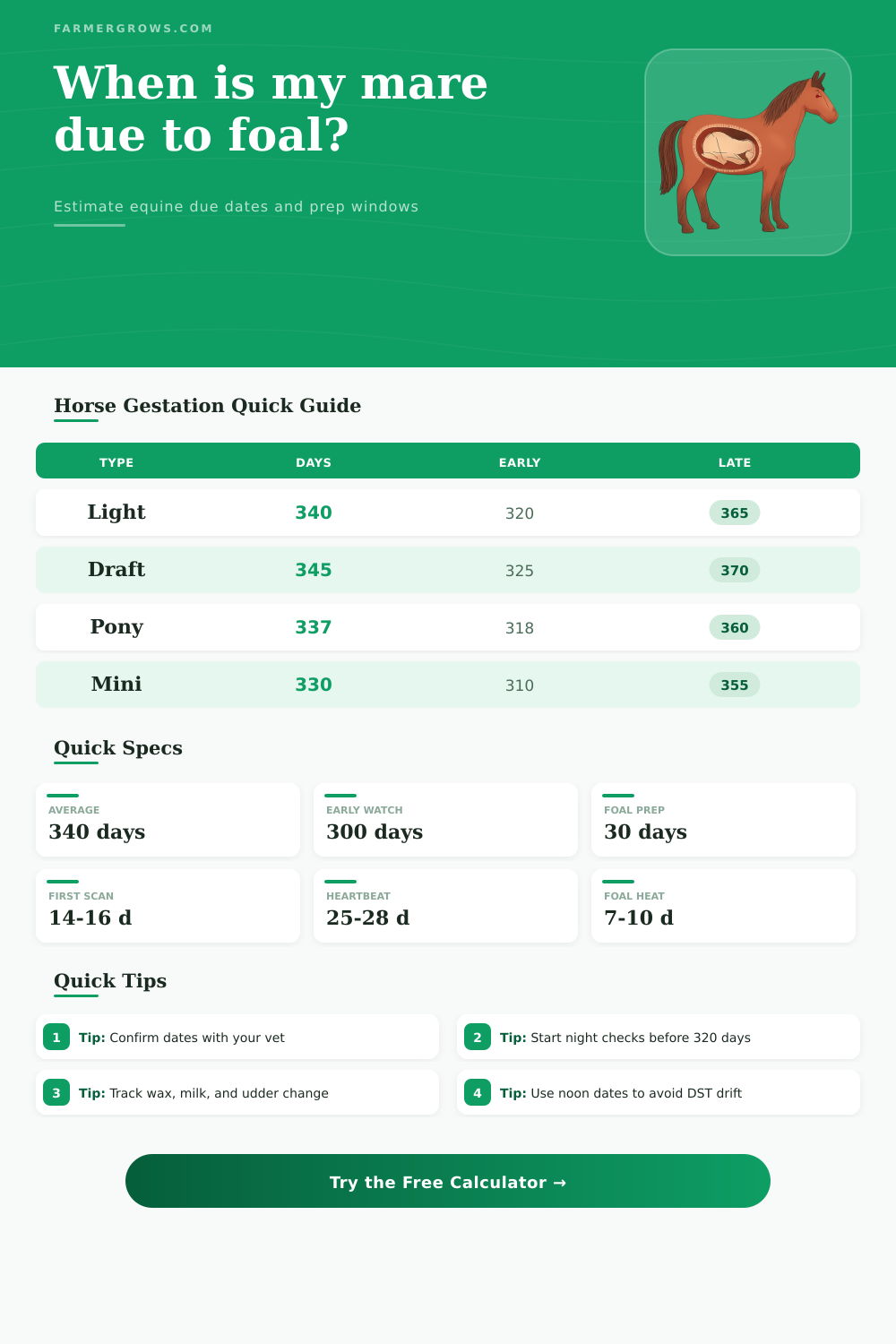
| Breed type | Planning target | Common watch range | Calculator adjustment |
|---|---|---|---|
| Light horse | 340 days | 320 to 365 days | Baseline due date for most saddle mares. |
| Thoroughbred | 341 days | 320 to 365 days | Close to light horse, often tracked by ovulation. |
| Warmblood | 343 days | 322 to 368 days | Adds a small large-frame allowance. |
| Draft horse | 345 days | 325 to 370 days | Longer target and later high-end range. |
| Pony | 337 days | 318 to 360 days | Earlier due target with broad variation. |
| Miniature horse | 330 days | 310 to 355 days | Earlier watch start and shorter target. |
| Arabian | 342 days | 321 to 366 days | Uses a modestly longer light-horse target. |
■Reference table 2: ultrasound and exam windows
| Window | Day count | Use | Calculator reminder |
|---|---|---|---|
| Early pregnancy scan | 12 to 14 days | Detect early pregnancy and possible twins. | Shown when early twin screen is selected. |
| Standard pregnancy check | 14 to 16 days | Common first confirmation window. | Default ultrasound reminder. |
| Heartbeat confirmation | 25 to 28 days | Checks viability after early confirmation. | Displayed as the second milestone. |
| Fetal sexing range | 60 to 75 days | Optional reproductive management check. | Used when fetal sexing is selected. |
| Late pregnancy review | 300 days | Review vaccines, nutrition, udder change, and foaling plan. | Always included in milestone output. |
■Reference table 3: prep and watch milestones
| Milestone | Typical timing | Record to check | Planner meaning |
|---|---|---|---|
| Foaling kit ready | 30 days before due | Wrap, towels, disinfectant, emergency contacts. | Uses your target prep lead. |
| Close night watch | 20 days before due | Udder fill, tailhead, behavior, camera checks. | Uses your close watch lead. |
| Early viable watch | About 320 days | Any signs of premature labor or milk loss. | Uses your early range setting. |
| Expected due date | Breed target day | Breeding date plus adjusted gestation target. | Main card result. |
| Late call point | About 365 days | Vet guidance if mare carries beyond normal farm range. | Uses your late range setting. |
■Reference table 4: age and foaling history modifiers
| Mare factor | Calculator effect | Why it matters | Planning note |
|---|---|---|---|
| Maiden mare | Adds 1 planning day | First foaling patterns are less predictable. | Keep the watch range broad. |
| Previously early | Subtracts 3 planning days | History may matter more than breed average. | Prepare kit earlier. |
| Previously late | Adds 3 planning days | Some mares repeatedly carry longer. | Avoid panic at the average date. |
| Senior mare | Adds 1 planning day | Older mares deserve closer veterinary context. | Review risk plan before day 300. |
| Very young mare | No due-date shift | Management risk changes more than calendar math. | Ask your vet about growth and nutrition. |
✓Two practical tips
If the mare was bred across several days, ovulation date gives the cleanest estimate. If ovulation is unknown, enter the best breeding date and keep the early-late range wide.
A mare that foaled early or late before may repeat that pattern. Use the history field to nudge the target, then rely on veterinary checks and daily signs.
This calculator is not a diagnostic tool. Call your veterinarian promptly for premature udder development, milk loss, colic-like signs, red bag concerns, prolonged labor, or any abnormal discharge.
The gestation period of a horse are the length of time between when a mare was bred and when the foal is born. For some mares, the gestation period will be more slightly longer than others. Due to these potential variation in gestation period lengths, many people turn to a gestation period calculator to help determine when a specific mare is likely to give birth.
The calculator take into account the breeding date of the mare, the type of breed of the mare, and the individual features of the mare to calculate the date that the mare is likely to give birth to her foal. For light horse breed, the target gestation period is 340 days; 340 days is used for light horses as a starting period for gestation for mares that are not too young or too old. The gestation period can be longer or shorter than 340 days, though.
When a Mare Will Give Birth and How to Prepare
For instance, some breed of mares will deliver their foals at 320 days, while other breeds may take longer than 360 days to deliver their foal. Each of these breed tendencies, previous delivery dates of the mare, and the natural variation within each breed can impact how long the gestation period for each mare lasts. The type of breed that the mare is of can impact the length of gestation period.
For instance, draft breeds have a longer gestation period for their foal because the foal will be of a larger mass. Additionally, breeds that are consider ponies or miniatures may have a shorter gestation period for their foals; these foals require less time to develop to reach the size typical of the breed. A gestation period calculator allows for each of these features of the mare to be account for.
The history of the mare can have an impact upon the length of gestation period for that mare. For instance, if a mare has delivered foals at 320 days in the past, it is more likely that the mare will have a short gestation period again. Maiden mares that has not yet delivered any foals may have a less predictable gestation period.
Additionally, the age of the mare can have an impact upon the gestation period; older mares may require more planning of gestation than younger mares. Each of these features impact the length of gestation period that may develop for each mare. In addition to the features of the mare, the gestation period calculator can indicate the dates upon which a mare should be watched for the delivery of the foal.
For instance, an early watch date can be programmed around 320 days for the birth of the foal; this allow for the mare to be watched for any early sign of birth, allowing for the installation of cameras and the gathering of supplies for the birth. Additionally, the later date range can be used to account for the fact that some owners may not expect the mare to give birth on time, as some gestation periods may extend to 365 days or beyond. Ultrasounds can be used for determining the health of the developing foal within the mare.
For instance, an ultrasound taken at fourteen to sixteen days will confirm if the mare is pregnant and if she has twins. An ultrasound performed at twenty-five to twenty-eight days will confirm that the foal has a heartbeat and is viable. A gestation period calculator can help remind owners of these date.
Preparations should be made prior to the gestation period of the mare ends. For instance, most farms prepare the foaling kit and stall approximately thirty days prior to the estimated birth date of the mare and her foal. This allows for the preparation of the stall in which the mare will give birth; mares do not follow the calendar for their births, so preparations thirty days in advance will ensure that the mare is ready for birth.
Tables on the page contain the references for the average gestation periods for each type of mare. These tables account for each breed of mare, gestation period averages, and the impact of age upon gestation. These tables allow people to understand how the calculator determined the date that the foal will be born.
Additionally, these tables help to demonstrate the variation of each mare from the average gestation period. Some of the mistake that may occur in the care of a mare and her foal includes ignoring the natural range of gestation period for the mare, and using the incorrect breeding date for the mare. For instance, some may begin to monitor the mare for the birth of her foal at day 300; most mares and their natural gestation period ignore this range.
Similarly, waiting until the due date for the foal to arrive can cause the mare and her owner to become worried for the mare. Both of these mistake can be avoided by using the gestation period calculator for the mare. Additionally, determining the correct breeding date for the mare ensures that the gestation period calculator calculates the correct birth date for the mare’s foal.
The quality of the information that is provided to the calculator will impact the output of the calculator. Thus, the breeding date must be accurately enter into the calculator. The season of the year in which the mare is to give birth could impact the care of the mare and the care that is taken of the stall in which the mare lives.
For instance, if the mare is to give birth during the winter months, it may be necessary to prepare the stall for the foal earlier than the gestation period calculator suggests. Conversely, if the gestation period for the mare is within the spring or fall months, the stall may be more easier to manage. While the gestation period calculator does not account for the seasons of the year, the calendar dates provided can help to prepare for these potential environmental impacts upon the mare.
The use of a gestation period calculator for a mare allows those who care for the mare to observe the mare itself. In addition to observing for any leakage of milk from the mare, restlessness in the mare, or the lifting of the mare’s tail, monitoring the mare during the gestation period with the calculator will aid in the determination of whether or not these features of the mare are developing normal. Thus, the calculator allows for owners or caretakers to prepare for the birth of the foal; should the foal be born, being prepared within the correct time frame is the most important feature for the care of the mare.