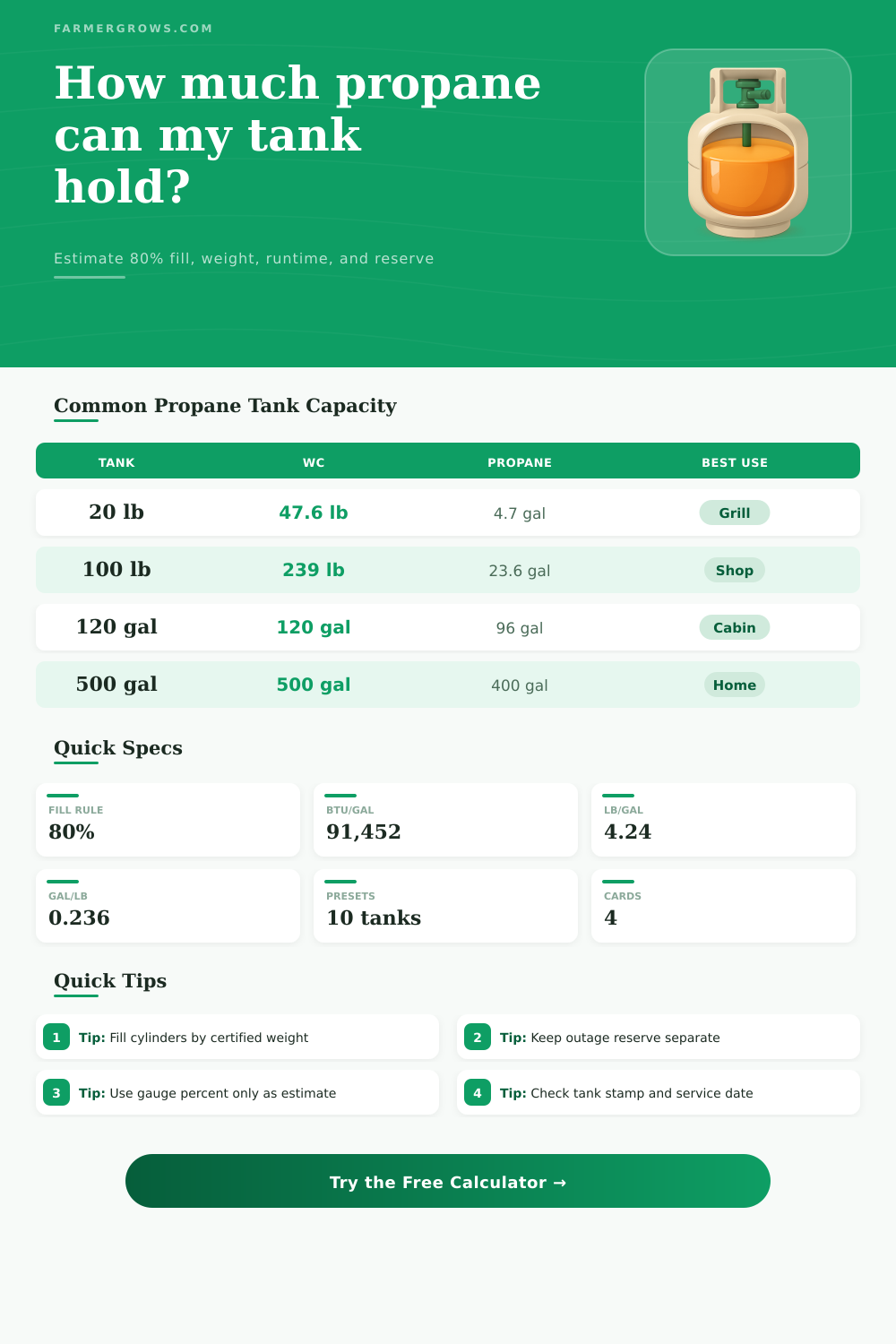
Propane Tank Capacity Calculator
Estimate water capacity, liquid propane gallons, 80% safe fill, temperature allowance, tare weight, and appliance runtime for cylinders and ASME tanks.
This planning calculator uses 4.24 lb per gallon of liquid propane and 91,452 BTU per gallon. Propane containers must be filled, inspected, placed, and transported according to the container label, supplier instructions, and local code.
Portable grill bottle, usually filled by certified weight rather than percent gauge.
Common for shops, cabins, sugar shacks, brooders, and backup heat.
A typical whole-home or farmstead tank when winter heating demand is steady.
Large reserve for high BTU loads, batch drying, greenhouse heat, or long refill gaps.
Propane Capacity Results
The selected cylinder is ready to calculate.
| Container | Approx water capacity | Propane at 80% | Propane weight | Typical use |
|---|---|---|---|---|
| 20 lb DOT cylinder | 47.6 lb WC | 4.7 gal | 20 lb | Grill, small heater, portable cooking |
| 30 lb DOT cylinder | 71.4 lb WC | 7.1 gal | 30 lb | RV, camper, mobile jobsite heat |
| 40 lb DOT cylinder | 95.2 lb WC | 9.4 gal | 40 lb | Food truck, camper, backup cooking |
| 100 lb DOT cylinder | 239 lb WC | 23.6 gal | 100 lb | Shop heater, cabin, sugar shack |
| 120 gal ASME tank | 120 gal water | 96 gal | 407 lb | Small home, greenhouse, farm office |
| 500 gal ASME tank | 500 gal water | 400 gal | 1,696 lb | Home heat, dryer, generator reserve |
| Planning condition | Max fill used | Reason | Calculator effect |
|---|---|---|---|
| Normal storage | 80% | Standard expansion headspace planning | Uses the usual propane capacity |
| Hot sun or warm delivery | 78% | Extra allowance for liquid expansion | Reduces usable fill slightly |
| Cold weather storage | 80% | Liquid volume is lower, but filling rules still apply | Does not exceed normal fill rule |
| Custom supplier limit | 1% to 85% | For local instruction or special container markings | Uses the entered maximum |
| Load | Gallons per hour | 20 lb cylinder | 100 lb cylinder | 500 gal tank |
|---|---|---|---|---|
| 20,000 BTU/hr | 0.22 gal/hr | 21.5 hr | 108 hr | 1,829 hr |
| 40,000 BTU/hr | 0.44 gal/hr | 10.8 hr | 54 hr | 915 hr |
| 80,000 BTU/hr | 0.87 gal/hr | 5.4 hr | 27 hr | 457 hr |
| 150,000 BTU/hr | 1.64 gal/hr | 2.9 hr | 14 hr | 244 hr |
| Conversion | Value | Use in calculator | Notes |
|---|---|---|---|
| Liquid propane density | 4.24 lb/gal | Gallons to propane weight | Common planning value near 60°F |
| Propane energy | 91,452 BTU/gal | Runtime estimate | Actual appliance output depends on efficiency |
| Water weight | 8.34 lb/gal | WC weight to water gallons | Stamped WC can be pounds on cylinders |
| Propane gallons per pound | 0.236 gal/lb | Propane size to gallons | Useful for 20, 30, 40, and 100 lb cylinders |
Use the stamped marks: DOT cylinders commonly show WC and TW on the collar. WC is water capacity, while TW is the empty cylinder weight used when filling by weight.
Plan reserve separately: keep a service-call or outage reserve out of your runtime number so a gauge error or delayed delivery does not consume the last usable fuel.
Propane tank are used to hold liquid propane, but the amount of liquid propane that is contained within a propane tank is not always the same than the size of the propane tank. A person may think that the propane tank is full based off the gauge that display the level of the propane tank, but the propane tank may actualy contain less liquid propane then that which the person think is within the tank. This relationship between the amount of liquid propane within the tank and the size of the tank is due to the expansion and contraction of the liquid propane in response to changes in temperature.
The number that is stamped on a propane tank is the water capacity of the tank. The water capacity is the amount of water that the tank can hold when the propane tank are filled with water. This water capacity should not be used to determine the amount of liquid propane that is available in the propane tank, as the propane tank should never be filled to 100% of its water capacity.
How to Tell How Much Propane Is in a Tank
Instead, the propane tank should be filled to only 80% of the water capacity of the tank. This 80% fill limit for propane tanks is used to prevent the propane from expanding within the tank with hotter temperature, and creating dangerous level of pressure within the propane tank. Some propane suppliers fill the propane tanks to only 78% of the water capacity instead, especially during the hot month of the year.
In order to calculate the amount of liquid propane that is within a propane tank, one must know the water capacity of that propane tank, as well as the tare weight of that propane tank. The tare weight is the weight of the empty propane tank. Propane suppliers measure the propane by weight, therefore, by knowing the water capacity of the tank, the tare weight of the propane tank, and the current fuel level of the propane tank (as indicated on the gauge), it is possible to calculate the amount of liquid propane within the tank.
The fuel level that is indicated on the gauge, however, may not be accurate. Therefore, it is recommended to use a calculator to determine the amount of liquid propane within the propane tank, as otherwise the propane tank may be underestimating the amount of liquid propane within the tank. The length of time that an appliance will run with the current amount of liquid propane within the tank will depend upon both the amount of the propane tanks liquid propane that is available and the demand that the appliance have for that liquid propane.
Appliances use a certain amount of energy within the propane tank, measured in BTUs. Different appliances have different demand for those BTUs. Therefore, the longer that a person knows how much liquid propane is within the propane tank and what the BTU requirements of the appliance are, they can calculate how many hour of runtime the propane tank will have for that appliance.
It is additionally recommended to set aside a volume of liquid propane within the tank, however. This reserve volume of liquid propane is a certain amount of propane that the appliances within the home are not to use. By setting aside a volume of propane within the propane tank, people will not experience a situation in which they run out of propane prior to the arrival of the propane delivery truck.
Additionally, by leaving propane in the tank, they will not be in a situation in which they require propane but the tank gauge display that the tank is filled with propane. The temperature within the propane tank impact the density of the liquid propane within that tank. Changes in the temperature cause changes in the amount of mass of the liquid propane within the propane tank.
In colder weather, the propane within the tank contract, suggesting that there is less mass of propane within the tank. In hotter weather, the propane within the tank expands, increasing the pressure within the tank. Because temperature impact the propane within the tank, people should of make adjustments to the propane tank fill percentage according to the weather and season within which the propane tank is utilized.
Common mistake regarding propane tanks are made when individuals assume that the size of a propane tank is the same than the weight of the liquid propane that tank contains. For instance, a propane tank that weighs 100 pounds when full does not contain 100 pounds of propane liquid; instead, you must calculate the weight of the liquid propane by subtracting the 80% rule for propane and the tare weight of the tank from the total weight of the propane tank. Additionally, another common mistake is to assume that the tank gauge is 100% accurate in relation to the amount of liquid propane within the tank.
However, if an individual utilizes a propane tank calculator to account for the water capacity of the tank, the tare weight of the tank, the current fuel level within the tank, and the reserve volume of liquid propane within the tank, they will have a more accurate understanding of the amount of liquid propane within the tank. These types of calculation is important to make in advance of the delivery of propane to the tank in order to ensure that there is enough liquid propane to operate the appliances within the home.