Firewood Weight Calculator
Estimate firewood weight from species, moisture content, cord volume, stack size, face cord depth, pickup bed volume, trailer loads, and pile packing.
●Firewood load presets
Choose a realistic load, then adjust the wood species, moisture, stack dimensions, split length, and packing style.
●Species, moisture, and load inputs
Species controls the seasoned cord weight and heat estimate.
Most firewood meters report dry-basis moisture: water weight divided by oven-dry wood weight.
Use 1 for a single cord, stack, truck bed, trailer, or pile measurement.
For a face cord, this is usually the split length: 16, 18, or 24 inches.
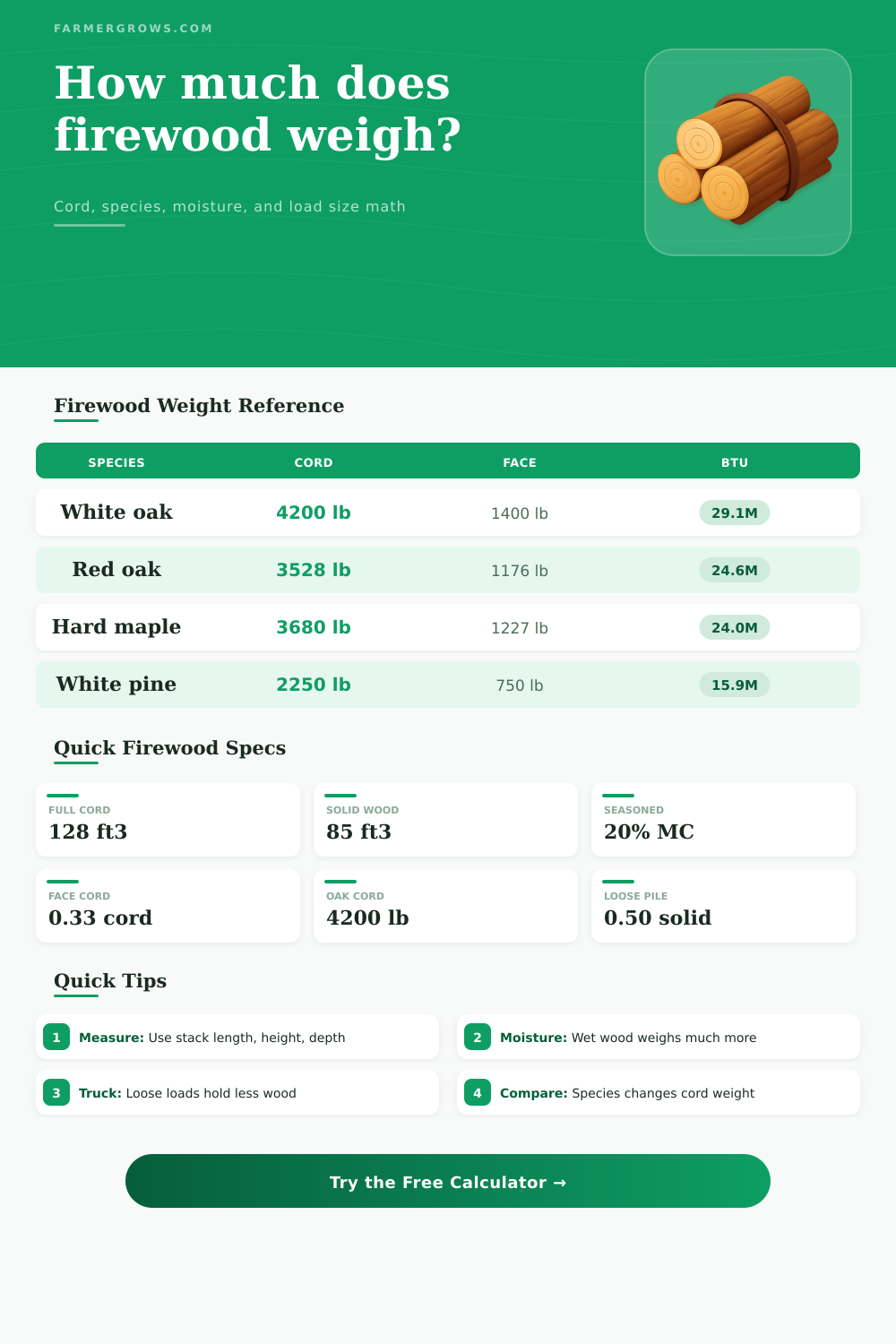
A legal full cord is 128 ft³ stacked, with roughly 85 ft³ of solid wood.
Use 0 for clean kiln-dried splits; use more for muddy, icy, or bark-heavy storm wood.
Optional. The calculator compares estimated load weight to this rating.
Use 60 to 75% for many wood stoves; lower for open fireplaces.
●Species weight snapshot
Weights are practical stacked full-cord estimates at about 20% moisture. Local growing conditions, bark thickness, split size, and stacking style can shift real loads.
●Seasoned cord weight by species
| Species | 20% moisture full cord | 16 in face cord | Approx heat per cord | Load note |
|---|---|---|---|---|
| Hickory | 4,460 lb | 1,487 lb | 30.6 million BTU | Very heavy, dense hardwood; watch trailer payloads. |
| White oak | 4,200 lb | 1,400 lb | 29.1 million BTU | Heavy even when seasoned; green loads climb fast. |
| Beech | 3,760 lb | 1,253 lb | 27.5 million BTU | Dense hardwood with strong cord weight. |
| Yellow birch | 3,689 lb | 1,230 lb | 23.6 million BTU | Medium-heavy; bark can hold extra moisture. |
| Hard maple | 3,680 lb | 1,227 lb | 24.0 million BTU | Common dense firewood with steady heat. |
| Red oak | 3,528 lb | 1,176 lb | 24.6 million BTU | Often sold wet; moisture greatly affects weight. |
| White ash | 3,450 lb | 1,150 lb | 24.2 million BTU | Good mid-heavy hardwood for mixed loads. |
| Black walnut | 3,192 lb | 1,064 lb | 22.2 million BTU | Moderate hardwood weight per stacked cord. |
| Black cherry | 2,928 lb | 976 lb | 20.4 million BTU | Lighter hardwood; nice for shoulder season. |
| American elm | 2,872 lb | 957 lb | 20.0 million BTU | Stringy splits can stack loosely. |
| Cottonwood | 2,160 lb | 720 lb | 14.0 million BTU | Light hardwood; green water can dominate weight. |
| White pine | 2,250 lb | 750 lb | 15.9 million BTU | Light softwood; bulky before it gets heavy. |
●Cord and load volume conversions
| Firewood unit | Stacked volume | Full cord equivalent | Typical dimensions | Weight formula |
|---|---|---|---|---|
| Full cord | 128 ft³ | 1.000 cord | 8 ft x 4 ft x 4 ft | Species cord weight x moisture factor. |
| Half cord | 64 ft³ | 0.500 cord | 8 ft x 4 ft x 2 ft | Full cord weight divided by 2. |
| Face cord, 16 in | 42.7 ft³ | 0.333 cord | 8 ft x 4 ft x 16 in | Full cord weight x split depth / 48 in. |
| Face cord, 24 in | 64 ft³ | 0.500 cord | 8 ft x 4 ft x 24 in | Two-foot wood makes a half-cord face row. |
| Measured stack | L x H x D | Volume x solid factor / 85.3 | Any row, shed bay, or rack | Uses packing style to estimate solid wood. |
| Loose truck bed | L x W x fill height | Volume x 0.50 / 85.3 | Tossed splits in bed | Loose loads hold less wood than stacked rows. |
●Moisture content weight adjustment
| Moisture content | Weight multiplier on oven-dry wood | Approx change vs 20% wood | Burning status | Weight meaning |
|---|---|---|---|---|
| 10% | 1.10 | 8% lighter | Kiln dry or very dry | Less water, faster ignition, lower hauling weight. |
| 15% | 1.15 | 4% lighter | Excellent seasoned | Often suitable for clean stove burning. |
| 20% | 1.20 | Reference | Seasoned target | Common firewood chart reference point. |
| 30% | 1.30 | 8% heavier | Marginal | Extra water reduces useful heat and adds load weight. |
| 45% | 1.45 | 21% heavier | Wet or partly green | Hauling weight climbs before heating value improves. |
| 60% | 1.60 | 33% heavier | Green wood | Heavy load with much of the mass as water. |
●Pickup and trailer load examples
| Load example | Measured volume | Approx cords loose | White oak at 20% | White pine at 20% |
|---|---|---|---|---|
| 6 ft bed, level full | 6 x 4.5 x 1.5 ft | 0.24 cord | 1,000 lb | 540 lb |
| 8 ft bed, level full | 8 x 4.8 x 1.5 ft | 0.34 cord | 1,420 lb | 760 lb |
| 6 x 10 trailer, 2 ft high | 120 ft³ | 0.70 cord | 2,950 lb | 1,580 lb |
| 4 x 8 utility trailer, 2 ft high | 64 ft³ | 0.38 cord | 1,575 lb | 845 lb |
| Loose 4 ft cube pile | 64 ft³ | 0.38 cord | 1,575 lb | 845 lb |
Loose-load cord estimates use a 0.50 solid-wood fraction compared with 85.3 ft³ solid wood in a standard full cord.
●Measurement comparison grid
Cord count
Best when buying or inventorying a ranked stack. One full cord is always 128 ft³ of stacked firewood, usually 8 ft long, 4 ft high, and 4 ft deep.
Face cord or rick
Best for one-row stacks. Weight depends on split length: 16-inch wood is one-third cord, while 24-inch wood is one-half cord in the same 8 ft by 4 ft face.
Loose truck or trailer
Best for hauled loads that are tossed instead of stacked. The calculator converts the measured box volume through a lower solid-wood packing fraction.
●Practical weight tips
When purchasing firewood, most individual do not consider the weight of the wood when they begin to buy or even cut it. Most individuals only consider the type of firewood, the dryness of the firewood, and the firewood’s potential to fit within there stove. However, the weight of the firewood are another critical piece of information to consider, as the weight will determine how many firewood can be transported and how much the truck or trailer can hold.
For many individuals, the weight of firewood becomes a consideration only after the truck or trailer begins to feel the additional weight. In order to understand the weight of the firewood, it is first necessary to understand the volume that firewood occupy. A full cord of firewood contains 128 cubic feet of firewood when stacked; however, actual firewood contain only 85 cubic feet of firewood, as there are gaps between each piece of firewood.
How to Calculate the Weight of Firewood
Additionally, different species of firewood will have different densities, which will impact the weight of the firewood. For instance, a cord of white oak firewood that contains 20% moisture weighs 4,200 pounds, but a cord of white pine firewood of the same moisture level only weigh 2,250 pounds. The weight of the firewood will also change according to the moisture level of the firewood and if the firewood was loaded into the trailer or bed in a loose fashion rather than in a tight, stacked fashion.
A firewood weight calculator will allow individuals to enter these variable to determine the weight of their firewood load. The moisture level of firewood is one of the factor that many individuals dont consider to be a significant part of the equation of the weight of firewood. Firewood with 20% moisture is considered seasoned firewood for most stoves.
If the moisture level is increased to 45%, the firewood will contain 21% more weight; however, it will not add heat to the stove. The moisture level of the firewood can be measured with a moisture meter and entered into the firewood weight calculator for estimate how much of the total weight is usable fuel. Similar to the species of firewood is the concept of the load type.
For instance, a face cord of firewood that is split in 16-inch splits only represents one-third of a cord; however, a face cord split in 24-inch splits is one-half of a cord. Additionally, pickup trucks often will not be able to hold as much solid firewood as a cord loaded into a trailer; the wood will be loaded in a loose fashion into the back of the truck rather than in a tight, stacked fashion. The firewood weight calculator will allow individual to adjust for the way in which the firewood was loaded into the trailer or pickup bed.
Often, firewood will contain more than just the firewood. Most firewood will contain some amount of bark, dirt, ice, or other debris. The firewood weight calculator will allow individuals to input the weight of this extra material to determine the total load that the trailer or truck will carry.
Additionally, the firewood weight calculator will allow individuals to enter the payload rating for the trailer or truck. The weight of the firewood will be compared against the payload rating to make sure that the trailer or truck will not become overloaded. Similar to the weight of firewood is the heat output that the firewood will produce.
A cord of hickory that has 20% moisture will produce 30.6 million BTUs of heat; however, only 70% of that heat is usable heat. Additionally, if the moisture level of the firewood is increased, the heat output will be mathematically reduced. This heat output can be calculated by the firewood weight calculator by entering the moisture level of the firewood and the efficiency of the appliance that will use that heat.
Individuals may think that the heavier the firewood is, the better. However, there are differences between the characteristics of heavy firewood versus light firewood. For instance, hardwood will produce more heat per cord than softwood; however, hardwood is more expensive to move and to move such heavy firewood.
Additionally, softwood will season faster and is easier to move, but more of the softwood will be required to produce the same amount of heat as hardwood. The firewood weight calculator considers the tradeoffs between these variables to assist in the decision of how much firewood to move and where to store it. The type of stacking of the firewood will have an impact upon the total weight of the firewood.
For instance, if the firewood is tightly stacked in the trailer, it will have a higher solid fraction than if the firewood is piled in a loose fashion. The number of trips that may be required to transport the firewood can be calculated by measuring the length, height, and depth of the firewood to be loaded and feeding those measurements into the firewood weight calculator. Most firewood that is purchased is green wood, which has a high moisture level.
Wood that was felled in the spring can have a moisture level of 60%. Much of the weight of green firewood is the weight of the water that will leave the firewood in the form of steam. The firewood weight calculator will show how much of the firewood is water weight to help the individual decide whether to allow the wood to season or not.
There are also reference tables within the firewood weight calculator that show the weight of various species of firewood when they contain 20% moisture. These tables can be helpful in situations where the moisture level of the firewood may vary, but an individual simply wishes to compare the weight of firewood of different species. For instance, a face cord of red oak contains 1,176 pounds of firewood, but a face cord of cottonwood contains 720 pounds of firewood.
The payload of the trailer and the truck is another critical number in the equation of the firewood weight. For instance, a half-ton truck may have a payload of 1,500 pounds. However, that payload will decrease if the truck is carrying passengers, fuel, or other item.
The firewood weight calculator will allow individuals to enter this payload rating, which will allow the calculator to ensure that the payload of the trailer or truck will not be exceeded. The accuracy of the firewood weight calculator is dependent upon the accuracy of the information that is entered into the calculator. Each of the dimensions of the trailer and the truck should be measured to ensure accuracy.
The moisture level of the firewood should be measured on several pieces of firewood to ensure that the moisture level entered into the calculator is accurate. Additionally, the packing style should be adjusted to ensure the accuracy of the calculator. The more accurate the information that is entered into the calculator, the more accurate the outcome of the calculator will be.
In general, when purchasing firewood and hauling it to the woodshop or home, the weight of the firewood should be considered to be a piece of information that should be collected and programmed into a firewood weight calculator. By entering each of the variables into the calculator, the buyer of the firewood will know the weight and the output of the firewood. Additionally, the other information will allow them to make more informed decisions regarding moving and burning the firewood.