Cord of Wood Calculator
Convert firewood stack dimensions, face cords, ricks, truck loads, and loose piles into full cords, stacked cubic feet, solid wood volume, estimated weight, and heat output.
●Firewood stack presets
Choose a real firewood situation, then adjust the dimensions, log length, species, condition, and reserve factor.
●Stack and wood inputs
Metric entries are converted internally to cubic feet, then to standard cords.
A legal full cord is based on stacked volume, not loose dumped volume.
For a single face cord, depth is usually the log length, often 16 inches.
Log length controls face cord and rick conversion to full cord equivalent.
Used when the method is face cords or ricks; one face is treated as 4 ft x 8 ft x log length.
Used by the target mode to estimate volume, face cords, and weight from a cord count.
For loose loads, stacked equivalent = loose cubic feet x packing factor.
A common full cord estimate contains about 85 cubic feet of solid wood inside 128 stacked cubic feet.
●Quick cord conversion cards
●Firewood unit comparison
Full cord
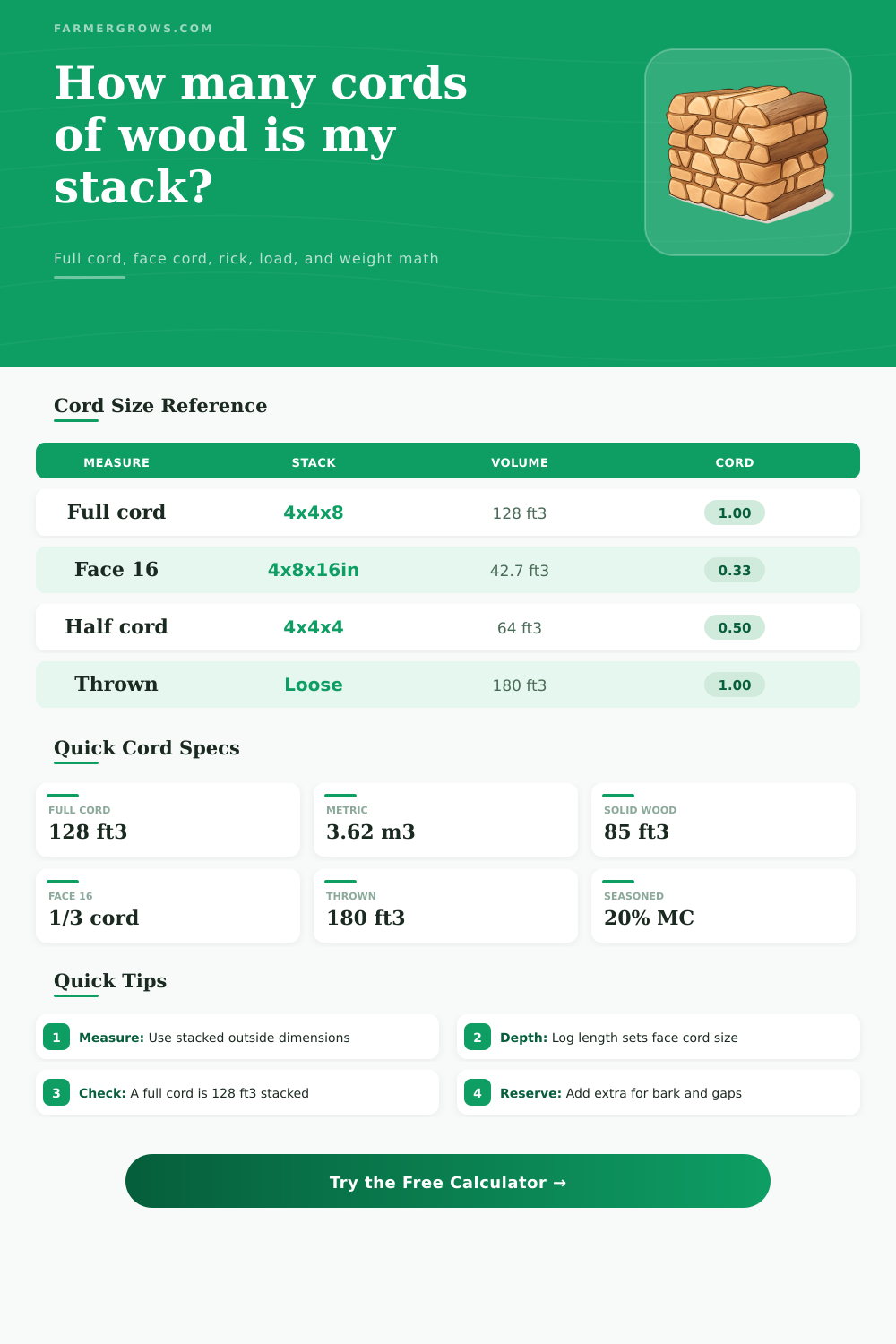
Exactly 128 stacked cubic feet, commonly visualized as 4 ft high x 4 ft deep x 8 ft long when stacked tightly enough for measurement.
Face cord or rick
Usually one 4 ft x 8 ft face with depth equal to log length. With 16-inch logs it is one third of a full cord.
Pickup load
A bed load depends on bed size, side height, stacking, and heaping. Loose loads need a conversion before comparing to cords.
Thrown cord
Loose dumped volume is larger than stacked volume. This calculator uses 165, 180, or 195 loose cubic feet per stacked cord.
●Standard cord measurement table
| Firewood unit | Typical dimensions | Stacked cubic feet | Full cord equivalent |
|---|---|---|---|
| Full cord | 4 ft x 4 ft x 8 ft | 128.0 ft3 | 1.000 cord |
| Half cord | 4 ft x 4 ft x 4 ft | 64.0 ft3 | 0.500 cord |
| Quarter cord | 4 ft x 4 ft x 2 ft | 32.0 ft3 | 0.250 cord |
| Face cord with 16-inch logs | 4 ft x 8 ft x 16 in | 42.7 ft3 | 0.333 cord |
| Face cord with 24-inch logs | 4 ft x 8 ft x 24 in | 64.0 ft3 | 0.500 cord |
| Average thrown cord | Loose, not stacked | About 180 loose ft3 | About 1.000 stacked cord |
Formula basis: full cords = stacked cubic feet / 128. Metric equivalent uses 1 ft3 = 0.0283168466 m3.
●Log length and face cord conversion
| Average log length | One 4 ft x 8 ft face volume | Face cords per full cord | Full cord fraction per face |
|---|---|---|---|
| 12 inches | 32.0 ft3 | 4.00 faces | 0.250 cord |
| 16 inches | 42.7 ft3 | 3.00 faces | 0.333 cord |
| 18 inches | 48.0 ft3 | 2.67 faces | 0.375 cord |
| 20 inches | 53.3 ft3 | 2.40 faces | 0.417 cord |
| 24 inches | 64.0 ft3 | 2.00 faces | 0.500 cord |
| 30 inches | 80.0 ft3 | 1.60 faces | 0.625 cord |
●Common stack and truck examples
| Example | Measured volume | Stacked cord estimate | Notes for measuring |
|---|---|---|---|
| One 8 ft rack, 16-inch logs | 4 ft x 8 ft x 1.33 ft | 0.333 cord | This is the common 16-inch face cord or rick size. |
| Two 8 ft racks, 16-inch logs | 2 x 42.7 ft3 | 0.667 cord | Two single-row racks are still short of a full cord. |
| Three 8 ft racks, 16-inch logs | 3 x 42.7 ft3 | 1.000 cord | Three rows of 16-inch wood make the 4 ft depth of a full cord. |
| 6 ft short bed, loose filled | 6 ft x 5 ft x 1.5 ft | About 0.25 cord | Loose pile conversion matters more than bed footprint. |
| 8 ft long bed, heaped | 8 ft x 5.3 ft x 2 ft | About 0.47 cord | Actual result changes with side boards and stacking. |
| 2 m x 1.5 m x 40 cm stack | 1.2 m3 stacked | 0.331 cord | Metric volume is converted to stacked cubic feet first. |
●Species weight and heat reference
| Wood species | Seasoned weight per cord | Green weight per cord | Approximate heat per cord |
|---|---|---|---|
| Hickory | 4,300 lb | 5,700 lb | 27.7 million BTU |
| White oak | 4,200 lb | 5,600 lb | 26.4 million BTU |
| Red oak | 3,528 lb | 4,888 lb | 24.0 million BTU |
| Sugar maple | 3,680 lb | 4,630 lb | 24.0 million BTU |
| White ash | 3,440 lb | 4,184 lb | 23.6 million BTU |
| Yellow birch | 3,689 lb | 4,312 lb | 21.8 million BTU |
| Douglas fir | 2,970 lb | 3,319 lb | 20.7 million BTU |
| White pine | 2,250 lb | 2,900 lb | 15.9 million BTU |
Weights vary by split size, bark, local species, and moisture. The calculator scales these per-cord reference values by measured cord equivalent.
●Practical measuring notes
An cord of firewood is an unit of volume and equals 128 cubic feet of firewood when stacked. However, if you dump the firewood into a loose pile, it will take up more cubic feet due to the gaps in the firewood pile. A loose pile of firewood can take up as much as 180 cubic feet of space.
This mean that a loose pile will take up more volume then a cord of stacked firewood. Because of this, two person could potentially disagree with the amount of firewood in a pile. The length of the logs is one of the factor that will change the volume of a face cord.
How to Measure Firewood and Why Amounts Differ
A face cord takes into consideration the area of the face of the firewood pile. However, the depth of the face cord will depend on the length of the logs. For example, sixteen-inch log will result in a face cord that is more smaller than a face cord with logs that are twenty-four inches long.
The length of the logs will change the volume of a face cord. Thus, to calculate how many face cord are in one cord, you will have to know the length of the logs. Without knowing the length of the logs, it will not be possible to compare the price of firewood between different place.
The species of the firewood will impact the amount of heat that the firewood gives off. Additionally, the moisture content of the firewood will also have an impact on the amount of heat given off by the firewood. Hardwood will burn longer and contain more energy than softwood.
Additionally, hardwood weigh more than softwood when the firewood is green. A cord of freshly cut oak will weigh more than a cord of dried oak. This is due to the fact that freshly cut oak will contain more water.
Since water does not burn, water will reduce the amount of heat that the firewood will give off. In order to burn well in a fireplace, firewood should contain approximately 20% moisture. If the wood contains more than 20% moisture, it will burn less efficient.
Pickup trucks is difficult to measure because the size of the truck bed and how the firewood is piled into the truck will alter the volume of firewood that the truck can carry. A pickup truck that is filled to the top of the bed may only have enough room to load a quarter cord of firewood. However, a pickup truck that has side boards and a loose load of firewood on the truck may be able to carry half a cord of firewood.
The difference in the amount of firewood that the two pickup trucks can carry is due to the fact that a loose load of firewood take up more space than a loaded cord of firewood. A calculator can help a person decide how to load the firewood into the truck bed to ensure that the volume of the load is converted into the volume of a cord of firewood. The tightness of the firewood stack can change the amount of firewood in the cord.
A cord of firewood that is loose and crookedly stacked will only contain 55% of the amount of firewood that a tight and straight cord will contain. This difference in the amount of firewood will affect the amount of weight that the firewood produces as well as the amount of heat that is given off by the firewood. A ten percent buffer should of been added to any firewood calculations.
A buffer of ten percent should be added because the bark on the logs and the way the firewood split will take up additional space within the calculations. Additionally, a buffer of ten percent should be added because wood naturaly settles over time. By adding ten percent to firewood calculations, people will not find themself short of firewood during the winter months.
The amount of firewood that an individual needs will depend on the size of the house and the heating habits of the inhabitants of that house. A small house with good insulation will need only two or three cord of firewood to last a winter season. However, an older house that has less insulation may require twice as much firewood.
The climate of the area in which the house is located and the insulation of the house will impact the amount of firewood that is required for that house to stay warm during the winter months. Before the delivery of firewood, it is necessary for the firewood to be measured. The length of the logs can be measured with a tape measure and the outside dimension of the firewood can be measured while it is still in its rows.
The dimensions of the firewood should be measured before the individual who will recieve the firewood dumps it on the ground. By measuring the firewood before it is dump, the individual will ensure that they will receive the correct amount of firewood. The unit of measurement for firewood is a cord of firewood.
All other units of measure will have to be converted to the volume of a cord of firewood.