Cheese Yield Calculator
Estimate finished cheese weight from milk volume, butterfat, protein, casein recovery, moisture, salt, trimming loss, and whey separation.
●Cheesemaking presets
Choose a starting batch, then adjust the milk solids and make targets to match your herd, recipe, and drain.
●Milk and cheese inputs
Milk is converted to kilograms using the density below; 1 gallon of typical cow milk is about 8.6 lb.
Higher fat raises cheese yield when the recipe retains butterfat in the curd.
Most rennet cheeses retain casein; whey proteins mostly leave unless making ricotta-style cheese.
Fresh cheeses carry more water; pressed and aged cheeses finish lower.
Lactose, minerals, and whey protein retention varies widely by style and acidity.
●Milk solids quick grid
●Cheese style yield table
| Cheese style | Typical moisture | Salt in cheese | Approx yield from 10 gal cow milk | Yield driver |
|---|---|---|---|---|
| Cheddar or hard pressed | 36% to 39% | 1.6% to 2.0% | 9 to 10 lb | Lower moisture and pressing reduce finished weight. |
| Gouda or washed curd | 39% to 43% | 1.4% to 1.8% | 10 to 11 lb | Washed curd holds moderate moisture with good fat recovery. |
| Feta or brined white cheese | 50% to 56% | 3.0% to 5.0% | 14 to 17 lb | High moisture and brine salt raise final mass. |
| Chevre or lactic goat cheese | 58% to 64% | 0.8% to 1.5% | 18 to 22 lb | Soft drain retains more water and fine solids. |
| Mozzarella | 48% to 54% | 1.0% to 2.0% | 10 to 13 lb | Stretching and hot whey can move fat out of curd. |
| Whole milk ricotta | 65% to 75% | 0.3% to 1.0% | 16 to 24 lb | Acid and heat recover whey proteins and fine solids. |
Use these as planning ranges. Actual yield depends on milk season, culture, cut size, cook temperature, pH at drain, and pressing schedule.
●Milk profile reference table
| Milk type | Fat % | Protein % | Total solids % | Best use in yield planning |
|---|---|---|---|---|
| Cow whole milk | 3.6 to 4.0 | 3.1 to 3.4 | 12.2 to 12.8 | Baseline for most farmstead hard and fresh cheeses. |
| Jersey or Guernsey milk | 4.8 to 5.5 | 3.6 to 4.0 | 14.0 to 15.2 | Higher solids can add several pounds per 10 gallons. |
| Goat milk | 3.4 to 4.2 | 3.0 to 3.5 | 11.8 to 13.2 | Smaller curd can need gentler handling to reduce fines. |
| Sheep milk | 6.5 to 7.5 | 5.0 to 6.0 | 18.0 to 20.0 | Very high solids create excellent hard-cheese yield. |
| Buffalo milk | 7.0 to 8.0 | 4.0 to 4.6 | 16.5 to 18.5 | High fat and casein are ideal for fresh stretched curd. |
●Recovery and loss reference table
| Make condition | Fat recovery | Casein recovery | Other solids retained | Calculator adjustment |
|---|---|---|---|---|
| Clean hard-cheese make | 90% to 94% | 92% to 96% | 5% to 10% | Use low moisture and 2% to 4% handling loss. |
| Fine curd or harsh stirring | 82% to 89% | 86% to 92% | 3% to 8% | Increase loss if whey looks cloudy or fatty. |
| Soft lactic drain | 86% to 93% | 88% to 95% | 10% to 25% | Raise moisture and other solids retention. |
| Ricotta-style acid heat | 55% to 80% | 25% to 55% | 30% to 65% | Use high moisture and high non-casein retention. |
| Trimmed aged wheel | 88% to 94% | 90% to 96% | 5% to 10% | Add rind trimming or aging shrink loss separately. |
●Milk volume conversion table
| Milk amount | Liters | Approx milk weight | Cheddar yield range | Fresh cheese yield range |
|---|---|---|---|---|
| 1 gallon | 3.785 L | 8.6 lb | 0.9 to 1.0 lb | 1.4 to 2.2 lb |
| 2 gallons | 7.57 L | 17.2 lb | 1.8 to 2.0 lb | 2.8 to 4.4 lb |
| 5 gallons | 18.93 L | 43 lb | 4.5 to 5.0 lb | 7 to 11 lb |
| 10 gallons | 37.85 L | 86 lb | 9 to 10 lb | 14 to 22 lb |
| 100 liters | 100 L | 227 lb | 24 to 27 lb | 37 to 58 lb |
●Yield comparison grid
Hard Pressed
Lowest moisture, firmest curd, and highest milk needed per pound of cheese.
Semi-Soft
Moderate moisture with good fat recovery, often a practical farmstead target.
Fresh Lactic
High moisture increases scale weight, but drain time changes yield quickly.
High-Solids Milk
Sheep, buffalo, and rich Jersey milk raise yield before recipe changes.
●Cheese yield tips
Yield is an amount of cheese that a person can make from a specific amount of milk. Yield is important in cheesemaking because if the sale of the cheese dont cover the cost of the milk that was used to make the cheese, the cheesemaker will not be profiting from the sale of that cheese. Furthermore, yield also allows a person to decide if a specific size of vat is appropriate for the amount of milk that they will use in the cheesemaking process.
Additionally, yield is an important number for cheesemakers to know in order to allow them to provide specific weights of cheese to their customers without guesswork. For instance, a person can have a yield of 9 percent or a person can have a yield of 11 percent, and the difference between those two yields can allow the cheesemaker to decide whether or not the cheese is potentially profitable to produce or disappointingly in it production. Milk is not a fixed ingredient in cheesemaking, as the components of milk changes constantly.
What Is Cheese Yield and Why It Matters
For instance, the breed of cow that produce the milk, the feed given to the cow, the time of year, and the stage of lactation of the cow changes the fat content of milk. Additionally, changes in the fat content of the milk will lead to changes in the weight of the cheese that is produced. The same relationship exists in regard to the protein content of the milk.
For instance, cows with higher amounts of protein in their milk will produce more cheese then cows with lower amounts of protein in their milk. These changing components of milk are not automatic in cheesemaking, as the recovery of milk components relies upon the size of the curd cut from the milk, the temperature of the curd cooked to, the acidity of the milk at the time of draining, and the care with which the cheesemaker handles the curd after it is produced. Another component of cheese that can affect the weight of the cheese are the moisture levels of the cheese.
For instance, soft cheeses contain more water than hard cheeses. Therefore, the weight of soft cheeses will be higher than hard cheeses if they contain the same amount of milk solids. However, the weight of soft cheeses will decrease over time during the aging of those cheeses, espesially if the cheese is to be sold in a dry form.
Hard cheeses will have less weight than soft cheeses because they press out more whey during the cheesemaking process. However, hard cheeses will lose less weight than soft cheeses during aging. Using a calculator that allows a cheesemaker to set a specific target for the moisture content of the cheese will show the cheesemaker the effect that the moisture target will have upon the total weight of the cheese.
Additionally, the amount of salt used in the cheesemaking process will also affect the total weight of the cheese. Brined cheeses will gain weight from the salt that is added to the cheese from the outside world. However, dry salted cheeses will lose weight as the salt draws moisture out of the cheese.
Whey volume is another element that must be calculated prior to the cheesemaking process. The volume of whey that is produced from the curd will allow a cheesemaker to ensure that they have the correct sized drain table or sink to accommodate the whey, or ensure that there is not no space left for the whey to exit the cheese making process. Additionally, calculating the expected volume of whey will alert a cheesemaker if the recovery rates of the cheese are unrealistic.
For instance, if the calculated amount of whey will indicate that a cheesemaker is attempting to retain too much fat in cheeses like ricotta, or if the combined moisture and salt levels in the cheese are too high for the fat content of the milk, the cheesemaker can avoid costly mistakes by being alerted of these problems prior to beginning the cheesemaking process. In reality, actual milk is often different than what is indicated in cheesemaking textbooks. For instance, a cheesemaker can test the fat and protein contents of the milk to ensure that they are representative of the content that will be entered into the cheese making calculator.
Additionally, the density of the milk can change the amount of milk that is weighed in comparison to the amount of milk that is measured. Milk has a density of 1.032 kilogram per liter. However, if the milk is richer in fat than regular milk, or if the amount of milk is measured by weight rather than volume, then the total amount of milk may change.
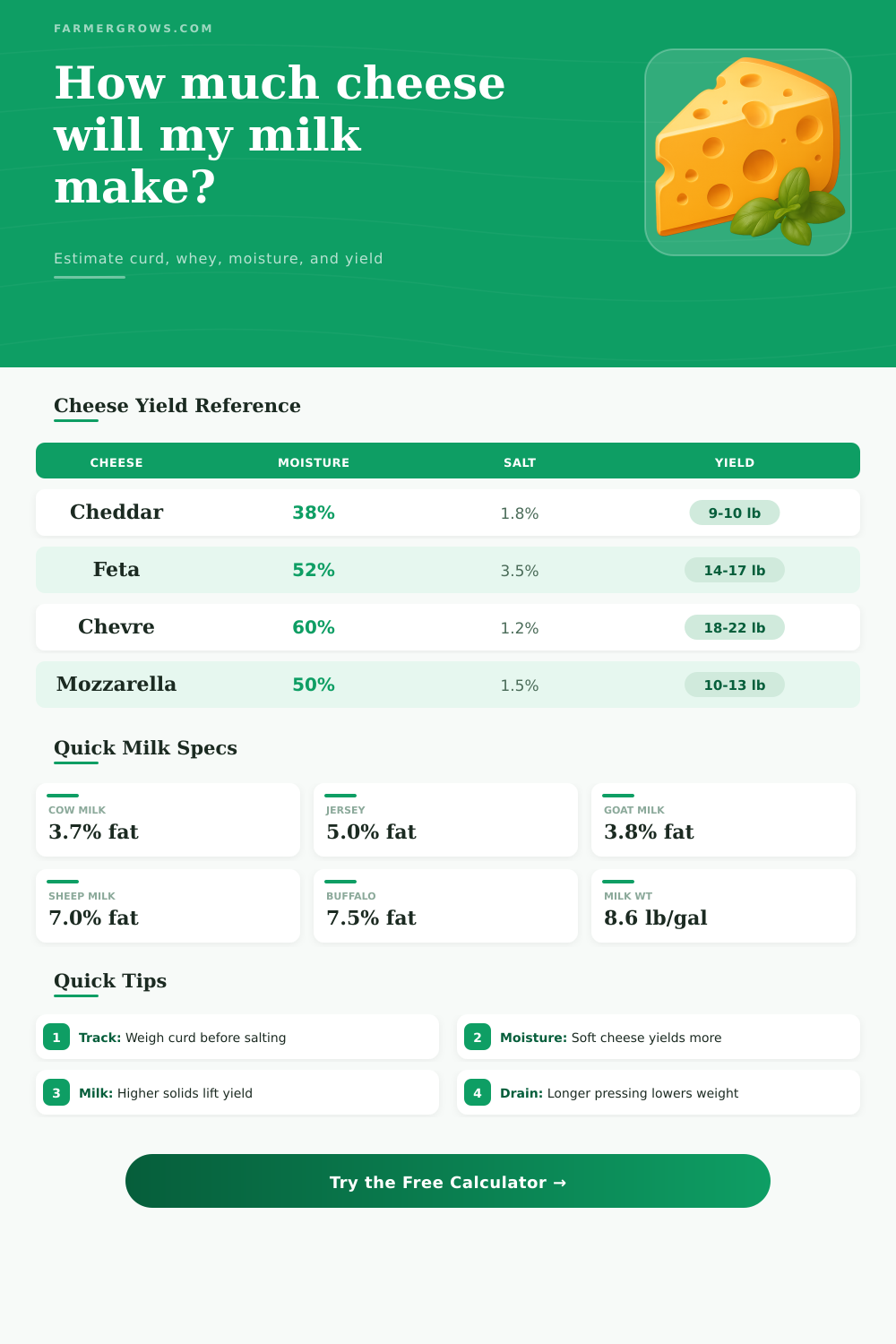
Tables can be used to compare different styles of cheese to different types of milk. For instance, different cheese styles contain different amounts of moisture and recovery rates of milk components from the cheesemaking process. For instance, feta cheese typically contains 52% moisture, while cheddar cheese has 38% moisture.
Each of these moisture percentages is within the realistic range for each type of cheese. These tables allow for cheesemakers to make comparisons between cheeses without having to memorize the various coefficients of the types of cheeses. There are a variety of mistakes that cheesemakers make who treat yield as a fixed component of the cheesemaking process.
For instance, if the yield percentage of cheese from milk is low, the cheesemaker may blame the culture or the rennet that is used in the cheesemaking process. However, they may not recognize that low solids content within the milk actualy causes the low yield, or that the curd was drained for too long during the cheesemaking process. Additionally, cheesemakers may attempt to increase the yield of cheese from milk by increasing the amount of moisture content of the cheese.
However, if the cheesemaker increases the moisture content, the cheese will not maintain that weight once it is removed from the cheesemaking process. By running calculations prior to the cheesemaking process, however, the cheesemaker can recognize these problems and avoid them. When a cheesemaking process is completed, the cheesemakers can use those calculations to assist them in the next batch of cheese that is made.
For instance, the cheesemakers may use the calculations to determine if they need to purchase additional milk in order to fulfill the order of their customer. Additionally, the cheesemakers can use the calculations to determine if they need to adjust the salt target that they use in their cheese to ensure that they reach the specific weight that they require for their cheese labels. Additionally, if a cheesemaker is considering adding a new source of milk to their milking process, the cheesemakers can use the calculations to determine if it is worth the effort to transport the milk to their cheesemaking process.
Thus, while calculations will not replace the experience that a cheesemaker gains over time in the making and selling of cheese, the calculations will remove the guesswork that must be performed prior to the cheesemaking process.