Dry Brine Bacon Calculator
Scale an equilibrium bacon cure from pork weight and slab thickness, including Cure #1, plain salt, sugar, spice, estimated cure time, nitrite ppm, and finished yield.
●Named bacon presets
Choose a starting point, then adjust the numbers for your exact slab. Presets use named bacon projects rather than generic batch labels.
▣Batch inputs
This calculator is for weighed equilibrium dry brines using Cure #1 containing 6.25% sodium nitrite. Do not substitute Cure #2, Tender Quick, celery powder, table salt, or a different nitrite blend without a tested formula.
Your bacon dry brine results
▦Cure ingredient grid
▧Cure #1 and nitrite reference
| Target | Cure #1 per kg pork | Cure #1 per lb pork | Use case | Calculator note |
|---|---|---|---|---|
| 120 ppm | 1.92 g | 0.87 g | Milder cured flavor | Useful for lighter bacon formulas |
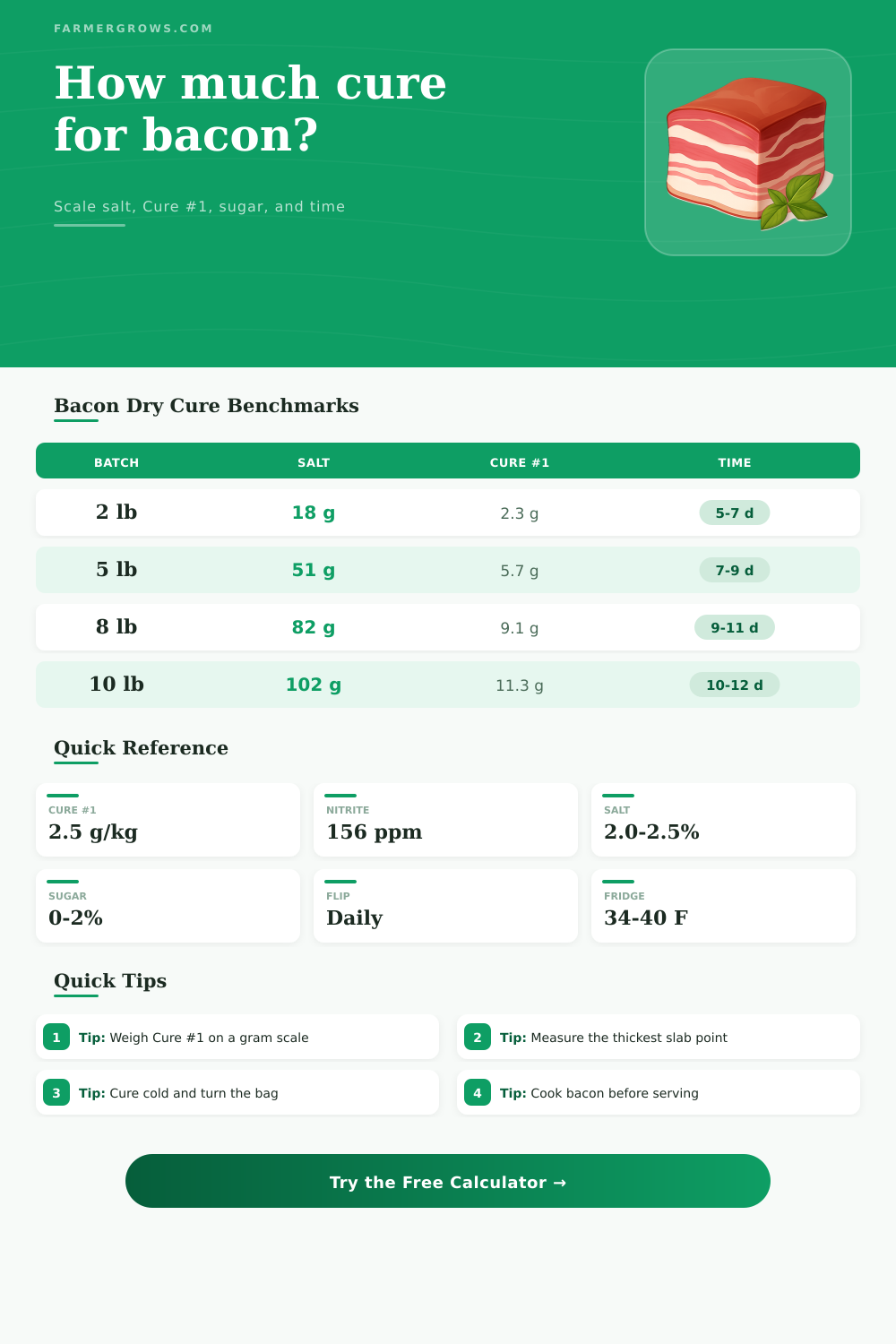
| 156 ppm | 2.50 g | 1.13 g | Common Cure #1 target | Default preset for weighed home batches |
| 200 ppm | 3.20 g | 1.45 g | Dry-cured bacon ceiling | Use only with a tested bacon process |
| 0 ppm | 0 g | 0 g | Uncured salted pork | Not a cured bacon calculation |
▩Salt and sugar range table
| Profile | Total salt | Sugar | Best fit | Flavor result |
|---|---|---|---|---|
| Mild breakfast | 1.75-2.00% | 0.50-1.25% | Thin belly or loin | Less salty, shorter storage |
| Classic belly | 2.00-2.35% | 0.75-1.50% | Most slab bacon | Balanced cure and slice flavor |
| Farmhouse pepper | 2.35-2.75% | 0.25-1.00% | Thick slabs or jowl | Firm texture and savory edge |
| Maple sweet | 1.90-2.25% | 1.50-2.50% | Smoked breakfast bacon | Sweeter browning and aroma |
| Pancetta style | 2.20-2.80% | 0-0.50% | Unsmoked cooked slices | Herbal, salty, and firm |
▰Thickness and cure timing table
| Thickest point | Minimum estimate | Common target | Turns | Notes |
|---|---|---|---|---|
| 1.0 in / 2.5 cm | 6 days | 6-7 days | Daily | Small slabs and jowl strips |
| 1.5 in / 3.8 cm | 8 days | 7-9 days | Daily | Typical pork belly slab |
| 2.0 in / 5.1 cm | 10 days | 9-11 days | Daily | Thick belly or shoulder bacon |
| 2.5 in / 6.4 cm | 12 days | 11-14 days | Daily | Use extra care for even coverage |
| 3.0 in / 7.6 cm | 14 days | 14-16 days | Daily | Often better split into thinner pieces |
▱Measuring conversion table
| Ingredient | Per teaspoon | Per tablespoon | Use in calculator | Accuracy note |
|---|---|---|---|---|
| Cure #1 | 5.67 g | 17.0 g | Teaspoon check only | Always weigh for bacon |
| Fine sea salt | 6.0 g | 18.0 g | Plain salt estimate | Brand and grind vary |
| Morton kosher | 5.0 g | 15.0 g | Plain salt estimate | Coarser than fine salt |
| Diamond kosher | 3.0 g | 9.0 g | Plain salt estimate | Large flake, low density |
| Brown sugar | 4.6 g | 13.8 g | Flavor estimate | Packing changes weight |
△Bacon style comparison grid
◆Practical cure notes
Making bacon at home involve several specific decisions regarding the salt and curing salt quantity, the amount of sugar, the number of day the bacon is cured, and the method of brining. Using the wrong amount of salt and curing salt will result in bacon that is under-cured. Under-cured bacon will either taste like ham or will pose a safety risk due to the lack of nitrite that would kills the germs that can grow in low-oxygen environments.
The calculator help the user to choose the proper quantities of each ingredient by eliminating the guesswork involved in calculating these ingredient. This calculator can help with dry brining, which relies upon the concept of equilibrium between the salt and curing salt that enters the meat and the salt that exists on the surface of the meat. Weight is one of the variable that must be considered in the dry brining process.
How to Use the Bacon Curing Calculator
A two-pound slab of pork will require a different amount of cure than a six-pound slab of pork. Thickness is another variable that must be considered. Thickness will affect how long it takes for the salt and curing salt to reach the center of the meat.
A thin piece of pork belly will cure faster than a thick slab of pork shoulder. The percentage of salt that is contained in the bacon will affect the flavor of the bacon, the shelf life of the bacon, and the texture of the bacon. A lower percentage of salt will create bacon that has a milder flavor and will allow the bacon to slice and brown more readily.
However, bacon with a lower percentage of salt will not stay fresh as long as bacon with a higher percentage of salt. A higher percentage of salt will produce bacon with a firmer texture and will have a longer shelf life. However, bacon with a high percentage of salt will be very salty if the cook does not cook it carefully to avoid excessive salting of the bacon.
The calculator allows for the user to input a total salt percentage that they desire for their bacon. However, the calculator will subtract the weight of the salt that is already contained in the curing salt (which is 93% salt by weight). Many people do not account for the salt content in curing salt, and they produce bacon that is too salty.
Curing salt has two different uses in the bacon-making process. First, curing salt contains the nitrite that prevents the growth of botulism in the bacon. Second, curing salt produces the pink color and flavor of bacon.
The amount of curing salt that is required for the bacon will change depending upon the parts-per-million (ppm) target of curing salt. The calculator will provide three different ppm settings: 120 ppm, 156 ppm, and 200 ppm. The 156 ppm setting is the standard ppm setting for bacon, and is the one that should be used for most home batches of bacon.
120 ppm is used for thin pork bellies that are to be consumed quickly, while 200 ppm is used for bacon that is cured for long periods. The amount of sugar and spices that is used is for changing the flavor of the bacon. Sugar counteracts the salt flavor, while sugar allow the bacon to brown during cooking.
Spices add aroma to the bacon, but do not chemically change the curing process. The amount of sugar and spices will change depending upon the weight of the bacon belly. For example, a five-pound bacon belly will require a different amount of sugar than a ten-pound bacon belly.
The calculator will convert the percentages of sugar and spices to grams, as well as to scoops of these ingredients for convenience of those who prefer to use scoops instead of scales to measure the ingredients. Weighing the ingredients will provide more accurate results than scooping the ingredients. Another variable in the recipe is the time that the bacon is cured.
The calculator will provide a minimum time for curing based off the thickness of the bacon belly. The calculator will also allow the user to view their planned cure time, and any cure time that is shorter than the minimum time required by the thickness of the bacon belly. If the user chooses such a shorter time, the calculator will allow the user to either split the bacon belly into smaller portions of bacon, or to plan for a longer curing time.
The bacon must be turned during the curing process to ensure that each surface of the bacon belly is in contact with the curing salt and curing salt solution. The calculator will also indicate how many times that the bacon should be turned during the cure period based upon the cure time that is chosen by the user. During the curing period and while smoking the bacon, the bacon will naturaly lose some of its water weight.
The calculator will apply a percentage to the initial weight of the bacon belly to determine the finished weight of the bacon after it is cured and smoked. The finished weight of the bacon will allow the user to determine how much bacon will be available for meals or gifts. For example, if the initial weight of the bacon belly was five pounds, and the percentage of moisture loss is eight percent, the finished weight will be four and a half pounds of bacon.
This information is useful in determining how many bacon bellies to cure at one time. One of the most common mistakes in the curing process is failing to recognize that the salt and nitrite must reach the center of the bacon belly. Therefore, each surface of the bacon belly must be in contact with the curing salt solution.
The bacon belly must be turned regularly to allow the cure to reach the center of the bacon belly. The thickness of the bacon belly must be measured at its thickest point to determine the time required for curing the bacon. If the thickness is measured at a wrong point on the bacon belly, the center of the bacon may not cure properly.
Any spot that is under-cured poses a risk for bacterial growth that can occur in low-oxygen environments. Finally, the temperature at which the bacon is cured is important for the safety of the bacon. The curing process must occur in the refrigerator, not on the counter.
The bacon belly should be between 34 and 40 degrees Fahrenheit. This temperature will slow the growth of bacteria in the bacon while it cures. Once cured, the bacon belly may move to smoking or cooking stages.
While the bacon curing calculator will not replace the need for a thermometer to ensure the bacon is safe to eat, the calculator will remove the guesswork and manual math that must otherwise be performed to calculate the proper ingredients and time for curing bacon. Each ingredient and schedule will be tailored to the user’s specific piece of pork belly. The rest of the process after the curing stage will be the same, regardless of the initial weight of the bacon belly.