Corned Beef Brine Calculator
Calculate an equilibrium corned beef brine from meat weight, cover water, salt target, Cure #1 target, sugar, pickling spice, injection draw, thickness, and refrigerator temperature.
This calculator sizes a closed-system curing brine: meat plus water are treated as the curing mass. Cure #1 must be weighed accurately, and the brine should stay refrigerated at 40°F or colder.
1Choose a corned beef preset
2Enter the brine and cure details
Your corned beef brine plan
Ingredient weights include the meat, the cover brine water, and the selected cover margin as one equilibrium curing system.
3Compare corned beef brine styles
4Ingredient reference grid
5Cure target table
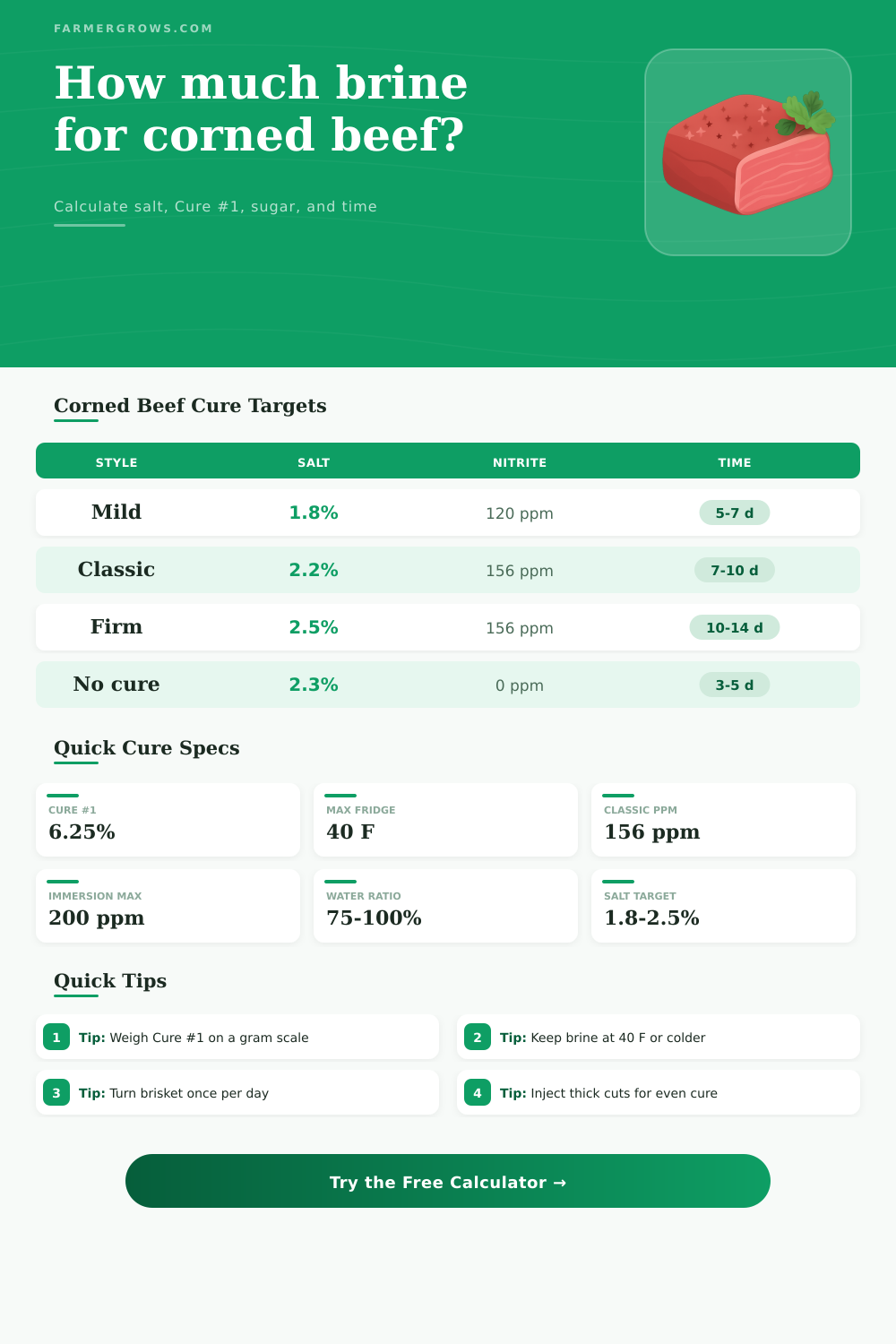
| Brine style | Salt target | Cure #1 target | Best use |
|---|---|---|---|
| Mild equilibrium cure | 1.8% to 2.0% | 120 ppm | Small brisket flats, short cook, less salty finish. |
| Classic corned beef | 2.1% to 2.3% | 156 ppm | Traditional pink brisket with balanced salt after simmering. |
| Firm lean roast | 2.4% to 2.6% | 156 ppm | Round, silverside, tongue, and dense cuts needing stronger seasoning. |
| Upper immersion limit | Recipe dependent | 200 ppm max | Regulatory ceiling for immersion or pumped meat products except bacon. |
6Salt and sugar measuring table
| Ingredient | Approx grams per Tbsp | Why weight matters | Calculator use |
|---|---|---|---|
| Diamond Crystal kosher salt | 9 g | Large flakes take more spoon volume for the same salt weight. | Use for spoon estimate only. |
| Morton kosher salt | 15 g | Denser crystals make tablespoons much saltier than Diamond Crystal. | Default salt conversion. |
| Fine sea or table salt | 18 g | Fine grains pack tightly and can oversalt when measured by volume. | Weigh for best accuracy. |
| White sugar | 12.5 g | Sugar is less safety critical than Cure #1 but affects balance. | Shown in the breakdown. |
7Water ratio and vessel table
| Container setup | Water as meat % | Cover margin | Good for |
|---|---|---|---|
| Vacuum pouch or zip bag | 50% | 0% to 5% | Small flats that can be fully surrounded with little free brine. |
| Compact food-safe tub | 75% | 5% to 10% | Most brisket flats and round roasts with a snug lid. |
| Standard crock | 100% | 10% to 15% | Whole briskets, tongues, and thicker point cuts. |
| Deep bucket | 125% to 150% | 15% to 25% | Irregular cuts where extra liquid is needed to keep everything submerged. |
8Curing time table
| Cut thickness | Soak only | With 10% injection | Check before cooking |
|---|---|---|---|
| 1.5 inches | 5 to 7 days | 4 to 5 days | Even firmness and color through the center. |
| 2.5 inches | 7 to 10 days | 5 to 7 days | No gray uncured stripe in a test slice after cooking. |
| 3.5 inches | 10 to 14 days | 7 to 10 days | Turn daily and inject dense centers for consistency. |
| 4.5 inches | 14 to 18 days | 10 to 13 days | Use a larger vessel and keep the meat fully submerged. |
9Batch notes
Reference basis: 1 lb = 453.59237 g; 1 quart = 0.946353 L; Cure #1 contains 6.25% sodium nitrite and 93.75% salt; USDA/FSIS refrigeration guidance for corned beef is 40°F or less.
Making corned beef at home require an understanding of the role that each of the ingredients plays within the process of making corned beef. The salt, the nitrite, and the spices that are used in the brine do more than flavor the meat; the salt, the nitrite, and the spices also play a role in the way that the muscle fiber of the meat hold water, as well as in the way that the meat will slice once it is cooked. If the brine are not measured and the meat isnt cured for the appropriate length of time, the beef may be firm enough to slice while raw, but it may not be able to hold its moisture once sliced.
Thus, the measurement of the brine and the length of the cure are the two most important factors to consider in the making of corned beef. Beyond the salt, the nitrite, and the spices, another factor to consider is the ratio of water to the weight of the meat that will be cured. Using a more tight ratio of water to meat will require more precise measurements of the salt and nitrite to ensure that they evenly distribute throughout the meat; using a loose ratio of water to meat introduce additional chance for error into the process.
How to Make Corned Beef at Home
A calculator will allow you to determine the amount of salt and the amount of nitrite you need to add to the brine according to the weight of the meat that will be cured and the water ratio that you choose. Additionally, you can use the calculator to determine whether you wish to use a tight or a loose ratio of water to meat; this decision will impact each of the other variables within the cure. Another factor that can impact the curing of the meat is the thickness of the brisket that is to be cured.
Due to the fact that a flat cut of brisket will be thinner than a point cut, the point cut will take longer to cure than the flat cut. The calculator will adjust the suggested length of the cure according to the thickness of the thickest portion of the brisket; if the middle portion of the meat is cured for too short a period of time, or if the outside of the meat is cured for too long, the mistakes will be visible after the meat is cooked. Cure #1 contains nitrite, and you must carefully measure the amount of Cure #1 that is used.
Using too little Cure #1 will result in the center of the brisket remaining gray after curing; using too much Cure #1 will impart a metallic flavor into the cured meat. The calculator will determine the gram weight of Cure #1 that is required for the meat and water to reach the desired level of nitrite. Additionally, the recipe will account for the salt content of Cure #1; any salt that is contained within Cure #1 will be subtracted from the total salt that is to be added to the brine.
Weighing the Cure #1 on a gram scale will ensure accuracy in the recipe. Another factor to consider in the making of corned beef at home is the salt level of the brine. The percentage of salt can be adjusted according to the way in which the brisket is to be served.
If the beef is to be simmered for long periods of time, a lower percentage of salt will be used; if the beef is to be sliced after cooking, a higher percentage of salt will be used. A calculator can be used to test different percentages of salt in the brine. The ability of the salt levels to be compared to one another can help the home cook to decide in what flavor of corned beef they would like to cook.
An additional method of curing the meat is injecting the liquid brine into the brisket. By injecting the brine into the brisket, the length of time that the meat must be cured will decrease; the injected liquid will distribute the salt and nitrite to the interior of the brisket. Additionally, injecting the meat will help to ensure that the middle portion of the brisket does not remain gray.
However, injecting the meat will produce a different texture in the meat than that which is not injected with brine. The calculator will determine how much liquid must be drawn from the brine according to the size of the brisket to be injected. The refrigerator at which the brisket is cured will have some impact upon the length of time that the curing process takes to complete.
If the refrigerator temperatures drop to temperatures below forty degrees, the nitrite reaction that occurs within the meat will slow; the temperature of the refrigerator must be ensured to remain stable. If the temperature is above forty degrees, the curing process will take longer to complete. The container in which the brisket is cured should be placed into the back of the refrigerator to ensure that it is maintained at a stable temperature.
Beyond the salt, nitrite, spices, water, and the parameters related to the meat, two other ingredients that can be added to the brine are sugar and pickling spices. The sugar ingredient helps to retain moisture within the meat while it is cooked, and it helps to counterbalance the salt flavor of the meat. Additionally, the pickling spices impart aroma into the meat, and contribute to the flavor of the meat while it simmers in the brine.
The amount of sugar and pickling spices that are used can be calculated according to the total weight of the brine that is to be prepared. By calculating each of the variables for making corned beef at home, it is possible to reliably prepare the ingredients required to produce the same result each time that the recipe is attempted. By using the same calculations for salt, sugar, and the length of time required for the cure, it is possible to identify which combination of these ingredients will produce your desired flavor of corned beef.
Furthermore, by varying only one of these variables, the others will adjust accordingly to accommodate that change. After the curing process is complete, it is recommended that a test slice is prepared. By preparing a test slice of the brisket, one may confirm that the center of the meat is fully cured.
By cooking a slice of the brisket, one can examine the color of the meat; if the color of the meat is uniform throughout the center of the meat, it is certain that the brisket has been cured. By performing a test slice, home cooks may avoid carving into a brisket that contains an uncooked stripe of meat in the middle. Once confirmed that the brisket is cured, it can be cooked using gentle heat.