Pork Brine Calculator
Calculate water, salt, sugar, optional Cure #1, and fridge brine time for chops, loin, ribs, shoulder, belly, ham, and other pork cuts.
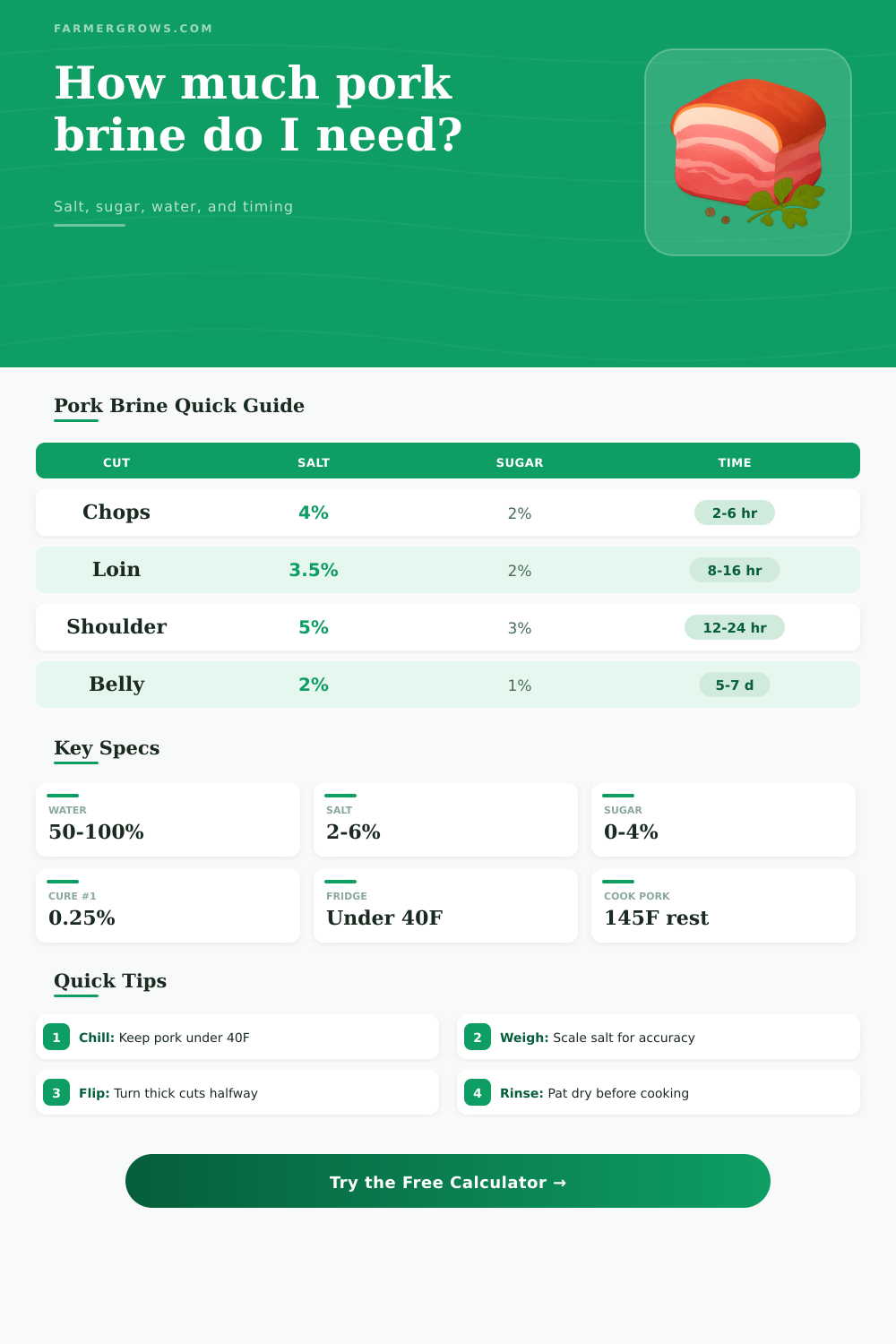
| Pork cut | Good salt target | Water ratio | Best use |
|---|---|---|---|
| Thin pork chops | 4% to 6% water-based brine | 50% to 75% | Fast soak before pan searing or grilling |
| Pork tenderloin | 3% to 4% water-based brine | 60% to 80% | Lean cut that benefits from moderate salt |
| Whole loin roast | 3% to 4.5% water-based brine | 75% to 100% | Even seasoning for roasting or smoking |
| Ribs | 4% to 5% water-based brine | 60% to 90% | Short soak before smoke, roast, or grill |
| Shoulder or butt | 4% to 6% water-based brine | 75% to 100% | Large barbecue cuts with dense muscles |
| Belly for cured bacon | 2% to 2.5% equilibrium salt | 40% to 60% | Use only with a tested cured-belly recipe |
| Cut or thickness | Fresh wet brine | Equilibrium cure | Handling note |
|---|---|---|---|
| 1 in chops | 2 to 4 hours | Not typical | Pat dry well for browning |
| 2 in chops | 4 to 8 hours | Not typical | Flip halfway if bagged tightly |
| Tenderloin | 4 to 8 hours | Not typical | Use a mild brine to avoid hammy texture |
| Loin roast | 8 to 16 hours | 1 to 2 days if recipe calls for curing | Rest uncovered after brining for better crust |
| Shoulder or butt | 12 to 24 hours | 2 to 4 days for tested cured recipes | Inject if the center must season faster |
| Belly slab | Not typical for fresh brine | 5 to 7 days with Cure #1 recipe | Turn daily and keep refrigerated |
| Fresh ham roast | 18 to 36 hours | 4 to 7 days for tested cured recipes | Thick hams often need injection |
| Ingredient | Approx grams per Tbsp | Approx grams per cup | Calculator use |
|---|---|---|---|
| Diamond Crystal kosher salt | 8 g | 128 g | Flaky salt, larger volume for same weight |
| Morton kosher salt | 15 g | 240 g | Dense kosher salt, measure carefully |
| Fine table salt | 18 g | 288 g | Very dense, easiest to overdo by volume |
| Fine sea salt | 17 g | 272 g | Varies by brand, scale is better |
| White sugar | 12.5 g | 200 g | Clean sweetness and browning support |
| Packed brown sugar | 13.8 g | 220 g | Molasses flavor for smoked pork |
Traditional Wet
Salt and sugar are calculated from water weight. It is simple, fast, and best for chops, tenderloin, ribs, and roasts.
Equilibrium
Salt and sugar are based on pork plus water weight. It is slower, more controlled, and useful for longer soaks.
Quick Brine
A higher water-based salt percentage shortens soak time. Use it for thin cuts and avoid leaving pork in too long.
Injection
Helpful for shoulder, ham, and very thick roasts. It speeds center seasoning but still needs cold holding.
| Topic | Common value | What it means | Do this |
|---|---|---|---|
| Prague Powder #1 | 6.25% sodium nitrite blend | Used for short cured products such as cured belly or ham-style pork | Follow a tested recipe and weigh it |
| Calculator estimate | 0.25% of pork weight | Equals 2.5 g Cure #1 per 1 kg pork | Verify against your recipe and product label |
| Cold storage | Under 40°F / 4°C | Brining is not room-temperature storage | Chill brine before pork goes in |
| Fresh pork cooking | 145°F plus 3 minute rest | Applies to steaks, chops, and roasts | Use a food thermometer |
Brining is a process that is used to make pork juicy. Brining is a process that prevents pork from becoming dry. Brining works because salt go into the meat, and water goes into the meat along with the salt.
Salt changes the way that the proteins in the pork hold onto the moisture in the pork. Often, sugar is one of the ingredients that can be added to the brine. The sugar helps the pork to brown when it is cooked.
How to Brine Pork
Additionally, the sugar balance the flavor of the salt in the brining solution. The success of the brining solution depends upon several variable. For instance, the weight of the pork to be brined will impact the results of the brining.
The thickness of the pork will also impact the outcome of the brining solution. Additionally, other variables that impact the outcome of the brining solution include the temperature of the brining solution and the method in which the pork are to be brined. Each of the variables listed above can change the outcome of the brining.
For instance, the weight of the pork will impact the amount of salt that is need. The thickness of the pork will impact the length of time that the salt has to travel to the center of the pork. Additionally, the method in which the pork is to be brined will impact the percentage of salt that is used.
For instance, if equilibrium brining is used, the salt percentage will have to be calculated in relation to the weight of the pork and the amount of water that will be used. In instances in which traditional brining is used, the percentage of salt will only be calculated in relation to the weight of the water. The ratio of water can help to determine the amount of water that will be needed to adequately cover the pork that will be brined.
Finally, the percentage of salt and the percentage of sugar will control the flavor and texture of the pork. If there is too little salt in the pork, the brining will not work. If there is too much salt in the pork, the pork will taste like cured meat.
Cure #1 is one of the optional ingredients that will only show up on the website should it be select. Pork belly and pork ham recipes require a specific amount of curing salt. Therefore, the user can estimate the curing salt if this option is select.
Most recipes for fresh pork do not require curing salt. Additionally, the temperature of the pork and the brining liquid is critical for the success of the brining process. The pork must remain below forty degrees.
Should the temperature of the pork or the brining liquid be kept below forty degrees, the growth of bacteria in the pork will be prevented. Brining should never be performed at room temperature; the pork should be placed in a refrigerator to ensure that the pork and the brining liquid is kept cold. The tool provides a starting recipe for the brining solution that must be followed.
However, the recipe cannot be changed. For example, the tool will provide a certain volume of water, a weight of salt, a weight of sugar, and a time range within which the brining process should occur. These variables will be calculated according to the thickness of the pork cut, the weight of the pork, the cut of the pork, and the method of brining that is to be used.
For instance, if equilibrium brining is chosen as the method for brining the pork, the weight of the salt will change as salt will be calculated in relation to the weight of the pork. Additionally, if the cut of pork changes from a pork chop to a thick pork shoulder, the time that the pork will be in the brine will change; the salt will have to travel a greater distance in a thick pork shoulder. Reference tables will be provided on the website that allow for the comparison of the recipe output with the typical range of different cuts of pork.
Brining works because the salt will change the structure of the proteins in the pork. If the salt is added to the meat in the proper concentration, the proteins will unwind, trapping the water in the meat. This trapped water will prevent the moisture in the pork from being cooked out of the meat.
The rate at which the brining process occurs will slow if the pork is brined at cold temperatures. Therefore, the tool assumes that the pork will be brined in a refrigerator. Warm brines will allow for the temperature of the pork to warm; however, warm liquids can also allow for the growth of bacteria in the pork before the brining process is complete.
The thickness of the pork will also impact the length of time that the salt will have to travel into the center of the pork. For instance, a two-inch pork chop will allow for the salt to travel a shorter distance than a four-inch pork shoulder. Therefore, the two-inch chop will season in a shorter period of time than the four-inch shoulder.
Many people make mistake when brining pork. For instance, many people do not understand that different cuts of pork require different strengths of brine. For instance, thin cutlets require a different amount of salt than the whole pork bellies that are often used in pork rinds.
Additionally, many people measure the salt by volume in place of using a scale to measure the weight of the salt. Using volume measurements will create incorrect results. The tool will ask for the type of salt to be used.
This will ensure that the volume of salt is correct. For instance, a tablespoon of fine table salt will contain more sodium than a tablespoon of Diamond Crystal kosher salt. Another mistake that is often made is leaving the pork in the brine for too long.
If the pork is left in the brine for too long, the texture of the pork may turn out similar to deli meat. The time ranges will provide a cushion of time; however, the pork should not be left in the brine for too long. If the pork is to be removed from the brine after cooking, the pork should be removed from the brine at least some of the time.
If the pork is removed from the brine, rinsed of the salt, and kept in the refrigerator uncovered, the pork will dry; this will allow for the pork to brown better when it is cooked. In equilibrium brining, the percentage of salt is calculated in relation to the weight of the water and the pork. The level of salt in the pork will never go higher than the percentage that is select.
In traditional brining, too much salt can be used, as there is no limit to how much salt can travel into the pork. Equilibrium brining is useful for brining pork belly or pork ham for long periods of time. For pork chops, the difference between equilibrium and traditional brining is less significant.
Injection of brine can be used for very thick or very dense cuts of pork. Thick cuts require that the salt be injected into the pork to help the salt reach the center of the thick cut of pork. The tool will not provide an exact volume for injection; however, the tool will provide information indicating that injection will shorten the time that the pork must remain in the brine.
For injection, a portion of the brine can be injected into the pork; the remainder of the pork can be brined in cover brine. During injection, the pork should be kept cold in contact with the brine. The decision of what type of brine to use will depend upon the schedule and the equipment that will be used in the brining.
For instance, if time is limited, brining thin pork chops quickly is a better option than an equilibrium brine for a whole loin of pork. For instance, if time is unlimited and there is a large cooler, a traditional brine can be used on a pork shoulder. The brine calculator will eliminate the need for mental math for the user.
The user can focus on the time and the cut of the pork. Brined pork must still be cooked properly. Brining will help the pork retain its moisture when cooked.
However, the brining recipe cannot be used to neglect proper food safety. The pork should be checked with a thermometer to make sure it reaches the proper temperature. After cooking, the pork should be allowed to rest for a brief period of time.
If the pork is kept cold, the salt is weighed correctly, and the thickness of the pork is considered, the brining process will be successful.