Water to Wax Calculator for Candle Making
Convert a water-filled vessel test into wax weight, fragrance oil, dye or additive amount, transfer loss, and per-candle batch targets using wax-specific density.
🕯Named Candle Presets
⚖Water Test Inputs
Formula Breakdown
📊Batch Snapshot
🧪Wax Density and Water Multiplier Table
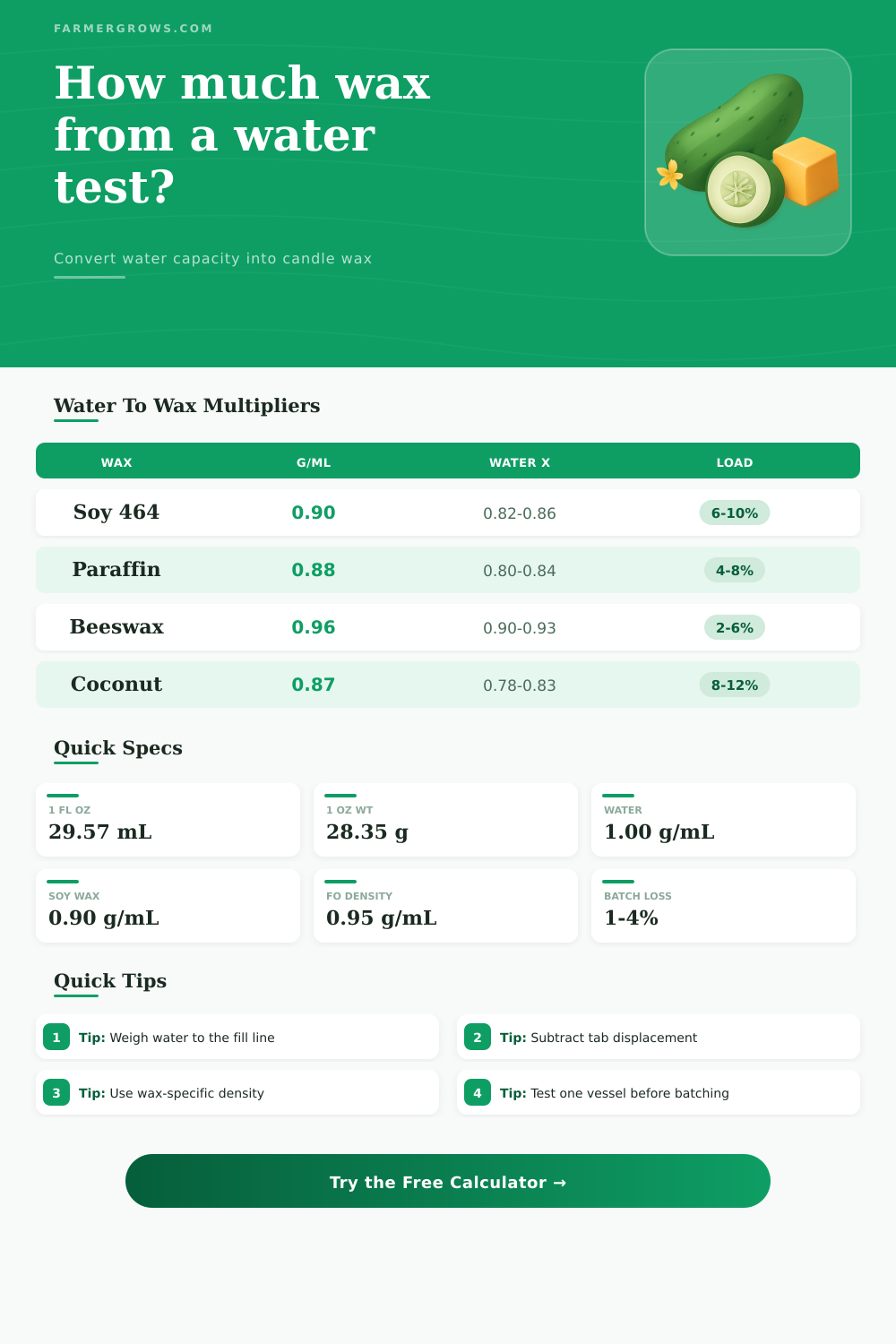
| Wax type | Density g/mL | Wax oz per water fl oz | Common fragrance load |
|---|---|---|---|
| Soy 464 container soy | 0.90 | 0.94 oz wt per fl oz water | 6% to 10% |
| Container paraffin | 0.88 | 0.92 oz wt per fl oz water | 4% to 8% |
| Filtered beeswax | 0.96 | 1.00 oz wt per fl oz water | 2% to 6% |
| Coconut soy blend | 0.88 | 0.92 oz wt per fl oz water | 7% to 10% |
| Coconut apricot blend | 0.87 | 0.91 oz wt per fl oz water | 8% to 12% |
| Palm pillar wax | 0.89 | 0.93 oz wt per fl oz water | 3% to 6% |
| Rapeseed container wax | 0.91 | 0.95 oz wt per fl oz water | 6% to 10% |
| Low density gel wax | 0.86 | 0.90 oz wt per fl oz water | 0% to 3% |
The ounce column uses water volume converted to milliliters, then wax density converted to avoirdupois ounces. Fragrance volume lowers the wax-only portion when included in the vessel fill.
📝Fragrance Load Reference
| Wax family | Conservative load | Typical container load | When to reduce |
|---|---|---|---|
| Soy container wax | 5% to 6% | 7% to 10% | Soft tops, seepage, weak cure |
| Paraffin container wax | 3% to 5% | 5% to 8% | Smoking wick or oily surface |
| Beeswax blend | 1% to 3% | 3% to 6% | Natural scent competes strongly |
| Coconut apricot blend | 6% to 8% | 8% to 12% | Very soft wax or hot climate |
| Palm pillar wax | 2% to 4% | 4% to 6% | Pillar sweating or mottling changes |
| Gel wax | 0% to 1% | 1% to 3% | Non-polar scent not verified for gel |
📏Common Vessel Water Tests
| Container style | Water at fill line | Soy wax at 8% FO | Best batch use |
|---|---|---|---|
| Standard tea light cup | 0.50 fl oz / 15 mL | 12 g wax plus 1 g FO | Trays and sample scents |
| Small jelly jar | 3.7 fl oz / 109 mL | 90 g wax plus 7 g FO | Single wick testers |
| Eight ounce tin | 6.8 fl oz / 201 mL | 165 g wax plus 13 g FO | Travel tins and gifts |
| Nine ounce straight jar | 7.5 fl oz / 222 mL | 182 g wax plus 15 g FO | Core retail vessel |
| Large tumbler | 11.0 fl oz / 325 mL | 267 g wax plus 21 g FO | Two or three wick candles |
| Mason jar pint | 14.0 fl oz / 414 mL | 340 g wax plus 27 g FO | Large single wick candles |
Reference values assume 0.90 g/mL soy wax, 0.95 g/mL fragrance oil, and no transfer loss. Use the calculator above for exact counts, displacement, and reserve.
🔢Water and Wax Conversion Factors
| Measure | Metric equivalent | Use in calculator | Accuracy note |
|---|---|---|---|
| 1 US fluid ounce water | 29.5735 mL | Volume mode | Best for marked pitchers |
| 1 avoirdupois ounce water | 28.3495 g | Weight mode | Scale weight, not fluid ounces |
| 1 gram water | 1 mL near room temperature | Weight mode | Most repeatable water test |
| 1 pound wax | 453.592 g | Bulk wax planning | Useful for slab or case portions |
| 1 ounce wax weight | 28.3495 g | Small batch weighing | Use weight ounces for ingredients |
| 1 cup volume | 236.588 mL | Pitcher capacity check | Volume only, not wax weight |
🔍Method Comparison Grid
Weighing water to the intended fill line is the most repeatable approach because 1 gram of water is approximately 1 milliliter of volume.
Multiplying water volume by wax density is fast, but it overfills when fragrance oil and additives also occupy container volume.
This calculator solves wax, fragrance, and additives together, then adds transfer loss, top-off reserve, and rounding after the fill volume is satisfied.
🌱Practical Candle Batch Tips
The water test is a method used in candle making to determine the amounts of wax that is needed to fill a container of a specific size. To perform a water test, a finished container are filled to the line that is to be occupied by the melted wax. The maker weighs the container to determine the weights of the water that is required to be use to calculate the amount of wax that should be melted.
A water test is necessary to compensate for the different volume of wax and fragrance oils, as well as the volume that is displaced by the hardware that is contained within the candle container. Because each type of wax and fragrance oil have a different volume, performing a water test will save the candle maker both time and wax. To perform a water test with the calculator, it is common for the candle maker to begin with filling the container with water.
How to Do a Water Test for Candle Making
One gram of water is approximately the same than one milliliter of water, which is an easily measured volume. Using water as the initial fill will allow the candle maker to determine an initial amount of wax that will be required to fill the container. However, using water will result in an initial shortage of wax once the fragrance oil are added to the container; the calculator will automatically adjust for this calculation for the candle maker.
In addition to the initial water fill amount, the candle maker will also enter the type of wax that is to be use in the batch, the amount of fragrance oil that will be used, and the type of hardware that will be contained within the container. The density of the wax that is to be used in the batch is one of the variable that new candle maker can often underestimate. For instance, soy wax has a density of 0.90 grams per milliliter, but filtered bees wax has a density of 0.96 grams per milliliter.
In addition to these different densities of the waxes, the fragrance oil have its own density as well (around 0.95 grams per milliliter). By assuming that the container will be filled with wax only, the candle will end up with a volume of wax that is less than that which is contained within the container. The calculator adjust for the density of both the wax and the fragrance oil so that the wax calculations account for the true volume that will be filled with wax.
The wick tab and the glue that adheres to the bottom of the container will also displace some of the wax that is to be melt for that batch of candles. By using the calculator, the wax weight will be calculated with the volume of the wick tab subtract from the container; by doing so, it ensures that the poured candle will not be too low within the container after it is poured. Any other hardware or warning labels that the maker is to be placed within the container prior to pouring the wax will also have their volume accounted for in the same manner.
Another consideration of the calculation is the transfer of the wax from the melting pitcher to the container. Some of the wax will remain within the pitcher; adhered to the thermometer; and to the spout of the pitcher. In addition, some container may develop sinkholes that require a second pot of wax to be added to the container.
These percentage of the total batch can be accounted for within the initial batch of wax to be melted. After the initial batch is calculated, the calculator will account for these variable to create a total amount of wax that will account for these potential loss. The tables on the calculator allow the candle maker to determine the different behaviors of the various types of wax with the addition of different type of fragrance oils.
These tables are not rules that the candle maker must be followed, but they do provide an understanding of the behavior of each type of wax and fragrance oil; soy wax often has higher fragrance load than other types of wax before it begins to sweat, beeswax blends contain less fragrance oil because of the scent of the bees wax itself, and coconut apricot blends tend to contain higher percentages of fragrance oil, which is why those blends are often used in recipes that is prepared for large containers. By calculating each of the ingredients separately, the candle maker can more easy make adjustments to the batch if any problem arise. For instance, if there is seepage within the candles, the candle maker can review the batch recipes to determine whether the issue was caused by too much fragrance oil or too high of a pour temperature.
Issues with the wax tunneling or the wick can also be easily rectify by adjusting only one ingredient. By calculating each ingredient separately, the calculator ensures that the recipe remains legible and organized. Each ingredient is also essential to scale the batches that were calculated with the water test.
The four ounce batch that worked for the tester candles may not produce the same result with the sixteen ounce batch that is to be produced; the rates at which the wax solidifies will change, which will change the amount of wax that must be reserve within the pitcher. By performing a water test on the larger container, the weights can be entered into the calculator to generate a new batch of wax weights. Some of the most common mistake in the creating of candles with the use of these calculators is the failure to set the percentage fill of the container to a value that is less than 100 percent.
By performing the water test and placing the percentage fill at 100 percent, the candle maker will end up pouring the melted wax to the brim of the container. Another error is the failure to account for the volume of the wick tab within the container; by not doing so, the candles that are poured will sit too low within the container. Each of these variable is accounted for within the calculator so that the candle maker can determine which variable are important within the batch of candles.
One of the main value of the use of these types of calculators is that it allow the candle maker to focus upon the aspects of candle making that require the attention and judgment of the individual crafters. After the wax weights are determined, the candle maker can focus upon the selection of the scent oils, the testing of the wicks, and any adjustment to the batch based upon the behavior of the wax and the fragrance oil. Thus, the calculator allows for the wax weights to be determined so that the remaining step in the candle making process may be focused upon by the crafters.
Additionally, because the water test is such a reliable calculation, it ensures that each batch of candles will have the same amount of wax.