Candle Wax to Fragrance Ratio Calculator
Plan wax, fragrance oil, additive load, overage, and per-candle fill weight from one balanced batch formula.
🕯Named candle batch presets
⚖Batch inputs
Formula breakdown
📊Wax comparison grid
🧪Fragrance load reference by wax
| Wax family | Conservative test | Common working range | Upper test cap |
|---|---|---|---|
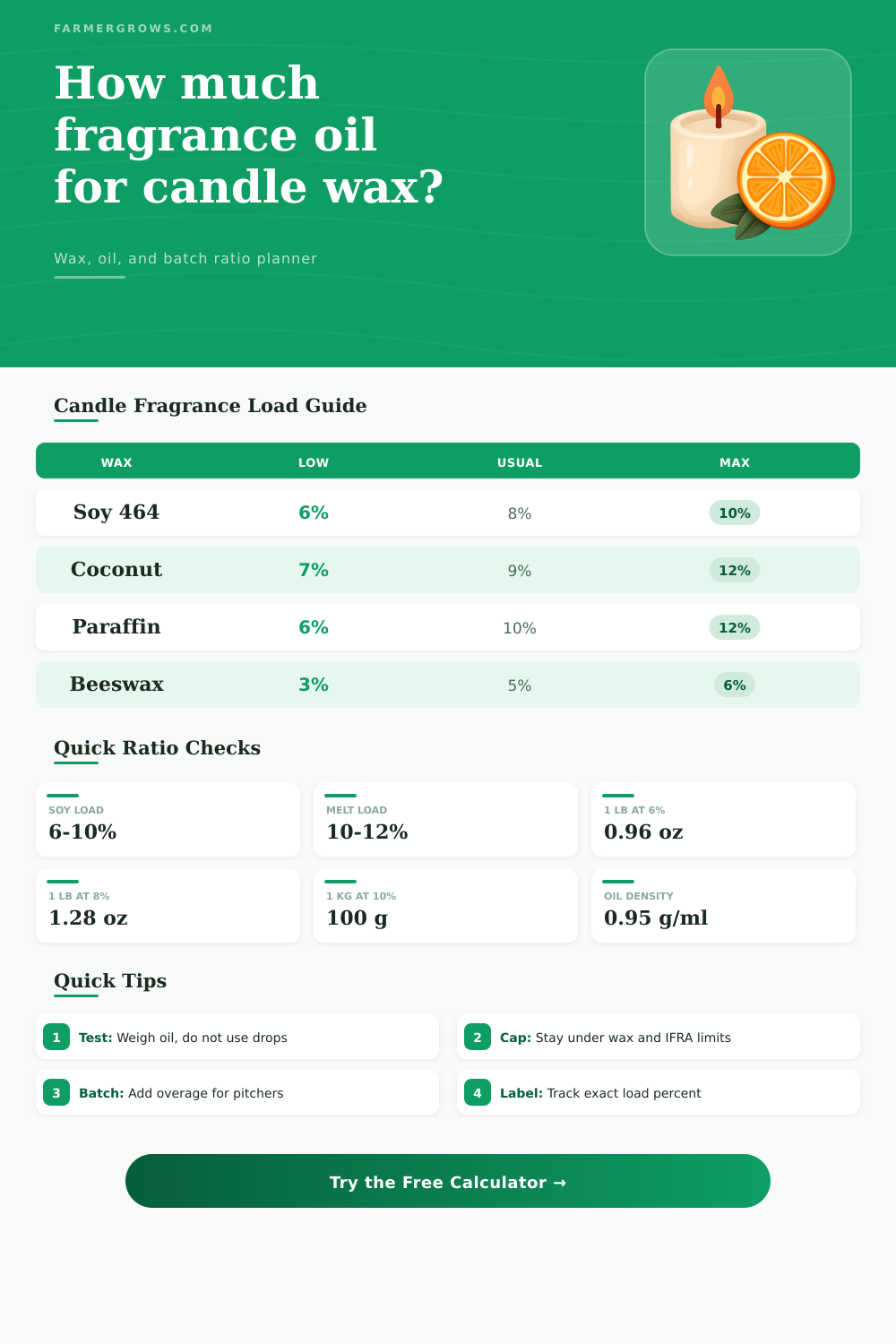
| Container soy, 464 style | 6% | 7% to 9% | 10% |
| Container soy, 444 style | 6% | 7% to 8.5% | 9% |
| Coconut soy container blend | 7% | 8% to 10% | 12% |
| Soft paraffin container wax | 6% | 8% to 10% | 12% |
| Parasoy wax melt blend | 8% | 10% to 12% | 12% |
| Filtered beeswax | 3% | 4% to 5% | 6% |
| Palm pillar wax | 4% | 5% to 6% | 8% |
| Rapeseed coconut blend | 6% | 7% to 9% | 10% |
📏Fragrance oil per wax weight
| Load | Oil per 1 lb wax | Oil per 1 kg wax | Total blend from 1 lb wax |
|---|---|---|---|
| 4% | 0.64 oz | 40 g | 16.64 oz |
| 6% | 0.96 oz | 60 g | 16.96 oz |
| 8% | 1.28 oz | 80 g | 17.28 oz |
| 10% | 1.60 oz | 100 g | 17.60 oz |
| 12% | 1.92 oz | 120 g | 17.92 oz |
🫙Common vessel planning weights
| Container or mold | Typical fill | Good first test load | Planning note |
|---|---|---|---|
| 4 oz jelly jar | 3.2 to 3.6 oz | 6% to 8% | Small flame, easy cure check |
| 8 oz tin | 6.0 to 6.8 oz | 7% to 8% | Leave headspace under lid |
| 10 oz straight jar | 8.0 to 8.8 oz | 8% to 9% | Common single wick test |
| 14 oz three wick bowl | 12.5 to 14 oz | 8% to 10% | Watch melt pool heat |
| Six cavity melt clamshell | 2.5 to 2.8 oz | 10% to 12% | No wick combustion test |
📝Batch sizing reference at 8% fragrance load
| Finished blend target | Wax needed | Fragrance oil | Approx oil volume |
|---|---|---|---|
| 1 lb / 453.6 g | 14.81 oz / 420 g | 1.19 oz / 33.6 g | 35 ml |
| 5 lb / 2.27 kg | 74.07 oz / 2.10 kg | 5.93 oz / 168 g | 177 ml |
| 10 lb / 4.54 kg | 148.15 oz / 4.20 kg | 11.85 oz / 336 g | 354 ml |
| 25 lb / 11.34 kg | 370.37 oz / 10.50 kg | 29.63 oz / 840 g | 884 ml |
🔍How the wax families compare
Soy container wax
Often starts cleanly at 6% to 8%. Higher loads may need cure testing for frosting, seepage, and hot throw.
Coconut blends
Usually tolerate richer fragrance loads, but soft blends can need extra top-off reserve and careful wick testing.
Wax melts
Melt formulas commonly run higher than wicked candles because they are warmed rather than burned by a wick.
Beeswax and pillars
Lower fragrance ranges help preserve hardness, clean release, and stable burning in denser wax structures.
💡Ratio tips
Making an candle requires choosing the right ratio of fragrance oil to waxes. The ratio of fragrance oil to wax is important because the amount of fragrance oil that you use will determine how strong of an scent each candle will emit. Using too little fragrance oils will make teh scent of the candle faint.
Using too much fragrance oil can make the wax appear cloudily and cause the wax to sweat on the surface of the candle. Using too much fragrance oil can also cause the burn of the candle to be even more. A candle wax to fragrance ratio calculator can help to determine the amount of fragrance oil and wax that you need.
How Much Fragrance Oil to Use in Candles
The calculator will prompt you for several differentlys inputs into the calculator. You will need to provide the weight of each container of candles that you will fill with melted wax, the number of candles that you will make, and how much of the melted wax and fragrance oil you can expect to lose during the candle making process. The loss of material is due to the fact that some of the melted wax and fragrance oil will remain in the pitcher or melting pot.
The calculator takes this extra material into account so that you dont run out of material while pouring your candles. The calculator separates the fragrance load from the maximum wax fragrance limit. The fragrance load is the percentage of fragrance oil that you want to use for your candles.
The maximum wax fragrance limit is the maximum percentage of fragrance oil that the wax manufacturer allows or the amount of fragrance oil that IFRA permits. These two value may not be the same. For instance, the soy wax may allow for up to 8% fragrance oil but the fragrance oil may only allow for 6% of that maximum load.
The calculator displays these two different number so that you do not go beyond the limits for the fragrance oil that you are using. The type of wax that you use will impact the maximum percentage of fragrance oil that you can use. Container soy wax can contain between 6% and 9% of fragrance oil.
Blends of soy and coconut wax can contain more fragrance oil than container soy wax because of the coconut fraction in the blend. Beeswax has a more rigid structure than soy wax so it can contain only 5% to 6% of fragrance oil. You can change these values in the calculator.
The density of the fragrance oil impacts the amount of fragrance oil of the wax. The weight of the fragrance oil per milliliter of oil can change the number of milliliters of fragrance oil that you have poured from the bottle. The calculator will convert the weight of the fragrance oil to volume so that you can use both a scale and a graduated cylinder to measure the oil.
Additives like stearic acid or UV inhibitors will have different percentages than the fragrance oil so the calculator will calculate them differently. The additive percentage will be calculated after the percentage of fragrance oil to the wax blend is determined so that the weight of the blend of wax and additives is maintained. Reference tables will be provided to the user so that they dont have to memorize the loads of fragrance oil that each type of wax will allow.
One table will provide the fragrance oil load for eight different types of wax. Another table will provide the amount of fragrance oil in grams for a pound of wax. These tables are merely starting points for the percentage of fragrance oil to wax so that you can see whether you plan to use a conservative or high percentage of fragrance oil.
Beyond the reference tables there will be fields for extra candles (top-off) and sample candles. The top-off field allows for the planning of any additional candles that may be made if the sample candle does not have the desired scent. The calculation will factor in the extra candles and the amount of wax that will be lost during the pouring process.
The calculator will show the planning number but will not calculate the hot throw or flash point of the fragrance oil. The hot throw of the candle is the strength of the scent of the burning candle. To determine this, you will have to burn a sample candle in a room.
The candle will also need to be allowed to cure for the length of time that the manufacturer of the fragrance oil recommends. The weight of the fragrance oil must be measured on a scale to determine the amount of grams of oil that will be used. Using a drop counter will not provide the same measurement as a scale because the scales will measure the grams of oil regardless of the thickness of that oil.
The calculator will determine the weight in grams and ounces so that your scale will be able to measure that amount of oil in grams or ounces. Using this calculator to determine the amount of fragrance oil and wax will make your candles more repeatable. You will know the amount of wax to remove from the box and the amount of fragrance oil to remove from it’s container.
This preparation will allow for control over the variables of your candles so that you can better control the scent and the appearance of the candle’s wax. The calculator will ensure that you know the amount of each ingredient without any uncertainty.