Row Spacing and Plant Population Calculator
Estimate plants per acre, total plants, seed required, planted row length, and target stand risk from acres, row spacing, in-row spacing, germination, rows per bed, and skip-row patterns.
Use the calculator for direct seeding, transplant counts, and field layout checks. Crop presets are practical starting points; always adjust row spacing, target stand, and germination to match your seed lot, planter, and local practice.
Plant Population Results
These results combine spacing capacity, target stand, germination, stand loss, skip rows, and buffer into a field-ready seed and row length estimate.
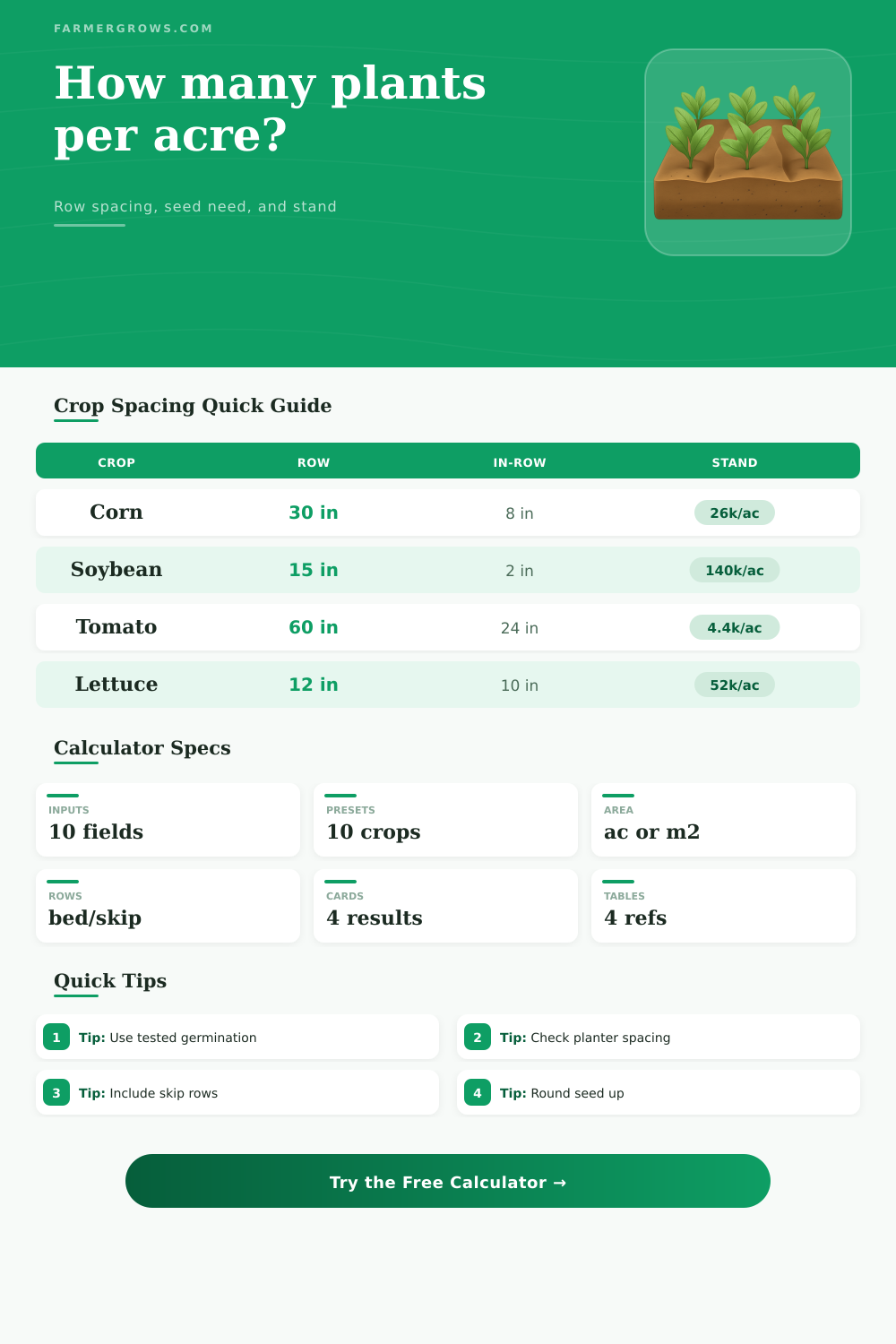
| Crop | Typical row spacing | Typical in-row spacing | Common target stand | Planning note |
|---|---|---|---|---|
| Field corn | 30 in | 6 to 10 in | 24,000 to 34,000 plants/ac | Target stand changes with hybrid, water, and yield goal. |
| Soybean | 7.5 to 30 in | 1.5 to 4 in | 100,000 to 160,000 plants/ac | Narrow rows need a higher seed count per row foot. |
| Sweet corn | 30 to 36 in | 8 to 12 in | 14,500 to 26,000 plants/ac | Block layout usually pollinates better than one long row. |
| Tomato | 48 to 72 in | 18 to 30 in | 2,900 to 7,200 plants/ac | Staked, trellised, and determinate systems differ widely. |
| Carrot | 8 to 12 in | 1.5 to 3 in | 174,000 to 348,000 plants/ac | Multi-row beds and thinning strongly affect final stand. |
| Skip pattern | Planted fraction | Row length effect | Population effect | Use case |
|---|---|---|---|---|
| No skipped rows | 100% | Full row length | No reduction | Standard solid-planted beds or fields. |
| Plant 2, skip 1 | 66.7% | Row length x 0.667 | Plants per acre x 0.667 | Dryland, traffic, or furrow access systems. |
| Plant 4, skip 1 | 80% | Row length x 0.8 | Plants per acre x 0.8 | Moderate access or water-conserving layout. |
| Plant 6, skip 2 | 75% | Row length x 0.75 | Plants per acre x 0.75 | Repeated pass pattern with two open rows. |
| Custom | Planted / total | Base row feet x fraction | Base stand x fraction | Use for farm-specific wheel tracks or alleys. |
| Germination | Stand loss | Survival factor | Seed multiplier | Field meaning |
|---|---|---|---|---|
| 95% | 5% | 90.3% | 1.11 | Fresh seed, good bed, low stress. |
| 90% | 10% | 81.0% | 1.23 | Normal field planning default. |
| 85% | 15% | 72.3% | 1.38 | Cool soil, older seed, or pest pressure. |
| 75% | 20% | 60.0% | 1.67 | Risky establishment; test seed first. |
| 65% | 25% | 48.8% | 2.05 | Often better to replace the seed lot. |
| Area | 30 in rows | 36 in rows | 60 in rows | Use this for |
|---|---|---|---|---|
| 0.10 acre | 1,742 row ft | 1,452 row ft | 871 row ft | Market garden block or trial strip. |
| 0.25 acre | 4,356 row ft | 3,630 row ft | 2,178 row ft | Small production planting. |
| 1.00 acre | 17,424 row ft | 14,520 row ft | 8,712 row ft | Full-acre planning and seed orders. |
| 5.00 acres | 87,120 row ft | 72,600 row ft | 43,560 row ft | Larger field seed and pass planning. |
| 10.00 acres | 174,240 row ft | 145,200 row ft | 87,120 row ft | Bulk seed and planter logistics. |
Use field-ready numbers: The seed need formula is target plants divided by germination and expected survival, then increased by the buffer. Use the seed tag germination when available.
Check the row system: Skip rows, alleys, and bed wheel tracks reduce planted row length. For beds, divide row feet by rows per bed and bed length to estimate passes.
Row spacing and plant populations determine the yield of a field, and row spacing and plant population will determine how much money a person make from that crop. The distance between each row affect how much sunlight, water and nutrients that each plant in that field will receive. The same is true for the distance between each seed that is drop into each row; each seed will also have an impact upon the amount of sunlight, water and nutrients that each plant will receive.
If the row spacing are too wide for that particular field and crop, the crop will not be able to reach its full productive potential. Too narrow a spacing between the rows, however, will also prevent those crops from reaching their full potential; each plant will compete with the others for sunlight, water and nutrients, potentially leading to each of those plants experiencing stress or even getting disease. Such stress and the diseases that result will lead to that plant stand thin out.
How Row Spacing Affects Plant Numbers and Seed Orders
The calculator will convert the physical feature of a field into the number of plants that should be planted into that field. The calculator will use both the row spacing and the in-row spacing to calculate the number of plants that should be planted into each field. Row spacing will determine the distance between each row of plants that is to be planted into the field.
In-row spacing will determine how many seed will be planted into each row. Multiply these two variables together by the total area of the field to determine the theoretical spacing capacity for that field. In reality, though, some plants will not emerge from the ground; there may be losses of plants due to germination issues, weather, pest and planter skips.
The calculation of the required order of seed for that field will take these losses into account. Additionally, there are also skip-row planting patterns that may be used that will impact the calculation of the number of plants that should be planted into each field. Some farmer will use skip-row patterns for their fields to allow for the movement of agricultural equipment within the field.
Others will use these patterns to allow for the even distribution of irrigation water across the field. The calculator will account for these variable that reduce the number of rows that will be planted into the field. The use of these patterns will reduce the plant population within each field.
Additionally, the change in how many rows are to be planted into the field will also impact the amount of sunlight and airflow that each plant receive. Changes to the amount of sunlight or airflow that reaches each plant will alter the development of disease within the crop, as well as alter the time of harvest of that crop. One of the most important numbers within this calculator is the target stand.
The target stand is the number of living plant per acre that the grower is to produce at the end of the growing season. This calculator will compare the theoretical spacing capacity for the field to that target stand; it will warn the grower if the target stand is not able to be achieved using the current layout of the field. Additionally, the calculator will work in reverse from the target stand to calculate the number of seeds that should go into the ground.
The stand loss and germination percentage for the crop will be applied to the target stand to calculate this number. Additionally, another percentage will be applied to that number to account for the fact that not all seed of each plant will be the same; the emergence rate for each batch of seeds can vary slightly from one batch to the next. Tables are provided on the calculator to assist the grower in understanding the various crops and their stand loss.
For instance, a person who is planning to plant carrots in beds that are very close together will use a different number than a person who is drilling soybean into rows that are thirty inches in width. These tables will allow the grower to understand the number of rows that can be planted in each field if using skip-row systems, which may be used when planting a variety of different crops using the same planter within the same season. The calculator will provide the grower with a series of baseline number for the field.
However, there are other variables beyond those provided within the calculator that may have an impact on the number of seeds to be planted into the field. For instance, the type of soil within the field may impact the amount of crusting or compaction of that soil that will impact the emergence of the plants from the ground. The method in which the field is to be irrigated may impact the benefit of planting rows that are narrow in width.
Additionally, the width of the equipment that will be used to plant the seed into the ground may impact the determination of whether or not a skip-row system is appropriate for that field. Finally, the cost or availability of the seeds may also have an impact upon the decision of how many seed to order for the ground. Many people make mistake when entering the various variables within this calculator.
For example, some individuals may use the same row spacing that the previous year used even if the change of row spacing for that year may lead to a better fit for the different type of hybrid crop that may be planted into the ground that year. Likewise, many people will use the percentage of germination that is provided on the seed package rather than testing the actual batch of seeds that will be planted into the ground; a percentage point difference in germination will have an impact upon the number of seeds that are ordered by hundreds of thousands of seed. Additionally, the length of each bed into which the seeds will be planted and the number of rows of plants that are to be planted into each bed will impact the number of passes that the planter will make over the field; such variable may become important if the grower has limited time or labor to work in the field, or if drip tape must be ordered to irrigate those plots.
It is important to run the calculator twice. The first pass at running the calculator will use the row spacing that the grower has used in the past. The second pass at running the calculator will allow for the grower to test a change in row spacing to determine if the change will result in a sufficient amount of plants to emerge from the ground.
Small changes in row spacing may result in the movement of thousands of plant per acre; small changes to row spacing, however, will not require the farm to purchase new equipment. While this calculator will provide a grower with an estimation of the number of seeds that are to be planted into the field, or the number of plants that will emerge from the ground, it isnt a prescription for how many seed to order for each acre of that field. Instead, though, it will force a grower to consider the number of plants that is lost during the establishment of those crops, and the various variables that may affect that number of plants; the field itself will contain the result of those efforts, but the numbers can provide a clearer starting point for the grower for that year than memory or habit of how many seed he or she typically orders for each field.