Soil Moisture Calculator
Convert wet and oven-dry sample weights into gravimetric moisture, volumetric water content, root-zone depletion, and irrigation water needed across a field, bed, or greenhouse zone.
Use a representative soil core, weigh it wet, dry it fully, then weigh it again. The calculator estimates how far the root zone is from your refill target using field capacity, wilting point, allowable depletion, root depth, and irrigated area.
Soil Moisture and Irrigation Deficit
Your sample results will appear here.
water mass = wet weight - dry weight
gravimetric % = water mass / dry weight x 100
bulk density = dry weight / core volume
volumetric % = gravimetric decimal x bulk density x 100
PAW = field capacity - wilting point
current depletion % = (FC - current water) / PAW x 100
target water = FC - target depletion x PAW
deficit depth = (target water - current water) x root depth
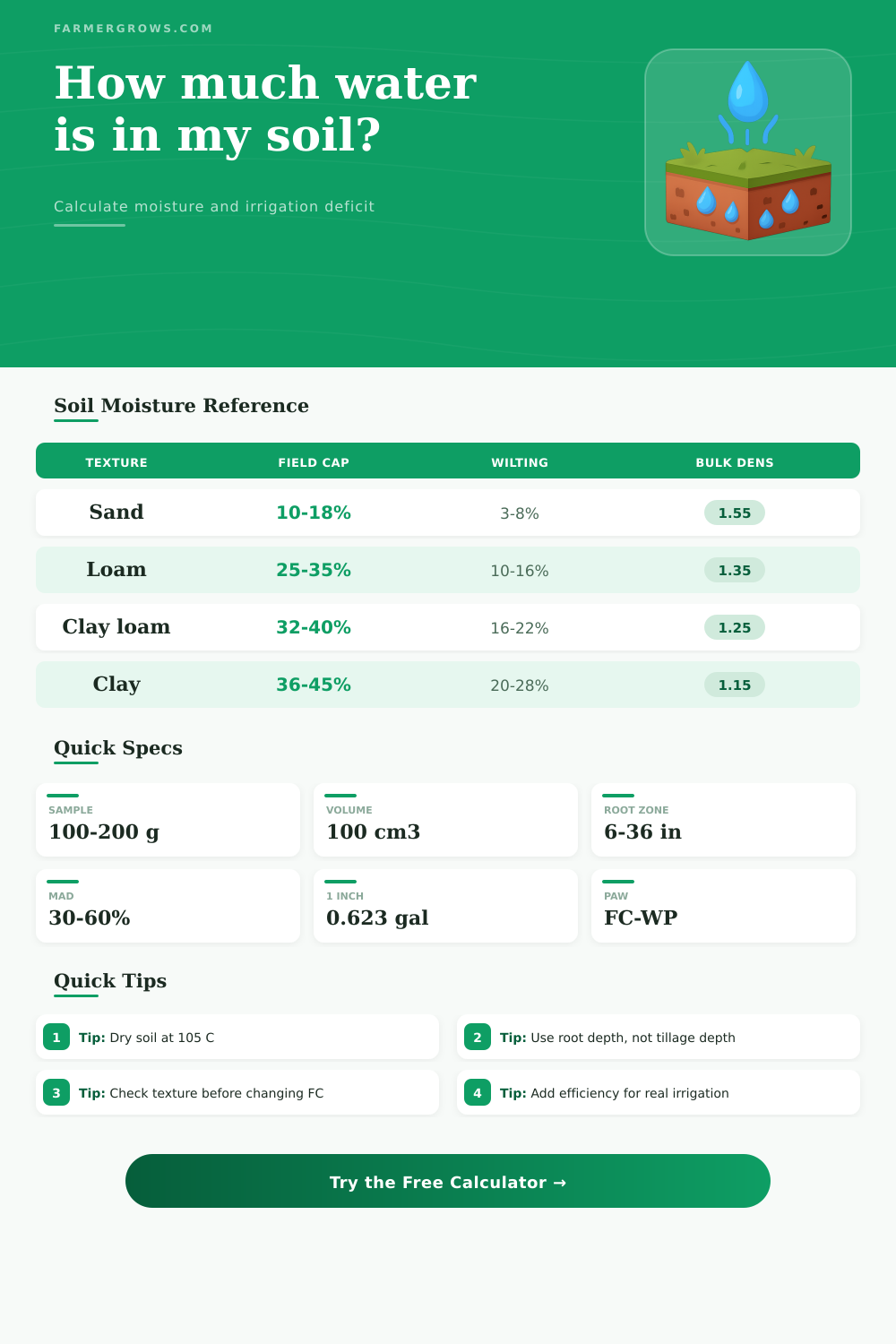
These cards compare the selected crop target with common soil textures. Use them to sense-check whether your field capacity and wilting point values are reasonable for the soil being sampled.
| Texture | Field Capacity (% v/v) | Wilting Point (% v/v) | Typical Bulk Density |
|---|---|---|---|
| Sand | 10-18 | 3-8 | 1.50-1.70 g/cm3 |
| Loamy sand | 12-20 | 5-10 | 1.45-1.65 g/cm3 |
| Sandy loam | 18-28 | 8-14 | 1.35-1.55 g/cm3 |
| Loam | 25-35 | 10-16 | 1.25-1.45 g/cm3 |
| Silt loam | 30-40 | 12-18 | 1.20-1.40 g/cm3 |
| Clay loam | 32-42 | 16-24 | 1.15-1.35 g/cm3 |
| Silty clay | 36-46 | 20-28 | 1.05-1.30 g/cm3 |
| Clay | 36-48 | 22-32 | 1.00-1.25 g/cm3 |
| Crop Group | Active Root Depth | Typical Refill Depletion | Irrigation Note |
|---|---|---|---|
| Leafy greens | 6-12 in / 15-30 cm | 25-40% | Keep moisture steady to avoid tip burn and slow regrowth. |
| Tomato, pepper, cucumber | 12-24 in / 30-60 cm | 35-50% | Use consistent moisture during flowering and fruit fill. |
| Corn, sorghum, sunflower | 24-48 in / 60-120 cm | 45-60% | Watch peak demand around tasseling, flowering, or seed fill. |
| Potato and root crops | 12-24 in / 30-60 cm | 30-45% | Large swings can reduce tuber quality or root shape. |
| Pasture and hay | 18-36 in / 45-90 cm | 45-65% | Deeper roots allow longer intervals if soil storage is high. |
| Orchard and vineyard | 24-60 in / 60-150 cm | 40-60% | Check management goal before using deficit irrigation. |
| Net Water Depth | Per 100 sq ft | Per 1,000 sq ft | Metric Equivalent |
|---|---|---|---|
| 0.25 in | 15.6 gal | 155.8 gal | 6.4 mm |
| 0.50 in | 31.2 gal | 311.5 gal | 12.7 mm |
| 0.75 in | 46.7 gal | 467.3 gal | 19.1 mm |
| 1.00 in | 62.3 gal | 623.0 gal | 25.4 mm |
| 1.50 in | 93.5 gal | 934.5 gal | 38.1 mm |
| 2.00 in | 124.6 gal | 1246 gal | 50.8 mm |
| Sample Method | Common Volume | Best Use | Handling Tip |
|---|---|---|---|
| Steel core ring | 100 cm3 | Bulk density and moisture | Trim flush, cap immediately, and avoid compaction. |
| Small core sampler | 50-75 cm3 | Greenhouse or container mix | Take several cores and average the result. |
| Large field core | 200-300 cm3 | Stony or variable soil | Remove coarse fragments or measure their volume separately. |
| Loose grab sample | Unknown | Gravimetric moisture only | Do not calculate volumetric water without a known volume. |
Sampling tip: Mix several cores from the same irrigation zone and crop stage, then weigh a subsample. One wet spot near an emitter can make the whole zone look wetter than it is.
Irrigation tip: If the calculated gross depth is more than your soil can absorb in one set, split it into shorter cycles and allow water to move downward between passes.
Soil moisture is a critical element in making irrigation decisions. Soil moisture will tell you if you should irrigate or not irrigate your crops. Some may use there sense to determine soil moisture, but using a weigh soil sample allows you to determine the actual moisture content in the soil.
Using the moisture information provide by a weighed soil sample, you can decide whether or not you should irrigate your field today or if you should wait to irrigate your fields. By knowing the moisture content of the soil in your fields, you can avoid both watering your crops too much and allow your crops to experience stress from being watered too little. The method of using a weighed soil sample is quite simple.
Check Soil Moisture by Weighing a Soil Sample
First, you will need to pull a core of soil from the ground. Next, you will weigh the soil while it is wet. Then, you will dry the soil and weigh it again.
By taking the difference between the wet weight of the soil and the dry weight, you can determine how much water was within the soil sample. Using that information, you can calculate the bulk density of the soil and the volumetric water content of the soil sample. Finally, you can use the weigh soil sample to determine the field capacity and wilting point of your soil.
These two values will allow you to determine how much water is available to the plants. The amount of available water in the soil are impacted by the texture of the soil. Textures like sand will hold less water than textures like clay.
Sand dries quick due to its large particle, whereas clay retains its water due to clay’s larger particles. However, because clay release its water more slowly than sand, clay will change the amount of water that you apply to your fields and how often you must irrigate. Loam soils are often used in vegetable bed due to the texture of the soil.
Using a soil moisture calculator will require you to input the soil texture of your fields. Another factor that will impact how you manage the soil moisture in your fields is the rooting depth of the crop that you will grow in those fields. A loss of soil moisture in comparison to deep-rooted crops like corn or orchard tree will negatively impact lettuces and other shallow-rooted plants.
The active root depth of your plants will determine how deep your storage bucket of soil moisture is. The tillage depth of soil is not a measurement of how much water your plants will need; rather, it is a measurement of how deep you will till your soil. Using the tillage depth is a common mistake that will make you think that there is more moisture in your soil than it is actualy present.
Management allowable depletion is the measurement that will tell you when you should refill the soil moisture. Management allowable depletion is a value between the field capacity and the wilting point measurements. Some crop can take being allowed to dry to fifty or sixty percent of the available water in the soil.
For other crops, however, you will need to irrigate the field when the management allowable depletion reaches thirty percent of the total field capacity of the soil. The percentage that is selected for management allowable depletion will depend upon the crop and your goal for that crop. For high-value vegetable, you may want to refill the soil moisture before it reaches thirty percent.
For vineyards or pastures, however, you may allow the field moisture to deplete further from field capacity. Once you have calculated the amount of moisture that your fields need, you must calculate how much water you will need to apply to your fields. The area of the field will impact the amount of water that you need to apply.
One inch of water over one thousand square feet of land is not the same as one inch of water over a single raised vegetable bed. Furthermore, even drip irrigation system will lose some of the applied water to evaporation. Thus, the gross amount of water that you apply will be more than the net amount of water that your fields receive.
Therefore, you cannot ignore irrigation efficiency in your calculation. The way that you take your soil sample will impact the moisture reading of that sample. If you take your soil sample next to one of your irrigation emitters, your soil will register a higher moisture percentage than the remainder of the irrigation zone.
Therefore, you should take several soil samples from your fields and mix those sample to obtain a more accurate average moisture content in your fields. The temperature at which you dry your soil sample will impact your measurement of the moisture content of your fields. If you dry your soil to a low temperature, the water in your soil sample will not evaporate complete.
However, if you dry your soil to too high of a temperature, the water that will evaporate is the structural water that is not available to the plants. To avoid these difficulties, dry your soil samples to 105 degrees Celsius until you reach a stable weight for your soil sample. Field capacity and wilting point can change based off the salinity, compaction, or organic matter of the soil.
Soils that contain a high amount of organic matter will hold more moisture than soils that contain less organic matter. The reference range for soil moisture are a good starting point for your fields, but you can use your soil samples to determine whether your fields contain moisture within the high or low range. It is also valuable to track the moisture in your fields throughout the season.
By tracking the moisture in your fields, you will be able to determine:
How quickly your fields will dry out;
How much water your irrigation system add to the soil;
How far in advance you can plan to irrigate your fields;
How much waste you will prevent by irrigating at the appropriate time;
How much stress you will prevent from your crops by irrigating at the appropriate time. By determining the amount of moisture that your fields have, you can set a limit for how much moisture you wish to maintain in your fields, thus allowing you to decide how much buffer you wish to provide between your fields’ current soil moisture and the soil moisture that will lead to stress in your crop.