Soil Amendment Calculator
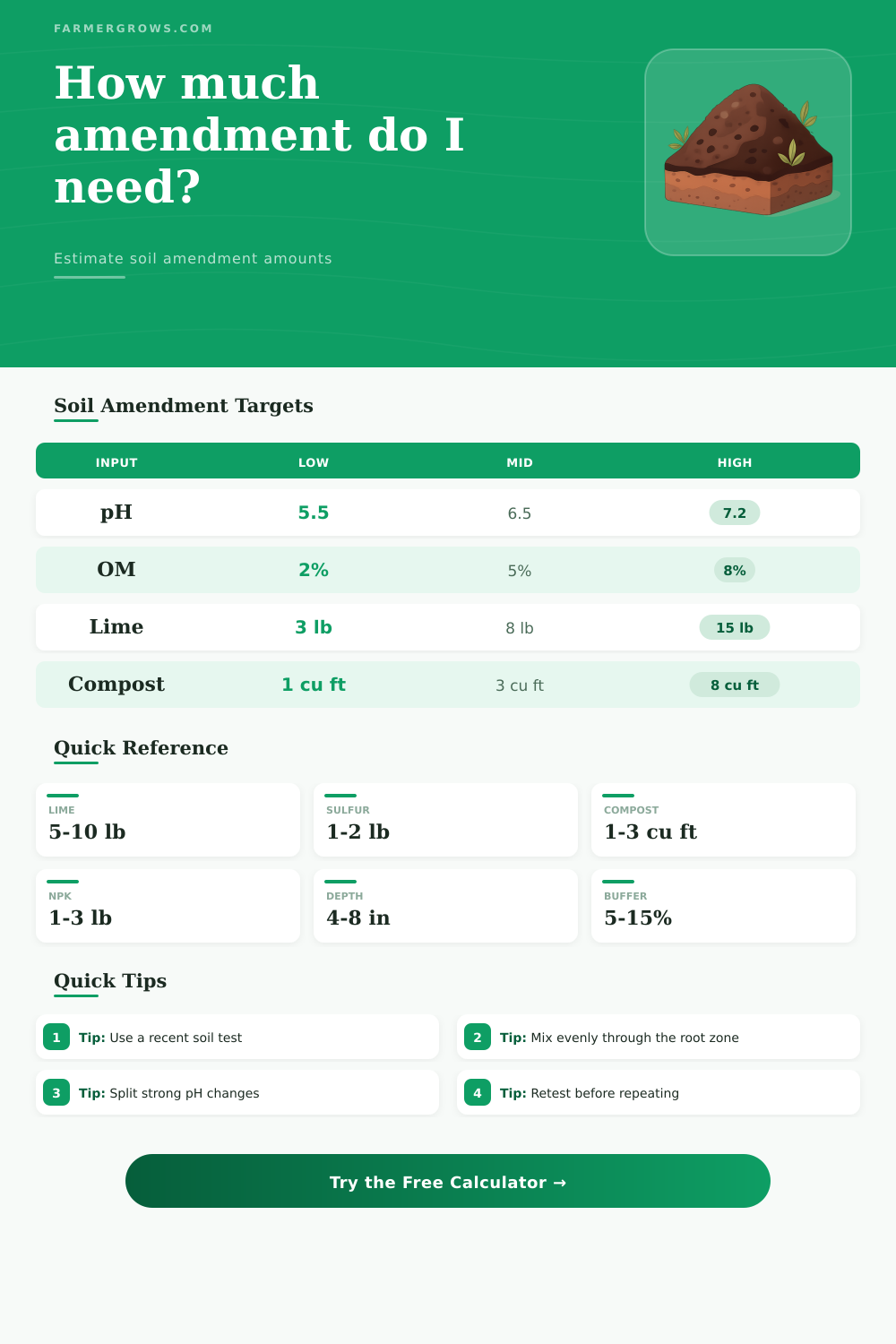
Estimate lime, sulfur, compost, gypsum, or NPK-style amendment amounts from bed area, soil depth, current pH, target pH, organic matter, application rate, incorporation depth, and buffer.
Use recent soil test numbers when available. The calculator scales the entered application rate by bed area, incorporation depth, soil buffering, and your selected safety buffer.
| Formula | Expression | What it estimates | Example use |
|---|---|---|---|
| Area conversion | sq m x 10.7639 = sq ft | Metric bed area converted for rate tables | 9.3 sq m = 100 sq ft |
| Soil volume | area x active depth / 12 | Cubic feet of bed soil considered | 100 sq ft x 8 in = 66.7 cu ft |
| Rate per sq ft | rate / 100 when basis is per 100 sq ft | Normalized application rate | 8 lb/100 sq ft = 0.08 lb/sq ft |
| Depth adjustment | incorporation depth / 6 | Scaling from common 6 inch lab basis | 8 in depth uses 1.33x |
| Total amount | area x rate x depth x soil x buffer | Final amendment to spread | 100 sq ft x adjusted rate |
| Amendment | Common reference rate | Main use | Important caution |
|---|---|---|---|
| Calcitic lime | 5 to 10 lb per 100 sq ft for modest pH lift | Raises pH and adds calcium | Do not apply repeatedly without retesting pH |
| Dolomitic lime | 5 to 10 lb per 100 sq ft for modest pH lift | Raises pH and adds magnesium | Avoid excess where magnesium is already high |
| Elemental sulfur | 1 to 2 lb per 100 sq ft for modest pH drop | Lowers pH slowly for acid-loving crops | Large changes can harm roots and biology |
| Finished compost | 1 to 3 cu ft per 100 sq ft for light feeding | Builds organic matter and tilth | Check salts for seedlings and protected beds |
| Balanced 10-10-10 | 1 to 3 lb per 100 sq ft as a starter range | Adds N, P, and K together | Follow crop and soil-test nutrient limits |
| Soil type | Buffer factor | pH change behavior | Application note |
|---|---|---|---|
| Sandy soil | 0.75x | Changes faster, stores fewer nutrients | Use lighter rates and retest sooner |
| Loam soil | 1.00x | Moderate pH and nutrient holding | Good default for garden bed estimates |
| Clay soil | 1.30x | Changes slowly due to high buffering | Needs careful mixing and patience |
| Raised bed mix | 0.90x | Often drains fast with variable compost | Use bed-specific tests when possible |
| Peaty or high organic soil | 1.15x | Organic acids can hold pH lower | Move pH in small steps |
| NPK-style material | Typical reference rate | Primary nutrient role | Best fit |
|---|---|---|---|
| Balanced 10-10-10 | 1 to 3 lb per 100 sq ft | General N, P, and K supply | Mixed vegetables with low test levels |
| Blood meal | 1 to 2 lb per 100 sq ft | Fast organic nitrogen | Corn, greens, and nitrogen-hungry crops |
| Bone meal | 2 to 4 lb per 100 sq ft | Slow phosphorus and calcium | Rooting crops where phosphorus is low |
| Kelp meal | 1 to 2 lb per 100 sq ft | Light potassium and trace elements | Transplant beds and stress support |
| Gypsum | 5 to 10 lb per 100 sq ft | Calcium and sulfur without pH lift | Sodic or tight clay soils when indicated |
Before changing pH: Treat lime and sulfur as slow corrections. For shifts larger than one pH point, apply part of the amount, water it in, wait, and retest.
Before adding nutrients: Compost and NPK materials can overlap. If phosphorus or salts are already high, prioritize organic matter quality over heavier application rates.
Soil is the foundations for everything that a person grows from seed, but people only tend to notice the soil if the soil is causing some types of problem for the plants that is growing in the soil. For instance, people might notice that there plants are pale, or they might notice that their garden bed become soggy after it rains; either of these problems are caused by the condition of the soil in which those plants are growing. People typically respond to these problems by adding amendments to the soil in which they grow their plants; however, adding amendments to soil without first understanding the soil in which they plan to add those amendments will waste both moneys and effort to fix the problems in the soil.
In order to fix problems with soil, a person must understand what the soil currently contains within the garden beds, as well as what type of amendments the soil needs. The effectiveness of certain soil amendments depend upon the situation of the soil in which they are to be used; for instance, people often use lime to raise the pH of acidic soil, but only if the soil is capable of holding that change that the lime will make to the soil; sulfur can be added to soil to lower its pH, but the changes can take time to occur due to the biology of the soil, as well as the fact that the sulfur may fail to have any effect in soils that are heavy in clay; compost can be added to soil to increase its amount of organic matter, but adding too much at once may lead to the soils salts or phosphorus levels becoming too highly for the plants that use that soil. Each of the variables in the calculator will mathematically change the results of the calculation.
How to Use a Soil Amendment Calculator
For instance, the area of the garden bed will mathematically change the total amount of the amendment that is required to treat each of the beds; the depth in which the soil will be amended will change the total amount mathematically; the depth of the amendment that is to be incorporated into the soil will change the total amount mathematically; the pH of the soil and the pH that is to be targeted will change the total amount mathematically; the percentage of organic matter in the soil will change the total amount of compost that is to be added to the soil; the texture of the soil will change the total amount mathematically due to the rate at which sandy soils respond to changes in pH as compared to clay soils; and the percentage of the soil that is to be buffered with the amendment will change mathematically; buffering the soil ensures that the amount of amendment that is spread by hand will not be uneven, and thus the percentage provides for error in spreading the amendment. The results of the calculator will provide the total amount of the amendment that is to be carried to the garden bed; the rate at which the amendment should be spread into the soil; the volume of soil that is to be amended; the pH and organic matter percentages that will indicate whether the change that will be made to the soil is a modest change or an aggressive change; the total amount of the amendment, the rate of application, the volume of soil, the pH and organic matter change, and the soil texture all influence how much of the amendment is to be added to the soil in which the plants are growing; these variables will tell people if the soil test results leads to a recommendation for spreading amendments. When soil texture is changed in the recommendation of the amendment that is to be added to the soil, sandy soil beds may require less of that amendment than clay soil beds of the same area and pH levels; clay soil tends to hold onto calcium, while sandy soil do not; sandy soil has a tendency to undergo large changes if the same amount of amendment is added as to clay soil; clay soil resists the movement of pH in the soil, while sandy soil does not; sandy soil beds may need three-quarters of the amount of lime as clay soil beds of the same area and pH levels.
Thus, changing the texture of the soil changes the amount of amendment that should spread into the soil. The depth choices that are offered in the calculator will change the total amount of the amendment that is required to treat the soil; if the depth that is chosen is less than the depth at which the amendment will be incorporated into the soil, the amount of the amendment will be less than if the depth choice was chosen to be more deep; if the depth that is chosen is more than the depth at which the amendment will actualy become incorporated into the soil, the amount of the amendment will be more than if the depth choice was set to less. Another place in which people may make mistakes is in the rate at which the amendment is to be spread into the soil; the rate suggested by the amendment manufacturer may not apply to the soil that is to be amended; for instance, rates suggested for lime are typically provided for soils that are of average loam texture and that have a medium gap in pH; if the pH gap is more extensive than average, or if the soil is heavier in clay or sand than average, then more of the amendment is to be spread; if the organic matter content in the soil is high, and if the gap in pH between the current pH and the target pH is small, then the suggested rate for the amendment may be too high; the amendment calculator adjusts the amount of the amendment that is to be spread into the soil with each of these variable.
Many people make mistakes when applying the calculated amount of the amendment to the soil. For instance, many people will apply lime or sulfur to their soil, and then will add more of that amendment before the first addition has become reactive with the soil; both lime and sulfur are slow moving in soil; sulfur, additionally, is also slow moving due to the biology of the soil; splitting the application of lime or sulfur into two growing seasons will allow for the amendment to become reactive with the soil, and then for a soil test to be performed between the application of the first amendment and the second application; patience should also be used in adding compost to soil; one layer of compost will provide benefits to the soil for many year, and excessive additions of compost may lead to soil pH issues. The soil amendment calculator does not account for each of the variables in the soil.
For instance, the calculator does not know the amount of salt in the compost; the calculator does not account for how much rain has fallen recently; the calculator does not calculate how compacted the soil in the garden beds is, and how that compacted soil may limit the ability of plant roots to explore the soil. Thus, each of these variables may impact the soil and the decisions that are made regarding the soil; however, they are not accounted for in the recommendation that spreads the amendment. It is recommended, then, that the amendment calculator is used as a way of obtaining the total amount of the amendment that is to be placed into each bed; however, the amendment should also be watched for its effect on the plants that are growing in those beds.
Treating the soil amendment as a conversation with the soil is the most important aspect of applying soil amendments. Add an amendment to the soil, the soil will change, the plants will show the results of that change, and you can adjust the amendment according to how well the soil and plants responded to the addition of that amendment. By removing the difficulty of the math of the soil amendment recommendation, the individual can focus upon the condition of the soil rather than the mathematical calculations of how much of the amendment is to be added.