Seed Quantity Calculator
Estimate how many seeds, ounces, planting spots, and row feet you need after spacing, seeds per hole, germination, thinning, successions, and buffer.
Use field, bed, or row measurements from your actual layout. Seed counts per ounce vary by variety and seed lot, so replace the default crop values when the packet gives a better number.
Seed Quantity Results
Totals include the selected crop spacing, sowing density, germination correction, thinning allowance, succession count, and buffer.
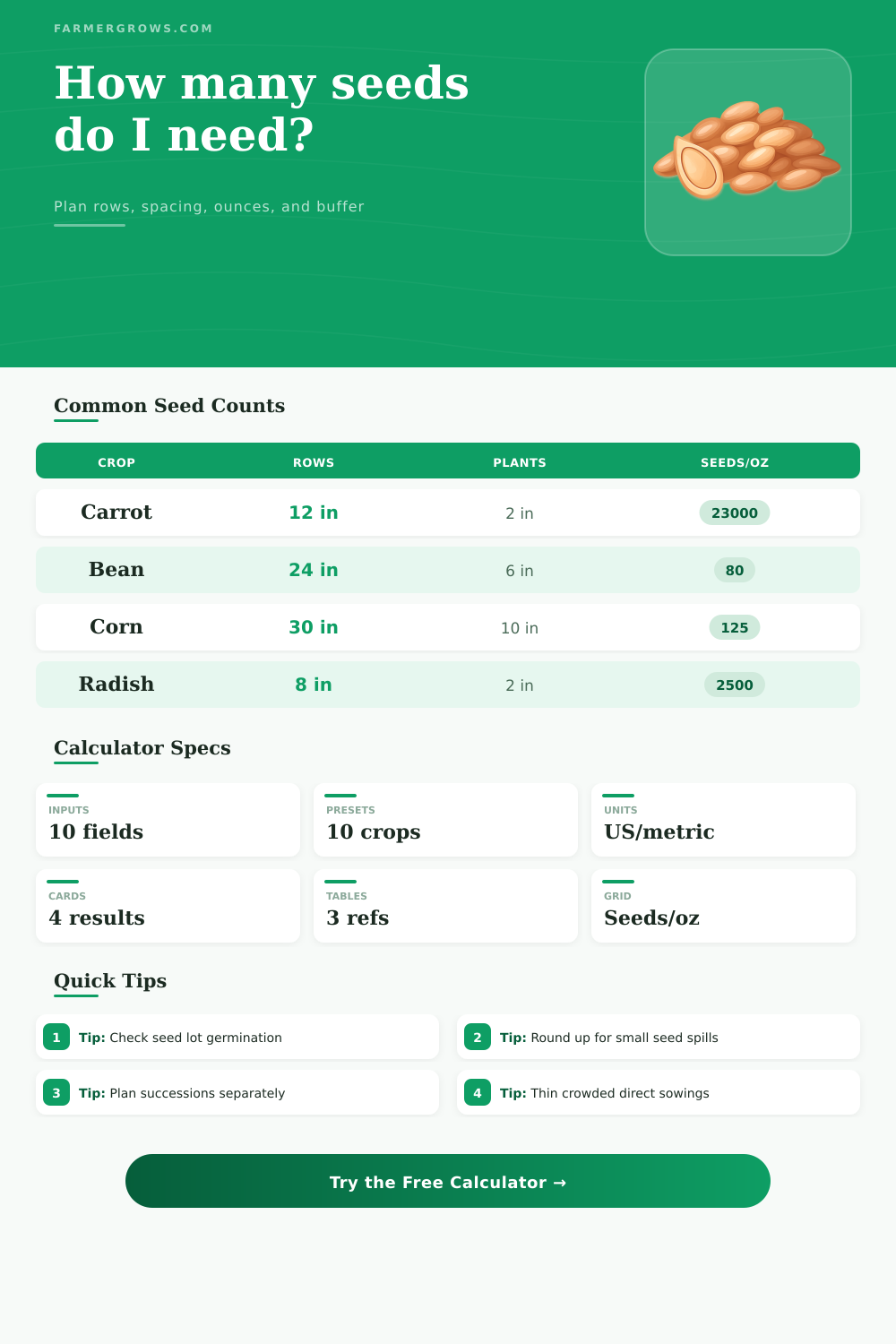
| Crop | Typical row spacing | Typical plant spacing | Common sowing density | Notes |
|---|---|---|---|---|
| Carrot | 8 to 12 in | 1.5 to 3 in | 2 to 4 seeds per station | Small seed often needs thinning and a modest spill buffer. |
| Lettuce head | 12 to 18 in | 8 to 12 in | 1 to 2 seeds per station | For transplants, count cells instead of final bed spots. |
| Bush bean | 18 to 30 in | 4 to 6 in | 1 seed per station | Large seed is easier to place and needs less thinning. |
| Sweet corn | 30 to 36 in | 8 to 12 in | 1 to 2 seeds per station | Block plantings improve pollination compared with one long row. |
| Radish | 6 to 10 in | 1 to 2 in | 1 to 2 seeds per station | Short crops often use multiple successions instead of one large sowing. |
| Germination rate | Seed multiplier | Use case | Field note |
|---|---|---|---|
| 95% | 1.05 | Fresh, tested seed | Usually enough for beans, peas, and strong seed lots. |
| 85% | 1.18 | Normal packet seed | Good default when packet germination is not printed. |
| 75% | 1.33 | Older or tougher crops | Useful for spinach, beets, and cooler soil sowings. |
| 65% | 1.54 | Weak lot or stress | Consider testing a sample before sowing a large block. |
| 50% | 2.00 | Very poor seed | Replace the lot if uniform stands matter. |
| Succession plan | Plantings | Spacing between sowings | Best crops | Seed planning cue |
|---|---|---|---|---|
| One main sowing | 1 | None | Corn, winter squash, storage crops | Use the full seed total at planting time. |
| Two waves | 2 | 10 to 21 days | Beans, cucumbers, beets | Split the total seed roughly in half. |
| Three waves | 3 | 7 to 14 days | Lettuce, radish, spinach | Use smaller repeated sowings to keep harvest steady. |
| Weekly micro-sow | 4 or more | 5 to 10 days | Salad mix, cilantro, baby greens | Keep a higher buffer for spills and weather misses. |
Before sowing: If the seed packet lists a tested germination rate or seeds per ounce, use that number instead of the crop default. Seed size shifts a lot between varieties.
For successions: Treat each wave like its own mini planting. Keep the same spacing, then adjust the buffer upward when weather, birds, or washouts are likely.
Calculating the amount of seed that is required for a gardens requires that you take into account several different variables. The variables that affect the amount of seed that is required for a garden include the spacing of the plants, the germination rate of the seeds, thinning and stand loss, succession planting, and the inclusion of a buffer for the garden. The first variable to consider is the spacing that is to be used for the plants in the garden.
The spacing of the plants will allow one to determine the number of planting stations that is to be utilized in the garden. Each planting station will include one seed that is to be planted in that particular spot within the garden. However, you may have to account for the fact that you can plant more than one seed at each station in order to provide for the germinating of the plant that is to be grown within the station.
How to Figure Out How Much Seed You Need for Your Garden
The second variable is the germination rate. Each packet of seeds includes some information regarding the germination rate of that particular type of seed. However, that rate may be lower than the information that is published with the seed packet due to the age of the seeds, the conditions in which they were stored, and the conditions in which they will germinate within the soil.
Therefore, if the germination rate is low, you will need to purchase additional seeds in order to account for the rate at which the seeds will germinate. The third variable is thinning and stand loss. Thinning and stand loss is the number of plants that will be removed from the stations in which they were planted, or the number of plants that die after they have germinated.
You may remove these plants due to the need for thinning to provide enough room for each plant, or they may die due to disease or poor placement within the garden. Therefore, additional seed must be purchased to account for these plants that will not germinate and grow into the plants that is to be grown in the garden. The fourth variable is succession planting.
Succession planting is the process of planting the same type of seeds in the garden in a series of waves, instead of all at once. Many of the vegetables that is to be grown in the garden benefit from succession planting. Therefore, the initial amount of seed that is calculated for the garden must be multiplied by the number of waves of succession planting that are to occur within the garden.
The fifth variable is the inclusion of a buffer. A buffer is an amount of seed that is purchased in addition to the total amount of seed that is calculated to be required to ensure that there is enough to account for any losses of seeds to wind, birds, or other issues during the planting of the seeds. A buffer of around 10% of the total number of seeds that will be planted is often used for this reason.
Once you have calculated the total number of seeds that will be required to establish the entire garden, you can calculate the total weight of the seeds. If you know the total number of seeds that you will need, as well as the number of seeds that are contained within one ounce of seed, you can calculate the total weight of the seeds required for the garden by dividing the total number of seeds by the number of seeds per ounce. This calculation of the total weight of the seeds can be helpful for gardens that contain small seeds, like carrot or lettuce seeds.
When calculating the number of seeds that will be required for a garden, there are some mistakes that should be avoided. One of the most common mistakes is assuming that the number of seeds contained within a packet is the amount that will be required for the entire garden. Each packet does include information regarding the spacing of the plants and the germination rate, but it does not account for thinning, succession planting, or the need for a buffer for the garden.
Another of the most common mistakes is failing to account for the need for succession planting for some of the vegetable that are to be grown in the garden. The last two variables that can impact the number of seeds that is required to establish the entire garden are the weather and soil conditions within the area in which the garden will be planted. The calculator cannot account for each of these variables.
For instance, cool weather and conditions within the soil will lead to lower germination rates, while dry weather will lead to a more higher need for a buffer due to the possibility of the germinated plants dying before they can be thinned. Thus, the number calculated by the calculator can be used as a starting point for the number of seeds that should be purchased, but adjustments must be made to that starting point according to the weather and soil conditions within the area in which the garden will be planted.