Planting Zone Calculator
Estimate your effective USDA planting zone and planting windows from average annual minimum temperature, elevation, microclimate, frost dates, frost-free days, crop hardiness, soil warming, and region type.
Use this as a planning tool for vegetable gardens, orchards, nurseries, and homestead beds. Local weather stations and your own frost log should override broad map estimates when they disagree.
Planting Zone Results
These results combine mapped cold hardiness with practical planting dates. Treat them as a planning baseline, then refine with your own soil thermometer and frost records.
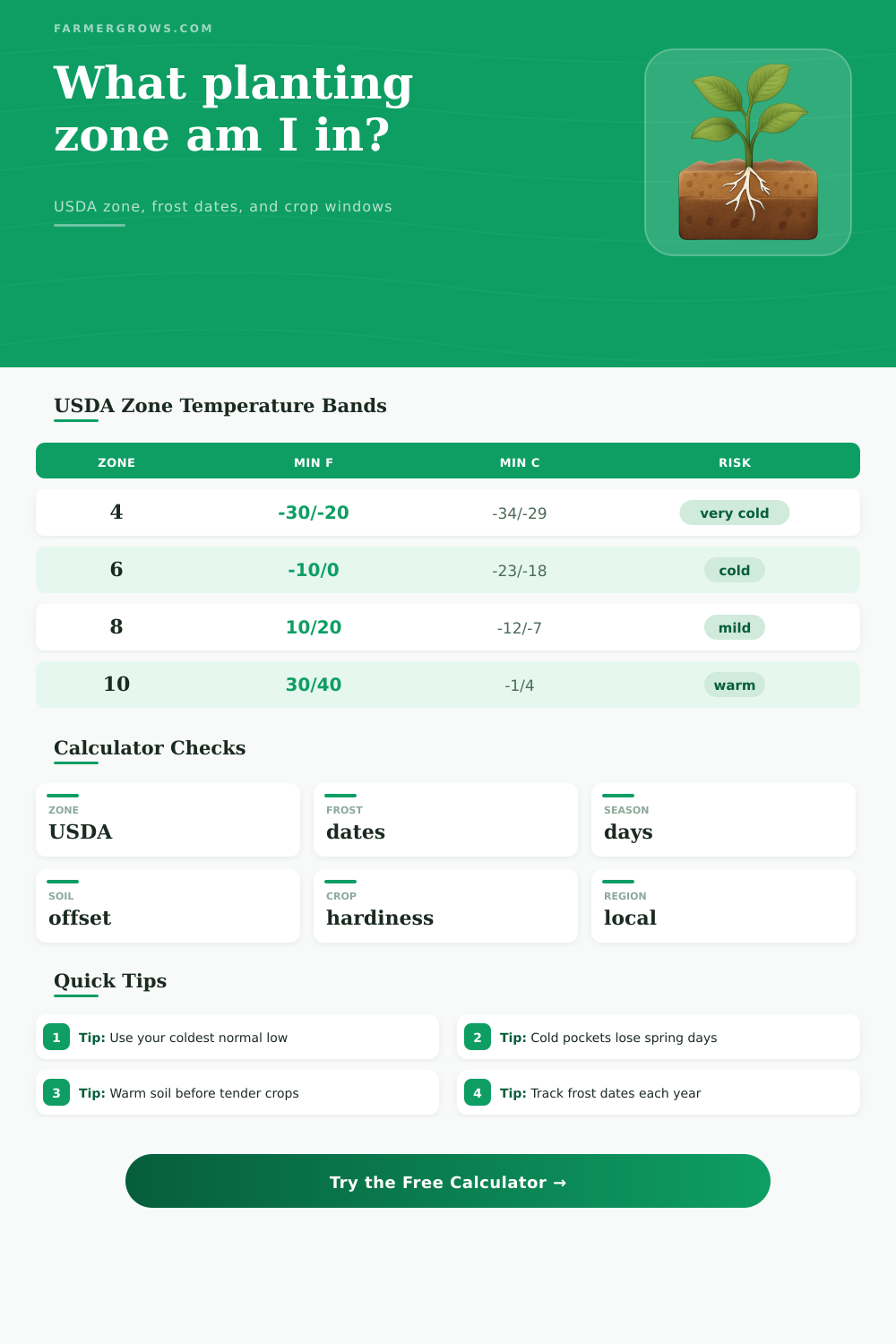
USDA zone mapping by average annual minimum temperature
| USDA Zone | Temperature Band | Common Planning Notes | Typical Constraint |
|---|---|---|---|
| 3a-3b | -40 to -30°F | Use very hardy perennials and short-season vegetables. | Short frost-free period |
| 4a-4b | -30 to -20°F | Start tender crops indoors and protect early transplants. | Late spring frost |
| 5a-5b | -20 to -10°F | Most cool crops fit; warm crops need timed transplanting. | Variable shoulder seasons |
| 6a-6b | -10 to 0°F | Balanced cool and warm-season schedules are common. | Spring soil temperature |
| 7a-7b | 0 to 10°F | Good fall gardens; many perennials overwinter reliably. | Summer heat stress |
| 8a-8b | 10 to 20°F | Long season with strong fall and winter crop potential. | Heat and humidity |
| 9a-9b | 20 to 30°F | Winter vegetables and early warm crops are practical. | Cool-season timing |
| 10a-10b | 30 to 40°F | Frost-light sites can grow subtropical perennials. | Summer planting gaps |
Crop hardiness planting offsets
| Crop Group | Spring Outdoor Rule | Fall Lead Time | Examples |
|---|---|---|---|
| Hardy cool-season | 4-6 weeks before last frost | 50-60 days before first frost | Peas, spinach, onions |
| Semi-hardy | 2-3 weeks before last frost | 40-50 days before first frost | Lettuce, carrots, beets |
| Half-hardy | Near last frost | 50-65 days before first frost | Potatoes, chard, parsley |
| Tender warm-season | 1-2 weeks after last frost | 65-80 days before first frost | Tomatoes, beans, basil |
| Very tender heat crops | 2-3 weeks after last frost | 80-100 days before first frost | Peppers, melons, okra |
| Perennial establishment | After soil is workable | 70-90 days before hard freeze | Berries, crowns, herbs |
Soil temperature targets
| Soil Target | Best Crop Fit | Planting Window Effect | Field Note |
|---|---|---|---|
| 40-45°F | Peas, spinach, onions | Can plant before frost-free date | Soil must be workable, not saturated. |
| 45-50°F | Lettuce, carrots, beets | Small delay in cold clay soils | Raised beds often gain several days. |
| 50-55°F | Potatoes, chard, parsley | Near frost date in many zones | Mulch can slow warming if applied early. |
| 55-60°F | Tomatoes, beans, basil | Usually after last frost | Cold nights can stall transplants. |
| 60-65°F | Peppers, melons, okra | Wait for stable warmth | Black plastic or tunnels can advance soil. |
Region and microclimate adjustments
| Condition | Zone Effect | Spring Effect | Fall Effect |
|---|---|---|---|
| Cold pocket or low hollow | Often 3-5°F colder | Delay planting 5-10 days | Expect earlier frost |
| Protected south wall | Often 3-5°F warmer | Can advance hardy crops | May extend tender crops |
| Coastal maritime | Milder lows | Cool soil may delay warmth | Fall is often extended |
| Mountain or high plateau | Colder night swings | Delay by elevation | Hard frost can arrive early |
| Desert basin | Large day-night swing | Watch cold nights | Heat may end spring crops |
Calibrate with records: USDA zones describe winter low survival, while planting dates depend on actual spring and fall frost history. Keep a simple yearly frost log for your garden.
Check the soil: Tender crops often fail from cold soil even after the last frost date. A thermometer at planting depth is the fastest reality check.
A planting zone calculator allow a person to understand the relationship between the weather in a given area and the success that a gardener will have with there plot. Many gardeners has likely experienced some level of disappointment with their gardens due to the fact that the calendar dates for planting certain crops does not account for an actual weather that will be present within the garden bed. A planting zone calculator allows a person to take all of this information into account and create a plan for the gardener that will allow for the best growing experience for the plot of land that they manage.
One of the main data points that a planting zone calculator gathers is the average annual minimum temperature for the area. This value help the planting zone calculator to determine which types of plants will be able to survive the winter months within that area. The average annual minimum temperature can be adjusted for factors like elevation, cold spots in the area, and locations that warm the area during the winter.
Plan Your Garden with a Planting Zone Calculator
Another important data point for a planting zone calculator is the frost dates for that region. The last spring frost date will determine when the gardener can begin to plant seed into the soil. A planting zone calculator will ask for the hardiness of the plants that will be grown in the area.
For instance, hardy greens will grow during the same time than peppers, but the hardiness of the greens allow for them to be planted earlier in the spring. In addition to frost dates, the planting zone calculator will ask for the soil type in the area. Clay soils will experience colder temperatures than sandy loam soil, and planting into raised beds or using black plastic covering the soil will allow the soil to reach the temperatures that is required of those types of plants.
The length of the frost-free period will help a gardener to understand if the crops that they wish to grow are within the range of crops that can be grown in the area. If the type of crop requires a frost-free period of one hundred days, but the area experience ninety frost-free days each year, that type of crop will struggle to grow in that area. A planting zone calculator allows a person to see this information before they begin to plan their garden to avoid disappointment in their crop yield.
Another data point for a planting zone calculator is the concept of microclimate. Microclimates are small areas within a region that experience different weather pattern than the remainder of the area. For instance, a hillside may experience different weather than the valley located only a few miles from the hillside.
These microclimates are accounted for in the planting zone calculator through the region type that the user is select for the area within the planner. Along with the main data points for a planting zone calculator are reference table. These reference tables indicate the different temperatures for different zones within the US according to the USDA.
These reference tables also show the different types of crops that have high tolerance to different soil temperatures. The individual using the planting zone calculator does not need to memorize these reference tables, but the planner of the garden should understand them. A planting zone calculator can help a person to understand that the number of frost-free days within the area might not be the same than the dates for the frost season within that area.
The frost-free days that are entered into the calculator might differ from the span of time between the two frost dates that the user provides. This difference in time may be due to the location of the weather station within the area, or the number of late frost that may occur in the area that contrast with the average number of late frosts per year. The biggest benefit of utilizing a planting zone calculator is that it allow a person to create a schedule for the garden based off all of the information that is entered.
Using this schedule, a person can determine when to begin to plant certain type of seeds, when the soil will be warm enough to plant the roots of these plants, and when the gardener will harvest the crops. Additionally, using the schedule generated by the planting zone calculator allows a person to determine which types of plants will mature during the fall before the first frost of the year kills the plants. Using this information avoids the waste of seeds and the dissapearing disappointment of plants that do not have time to ripen before the fall frosts.
Overall, the planting zone calculator allows a person to understand the impact of temperature, soil type, and frost dates on the growing season as opposed to simply using the calendar to determine when to plant.