PVC Pipe Length Calculator
Estimate pipe stock, sticks, cuts, and leftover from measured run length, fitting allowance, socket depth, expansion gaps, layout type, pipe sections, and waste percentage.
Use centerline measurements for the run, then add realistic allowances for offsets, sockets, expansion gaps, and field waste. The result is a planning takeoff, so verify final cut marks against the actual fittings you will install.
PVC Pipe Takeoff
Results include net pipe length, waste-adjusted pipe, whole sticks, cut count, and leftover stock.
| Formula | Expression | What it adds | Planning note |
|---|---|---|---|
| Layout run | measured run x layout factor | Extra pipe for routing complexity | Use 1.00 for direct runs and higher factors for grids |
| Fitting allowance | fittings x allowance each | Offsets, trim margin, and riser corrections | Measure real elbows, tees, unions, and adapters when possible |
| Socket adjustment | fittings x socket depth | Pipe inserted into hubs or sockets | Mark socket depth on each piece before assembly |
| Expansion gap | fittings x gap each | Length not fully seated inside sockets | Subtract only where a gap is intentionally left |
| Waste-adjusted pipe | net pipe x (1 + waste - reuse) | Breakage, recuts, and usable offcuts | Keep reuse credit conservative for short-pipe layouts |
| Layout type | Suggested factor | Typical fittings | Best use |
|---|---|---|---|
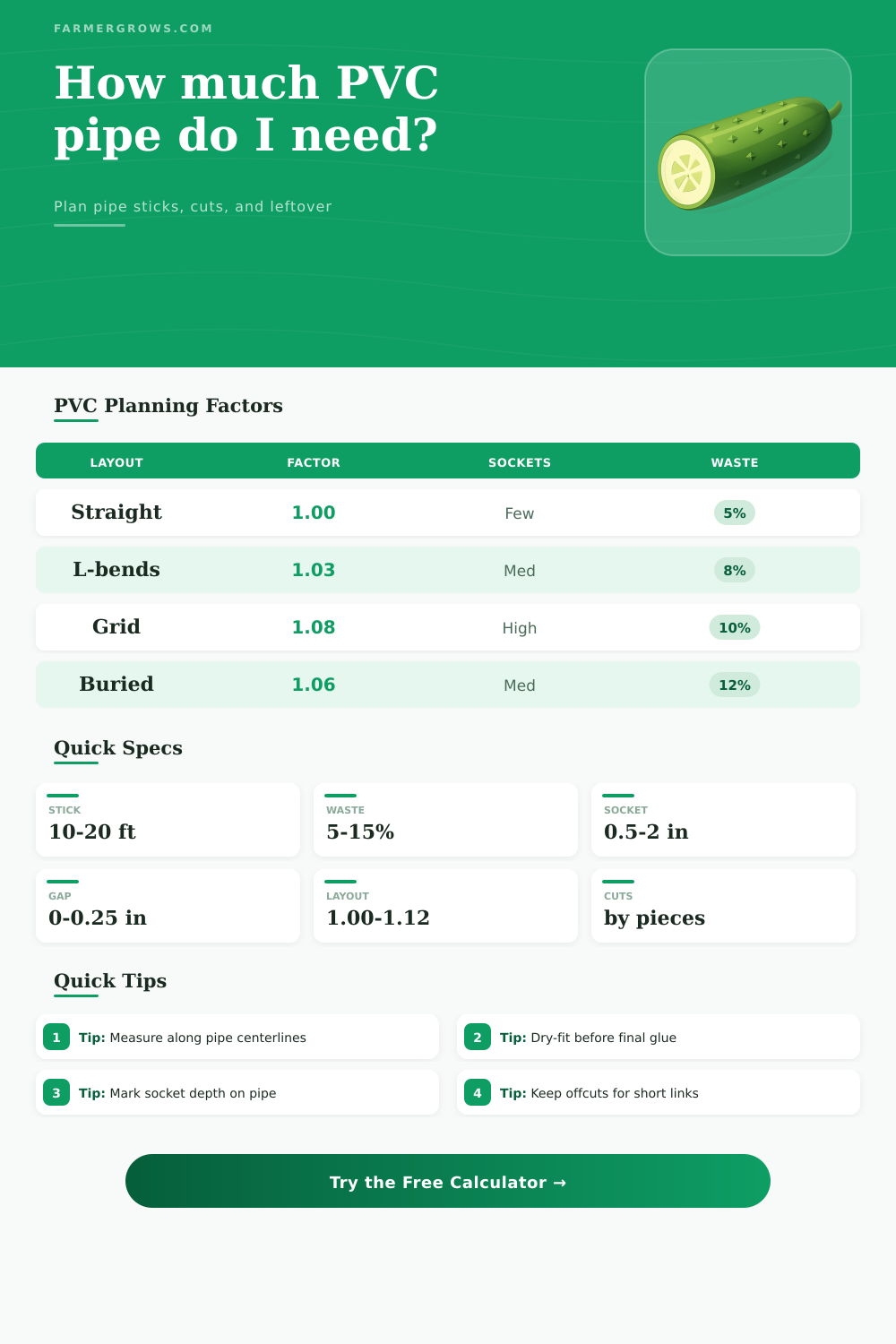
| Straight run or simple main | 1.00 | Couplers, end caps, few tees | Long greenhouse mains, headers, simple supply lines |
| L-bend route | 1.03 | Elbows and a few tees | Runs around beds, corners, tanks, or benches |
| Grid or manifold | 1.08 | Many tees, caps, valves, short branches | Raised bed grids, nursery bench networks, fertigation manifolds |
| Buried run with risers | 1.06 | Sweeps, risers, couplers, valves | Trenched irrigation pipe with unavoidable route changes |
| Frame or hoop build | 1.12 | Tees, crosses, elbows, repeated ribs | Low tunnels, row covers, trellis frames, temporary supports |
| Repair with uncertain routing | 1.10 | Slip couplers and replacement pieces | Work where the final exposed length may change after digging |
| Nominal PVC size | Typical socket depth | Gap range | Cut marking hint |
|---|---|---|---|
| 1/2 in PVC | 0.50 to 0.75 in | 0 to 1/8 in | Useful for small frames, emitters, and short water runs |
| 3/4 in PVC | 0.75 to 1.00 in | 0 to 1/8 in | Common for garden branches and light-duty manifolds |
| 1 in PVC | 1.00 to 1.25 in | 0 to 3/16 in | Common for headers, greenhouse mains, and wash stations |
| 1-1/4 in PVC | 1.25 to 1.50 in | 0 to 1/4 in | Check actual fitting depth because brands vary |
| 1-1/2 in PVC | 1.50 to 1.75 in | 0 to 1/4 in | Dry-fit and mark insertion lines before primer or cement |
| 2 in PVC | 1.75 to 2.25 in | 0 to 1/4 in | Use measured socket depth for drain and high-flow layouts |
| Stock stick length | Good for | Cut planning | Leftover behavior |
|---|---|---|---|
| 5 ft | Small frames and repair pieces | Easy to transport but more joints | Short leftovers are often reusable |
| 10 ft | Common garden plumbing and small builds | Works well for 3 to 8 ft pieces | Moderate leftover control |
| 20 ft | Long mains, headers, and buried runs | Fewer couplers and fewer long-run cuts | Leftovers can be longer but transport is harder |
| Custom bundle | Repeated ribs or equal sections | Set stick length to actual stock on hand | Best when offcuts match repeated short parts |
Before cutting: Write the final piece length, socket mark, and fitting location on each pipe. This keeps repeated manifold pieces from drifting slightly shorter with every cut.
Before final assembly: Dry-fit the longest path first, then compare the remaining stock against the calculator leftover. If the route changed, recalculate before trimming short connector pieces.
When you are planning a project for a greenhouse or a garden, you must determine how much pipe you are going to need to purchase. If you purchase too little pipe, you will have to make an emergency trip to the store to purchase more. If you purchase too much pipe, though, you will have to pay for pipe that you dont need for your project.
The amount of pipe that you will need will depend upon how you account for the small additions of pipe that will dissapear within the fittings or that may be lost to offcuts when routing the pipe. You must add allowances for sockets and expansion gaps to the total length that you calculate from measuring the centerline of the project. Additionally, you must make allowances for routing the pipe around obstacles or for dropping risers into a trench.
How to Figure Out How Much Pipe You Need
Each of these allowances is small, but the numerous allowances for these factors will change the total amount of pipe needed. Each of the inputs for the calculator represent one of these factors. The layout type accounts for the additional length of pipe that is necessary for making many tees or ribs.
The fitting allowance accounts for the length of pipe that is lost to the offsets in the various fittings. The socket depth allowances for the amount of pipe that disappears into the hub of the fittings. The expansion gap accounts for the gap between the various joints in the pipe that must be allowed for the movement of the pipe due to changes in temperature.
The waste percentage and the reusable offcut percentage account for the amount of pipe that will be lost to breakage and the amount that can be salvaged from any short pipe pieces. While the total number of sticks of pipe may be the focus of a project, the stick count and the leftover amount is also important. If the calculations indicate that, for instance, four full sticks of pipe are needed with a third of a stick left over, it is possible to use a smaller length of stock pipe.
However, if the calculations show that six sticks will be needed with almost no pipe left over, any change to the routing of the pipe will require buying additional sticks of pipe. The reference tables show the relationship between the nominal size of the pipe and the socket depth of the joints. Additionally, the reference tables also show the relationship between the length of the sticks of pipe and the type of project that will be undertaken with the pipe.
For instance, a two-inch joint will swallow up more pipe than a three-quarter inch joint. Furthermore, twenty foot sticks of pipe may work well for laying long main lines of pipe, but may create awkward amounts of leftover pipe if attempting to lay a bench grid made up of four foot sections of pipe. You should walk the route that the pipe will take before the calculations are made.
There may be a valve box that sits higher than anticipated or a bed edge that will require an elbow joint to accommodate the routing of the pipe. Even with the calculations made with this pipe length calculator, experienced individuals will typically add additional pipe to the project to account for these types of issues. Additionally, by calculating how many fittings will be used in the project, it is also possible to determine if two shorter lengths of pipe can be joined together to make one longer pipe piece; this can significantly reduce the amount of waste and the number of leaks that may occur in the joints of the project.
In addition to the factors described above, you must account for the effect of temperature in the calculations. PVC pipe will expand when hot and contract when cool. Thus, there must be expansion gaps to allow for this movement of the pipe.
While this movement will be less if the pipe is to be buried in the ground, where the soil will help to even out the temperatures that the pipe experiences, it will be more noticeable on exposed manifolds or greenhouse structures. Thus, the addition of a quarter inch of expansion at each end of a twenty foot length of pipe will result in a measurable amount of expansion. Thus, the expansion gap can be entered into the calculations of the length of pipe to be purchased.
Each piece of pipe should be marked at the socket depth before beginning to glue the pipes together. Otherwise, it is possible that the length of pipe that is pushed into the fitting will be too short to allow for the next pipe to be glued to it. Thus, marking each pipe piece at the socket depth will ensure that the length of pipe that is glued will be accurate to the calculations made with the calculator.
Even though the expansion gap and the socket depth are both accounted for in the calculations made with the calculator, marking each pipe piece at the socket depth will allow for accuracy in the length of the pipe that is glued to the other pipes. The percentage of waste that will be experienced during the laying of the pipe may be thought of as a single percentage, but it can take on different values for different projects. For instance, a project that involves long, straight header pieces will waste less pipe than a manifold project that requires numerous shorter pieces of pipe.
Additionally, a repair job will waste more pipe than a project that begins with clean, new pipe that does not have to be cut to fit into existing joints. Thus, you can adjust the percentage of waste with the complexity of the project to arrive at a more accurate total length of pipe that will be needed. The leftover length of pipe will be calculated as part of the total number of sticks that will be purchased.
If the leftover amount of pipe is large, it is both possible that too much pipe was purchased, but it is also possible that there is enough pipe to perform one or more future (smaller) projects. If the amount of leftover pipe is close to zero, it indicates that the correct amount of pipe was purchased for the project. However, having zero amount of leftover pipe also indicates that there will not be enough pipe to perform any repairs if any of the fittings begin to crack.
Therefore, there should be some amount of surplus pipe in excess of the length that is needed for the project. The length of pipe that is purchased in “sticks” also has to be considered when purchasing the pipe from the supplier. If the average length of the pieces of pipe will be twenty feet, it will be easy to purchase ten foot sticks or twenty foot sticks.
Each of these stock lengths will impact the total amount of pipe that will be purchased and the amount of leftover pipe. Thus, the calculator allows individuals to determine the total amount of pipe that will be purchased and the leftover amount of pipe after the purchase; the goal is to minimize the number of surprises that occur once the cutting of the pipe begins. By walking the route that will be taken by the pipe, by calculating the number of fittings that will be used in the project, and by utilizing the calculator to account for the small additions to the length of the pipe at each joint, an individual will be able to purchase the correct amount of pipe for their project.