Centrifugal Pump Viscosity Correction Calculator
Estimate how viscous liquids reduce centrifugal pump flow, head, and efficiency from a water-rated curve using approximate HI-style correction factors.
Enter the clean-water duty point from the pump curve, then add viscosity, specific gravity, speed, impeller diameter, temperature, and a correction method. Results are a screening estimate and should be checked against the pump maker's published viscous correction data.
Corrected Pump Estimate
Approximate viscous duty point based on water-curve flow, head, and efficiency.
Assumption: this calculator uses a smooth, approximate Hydraulic Institute style correction trend for Newtonian liquids. It is not a substitute for HI 9.6.7 charts, certified pump curves, NPSH checks, or vendor software.
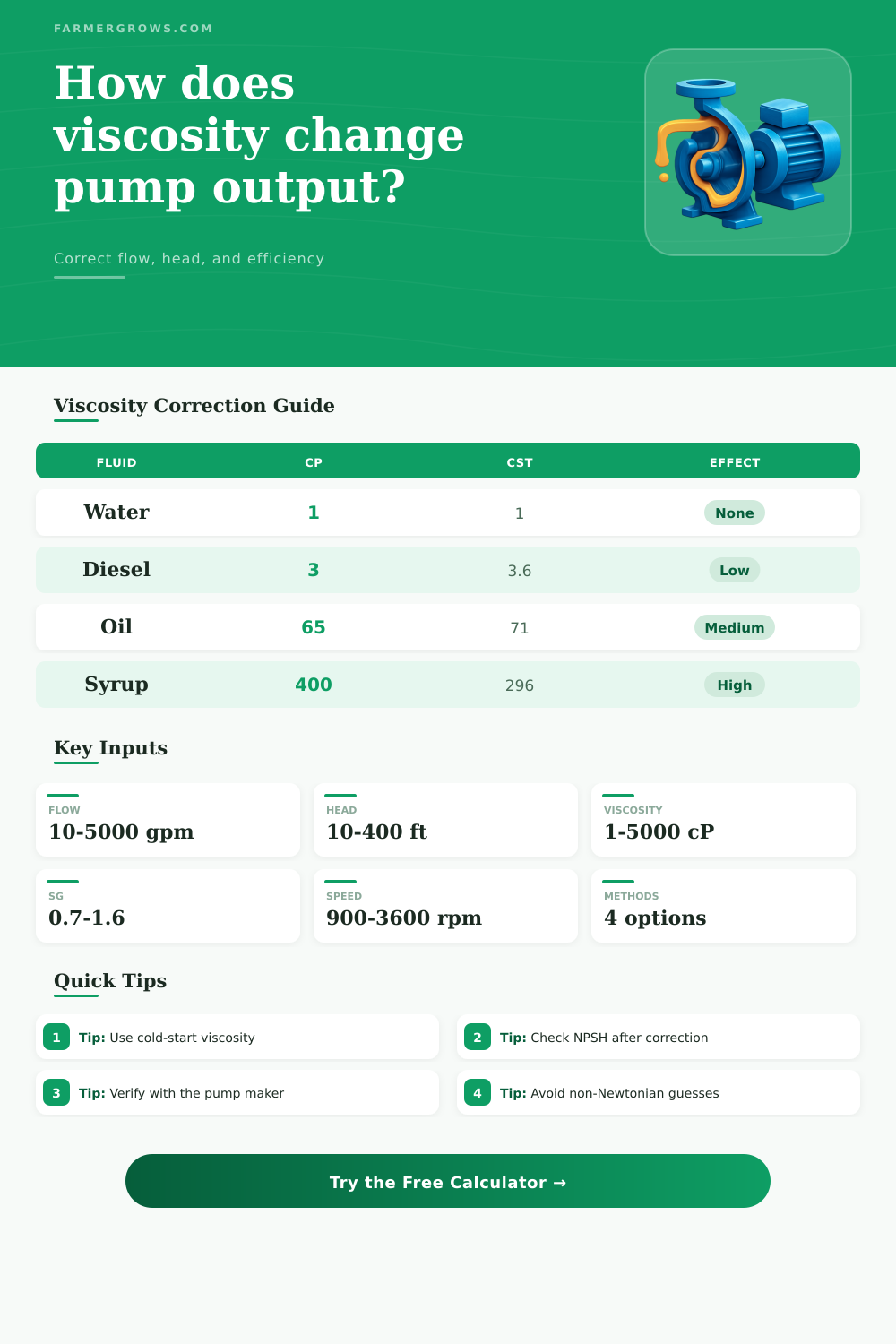
About 1 cP and 1 cSt near room temperature.
Flow, head, and efficiency corrections are normally negligible.
Diesel and kerosene often sit near 2 to 5 cP.
Expect small efficiency loss and a modest power change from SG.
Vegetable oil and hydraulic oil can range from 30 to 150 cP.
Capacity loss becomes noticeable, especially at cold startup.
Sugar syrups and glycerin blends can be hundreds of cP.
Check pump type, motor load, suction losses, and warm-up practice.
| Method | Factor style | Best use | Limit note |
|---|---|---|---|
| Approximate HI-style | Balanced CQ, CH, CE | First-pass Newtonian liquid screening | Verify against HI 9.6.7 or vendor data |
| Field estimate - mild | Smaller penalty | Warm, stable, low-risk services | Not for cold starts or unknown viscosity |
| Conservative selection | Larger penalty | Variable product, fouling, or uncertain curve | May oversize motor or pump selection |
| No correction baseline | CQ 1.00, CH 1.00, CE 1.00 | Compare against water curve output | Use only for clean-water checks |
| Item | Imperial relationship | Metric relationship | Why it matters |
|---|---|---|---|
| Kinematic viscosity | cSt = cP / SG | mm²/s = cSt | Correction charts commonly use kinematic viscosity |
| Corrected flow | Qv = Qw x CQ | m³/h uses same factor | Capacity usually drops as viscosity rises |
| Corrected head | Hv = Hw x CH | m uses same factor | Head loss changes the duty point estimate |
| Brake power | BHP = Q x H x SG / (3960 x Eff) | kW = m³/h x m x SG / (367 x Eff) | Motor load can rise even while flow falls |
| Temperature case | Typical concern | Calculator input | Action |
|---|---|---|---|
| Cold startup | Viscosity can be much higher | Use cold cP or cSt | Check motor torque and suction pressure |
| Normal running | Viscosity stabilizes after warm-up | Use operating temperature data | Compare to rated duty point |
| Seasonal tank | Outdoor fluid changes by season | Run warm and cold cases | Size for the worst credible case |
| Heated product | Lower viscosity may restore flow | Use heated viscosity | Confirm seals and material limits |
| Viscosity band | Screening signal | Likely correction | Next check |
|---|---|---|---|
| 1 to 10 cSt | Water-like | Small or none | Normal curve and NPSH review |
| 10 to 100 cSt | Light viscous service | Efficiency loss first | Confirm motor margin |
| 100 to 1000 cSt | Heavy service | Flow, head, and efficiency loss | Ask for corrected pump curve |
| Above 1000 cSt | High-risk centrifugal use | Large uncertainty | Compare positive displacement options |
Centrifugal pumps is designed to move water easy, and centrifugal pumps are designed so that the impeller can push the water with no much friction. When liquid become viscous, the viscosity of that liquid create drag within the centrifugal pump. This viscosity slow the liquid between the vanes of the impeller.
This viscosity also take energy from the centrifugal pump, leading to a decrease in the capacity, head, and efficiency of the centrifugal pump. People often use a water curve to understand the centrifugal pump they are use. However, the water curve only display the performance of a centrifugal pump with water.
How Thick Liquids Affect Centrifugal Pump Performance
The water curve will not show how much the impeller of the centrifugal pump will slip if the liquid that are being moved becomes viscous. To compensate for this, correction factor must be used to find the performance of the centrifugal pump with viscous liquids. The three main measurement of centrifugal pumps…
Flow, head, and efficiency (all change with viscous liquids). Flow will change because viscous liquids move more slow through the centrifugal pump than water does. Head will also change because the impeller will not be able to impart the same amount of energy into the liquid due to the increased losses within the impeller caused by the fluid’s viscosity.
Efficiency will suffer from the use of viscous liquids in that more of the shaft power will become heat, a result of the fluid’s viscosity. Brake horsepower will change for the same reasons that efficiency will change; it will also increase with higher specific gravity of the liquid then water. As such, brake horsepower must be considered in the sizing of motor that will operate centrifugal pumps.
The motor will run too hot if it is sized according to the performance of the pump with water only. Lastly, the temperature of the liquid will change the viscosity of that liquid, which will change the performance of the centrifugal pump. If the viscosity of the liquid is low during warm times of the day, the viscosity will be high during cold times of the day.
As such, when using these performance curve, the highest viscosity that will be expected for the centrifugal pump should of been used during the calculation of performance numbers. Check the motor margin and the suction condition against the highest viscosity in the system. Using the highest viscosity in the system will ensure that the centrifugal pump will function correctly.
Many system will encounter high viscosity during the startup of the system as the liquid may have been sitting in the tank and may have reached cold temperatures during the previous period. The pump will encounter the highest viscosity at the startup of the pump, which may require a more robust motor for the centrifugal pump or the installation of a soft start device for the pump. Centrifugal pumps have a variety of factor that impact their efficiency.
The power requirements of a centrifugal pump depend on the dynamic viscosity of the fluid and the specific gravity of the liquid. Additionally, the specific gravity of the liquid can be used to convert the dynamic viscosity of the liquid to the kinematic viscosity of the liquid. The pump can then correct the power that is required for the specific gravity of the liquid.
The different type of liquids have different specific gravities. A heavy liquid will require a different motor than a centrifugal pump that move a light liquid. Other factors that impact the efficiency of the pumps are the speed of the pumps and the diameter of the impeller of the centrifugal pump.
The lower speed at which the pump is designed to turn provides more time for the viscous liquid to slip within the centrifugal pump. Additionally, the smaller the diameter of the impeller, the more resistance to the flow of the liquid will be create. Using the information from the efficiency calculation of the centrifugal pump, several decision must be made regarding the pump.
The efficiency of the centrifugal pump will be used to make decisions on the viscous performance of the pump. If the efficiency of the pump is found to be very low, the manufacturer of the pump should be contacted to determine if the manufacturer create a viscous curve for their pumps. Additionally, if the power that is determined for the pump is higher than anticipated, then a decision must be made regarding whether the motor for the pump should be increased, whether a different type of pump should be used, or whether trace heating equipment can be installed into the system to allow for better fluid viscosity.
Using this efficiency calculation, it is also possible to determine the required NPSH for the system. As the viscosity of the liquid increases, the suction loss for the pump will increase. These suction losses will reduce the available NPSH for the system.
By calculating the required NPSH for the pump, with the numbers is corrected for the viscosity of the fluid, cavitation in the system can be avoided. By performing this calculation before purchasing a centrifugal pump, it is possible to create a plan for the system and the viscosity of the liquid. Additionally, by performing these calculations on the centrifugal pump, it will allow for the pump to work with the fluid being move, instead of the system having to fight against the fluid being moved by the pump.