Solar Water Pump Sizing Calculator
Estimate daily flow, total dynamic head, hydraulic power, pump watts, panel wattage, battery amp-hours, and tank storage for livestock troughs, gardens, drip zones, and remote farm water systems.
Enter the water needed per day and the total dynamic head in feet. Total dynamic head should include vertical lift, pressure requirement, pipe friction, fittings, and any elevation from the pump to the tank or trough.
Solar Pump Sizing Results
Enter your water and head values to size the pump, panel array, battery, and tank.
| Farm use | Typical daily gallons | Sizing note | Reserve to consider |
|---|---|---|---|
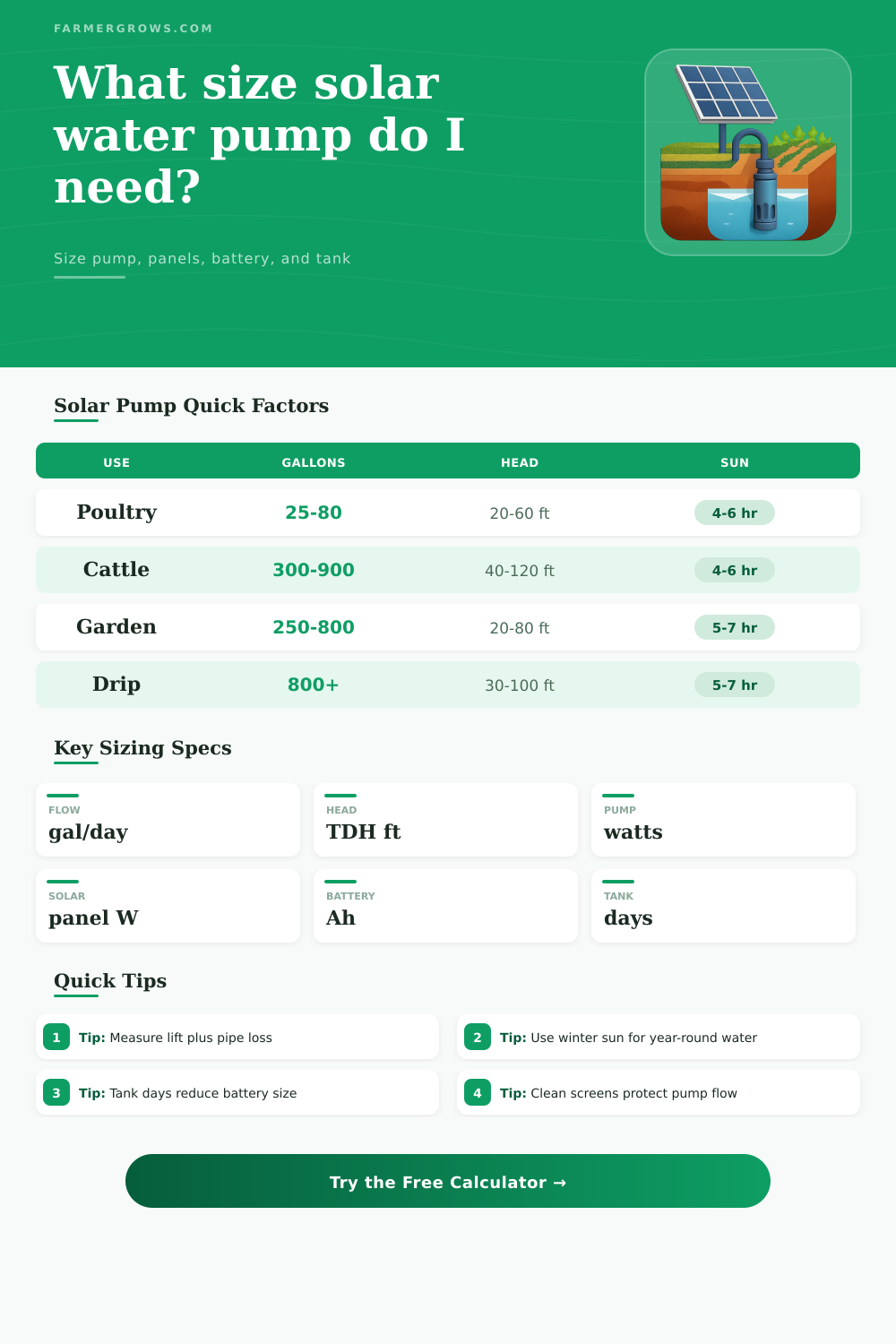
| Backyard poultry | 25–80 gal/day | Flock size and heat drive the total. | 1–2 tank days |
| Goats or sheep paddock | 80–250 gal/day | Use herd count plus wash and refill water. | 2–3 tank days |
| Small cattle trough | 300–900 gal/day | Summer drinking demand can be much higher. | 2–4 tank days |
| Market garden tank fill | 250–1,500 gal/day | Match the tank refill rate to irrigation timing. | 1–3 tank days |
| Drip irrigation block | 800+ gal/day | Emitter flow, bed count, and run hours matter. | 1–2 tank days |
| Head component | How to estimate | Typical range | Why it matters |
|---|---|---|---|
| Static lift | Vertical feet from water source to outlet or tank inlet. | 10–250 ft | The main load for wells, springs, and hills. |
| Pressure head | Desired pressure psi multiplied by 2.31. | 0–70 ft | Needed for sprinklers, drip regulators, and valves. |
| Pipe friction | Estimate from pipe length, diameter, fittings, and flow. | 5–40% | Small pipe can sharply raise pump load. |
| Filters and screens | Add allowance for clean and partly loaded filters. | 3–15 ft | Important for drip irrigation and surface water. |
| Input | Conservative value | Moderate value | Use when |
|---|---|---|---|
| Peak sun hours | 3–4 hr | 5–6 hr | Use winter or cloudy-season sun for year-round pumping. |
| Seasonal factor | 60–75% | 80–90% | Lower values cover dust, heat, haze, and shallow sun angles. |
| Panel reserve | 25–50% | 10–25% | More reserve helps pumps start and keeps tanks filling. |
| Battery autonomy | 2–3 days | 0.5–1 day | Use more battery when there is little water storage. |
| Scenario | Daily gallons | Adjusted head | Approx hydraulic watts |
|---|---|---|---|
| Low-lift poultry barrel | 60 gal/day | 35 ft | 1 W at 4 hr runtime |
| Goat trough from pond | 180 gal/day | 55 ft | 4 W at 4 hr runtime |
| Cattle tank on hill | 650 gal/day | 120 ft | 41 W at 6 hr runtime |
| Garden tank fill | 900 gal/day | 75 ft | 36 W at 6 hr runtime |
| High-lift spring line | 300 gal/day | 240 ft | 50 W at 5 hr runtime |
Head tip: Measure vertical lift first, then add pressure and friction. A pump that looks large enough by gallons alone may fail if head is understated.
Storage tip: Water storage can be more forgiving than battery storage. A larger tank often keeps livestock supplied through cloudy weather with less electrical complexity.
When designing a solar water system for livestocks or a garden, you need to calculate the total water and energy requirement of the system. Many people make mistake when installing these systems, such as using a pump that cant meet the water demand of the livestock or garden, or using batteries that cannot store enough energy to supply water during periods of cloudy weather. In order to design a solar water system for livestock or a garden, you need to determine the water requirement of the livestock or garden, and you also need to determine the energy requirements of the system based off the height of the water and the number of hours of sunlight that the system will receive.
The water requirements of the livestock or the garden will depend on a variety of factors. For example, the water needs of the livestock will vary according to the type of livestock, the size of the livestock, the weather condition, and other factors. In the case of a garden, you will need to determine the type of plants that you will be growing in the garden, the amount of water that each plant type require, the number of plants that you will be growing, and other factors that affect the water requirements of the garden.
How to Plan a Solar Water System for Livestock or a Garden
In addition to these requirements, you will need to account for water that will be lost to washing the livestock tanks or watering troughs, as well as in the event that some water is lost to leaks in the system. Finally, in the case of livestock watering, you will need to provide water for livestock that may wander into the water tanks or troughs. The total dynamic head of a water system is the total vertical distance that the water will have to travel, as well as the total distance for which the system will account for friction in the system.
Factors that contribute to total dynamic head are the length of the systems tank and the height of the tank above the water source, the diameter of the systems pipes, and other factors that contribute to friction. In the total dynamic head of a solar water system, it is necessary to include an allowance for friction in the system to ensure that the system will not run at maximum efficiency during hot weather, when friction in the system is more common. The energy requirements of the system are based on the number of sun hours that the system will receive each day.
The number of sun hours is not the same than the number of daylight hours; the number of sun hours refers to the number of hours each day that the solar panels receive the greatest amount of sunlight. In addition to the number of daylight hours, there are a variety of factors that can reduce the amount of sunlight that reaches the solar panel, such as winter angles of the sun and haze in the air. To account for these factors, it is necessary to use a lower seasonal value for the number of sun hours that will reach the solar panel; using a lower seasonal value will ensure that the system works during the shortest day of the year.
You can choose between using more batteries to store the energy requirements of the system, or you can use a larger water tank to store the water requirements of the system. If you use more batteries, the system will function both during daylight and after dusk. However, more batteries will increase the cost and maintenance of the system.
Alternatively, if you use a larger water tank, the system will automatically account for gaps in water availability. However, this only works if the livestock water pump can refill the water tank with water during sunlight hours. Thus, you must also determine if the site can take a water tank that is larger than the current tank, and if the livestock can survive periods without having access to water.
Pump and controller efficiency can range from 0.10 to 1.00. Both of these components will determine how much solar energy is converted into moving water in the system, as well as how much of that energy is lost as heat. Thus, if the efficiency of either the pump or the controller is low, there will be a need for the solar panels to contain more watts of energy so that there is enough energy to supply the water system.
The calculator can show the difference in the wattage requirements of the solar panels based on the efficiency ratings of the equipment. The losses in the system due to the pipes and filters will affect the total dynamic head of the system. If the system requires a high flow rate of water, or if the system uses a diameter that is smaller than the recommended diameter for that flow rate, the total dynamic head will have to account for the increased losses due to the pipes or filters.
Furthermore, if the system incorporates a filter, the system may fail if the filter becomes loaded with sediment from the water. Thus, you will need to note the percentage of the losses in the system that are due to the pipes and filters in the calculator inputs, to ensure that the system allows for enough diameter for the pipes. Depending on the system that is to be established, the requirements of the livestock area and the requirements of the irrigation area may be different.
For instance, the troughs for the livestock will require a system with low pressure requirements, but with a significant supply of water available for the livestock; in contrast, the irrigation area will require the water system to provide more pressure to the water that must travel through the emitters in the irrigation system. Thus, it is possible to employ the same pump and solar panel array to provide water to both the livestock and the irrigation areas. However, there will be different requirements for each area for both the head of the water and the flow of the system.
Additionally, if the irrigation areas are to be watered at the same time as the livestock require water, it is possible that the water system will require a larger water tank to supply the water to both areas. The formulas that are utilized in the calculator to determine the energy and water requirements of a solar water system are the same as those found in the manuals for most water pumps. To determine the energy requirements of the system, the flow of the water is multiplied by the total dynamic head of the system.
This product will be divided by the efficiency of the pump to determine the amount of solar energy that is required to supply the water system. Small changes in any of the variables of the system, such as the total dynamic head or the number of sun hours that the system will receive, can have a large effect upon the energy requirements of the system. Thus, the calculator is an appropriate tool to determine the energy and water requirements of a solar water system.
The variables of a solar system that is to be established at the site can include variables such as the number of gallons of water that come from the spring or well. For instance, during droughts, there may be less water available from the spring. The water level from a well may also change over time.
The length of the pipe that is established from the spring or well to the water tank may also need to be taken into consideration; longer distances result in greater friction in the system. Each of these variables can be accounted for by walking the route of the water system, noting each elevation change in the route, and noting each system fitting. If the pump is sized correctly for the system, then the pump will remain near its design point for maximum efficiency.
A pump that remains at or near its design point will experience less wear and tear on its components, the motor will produce less heat, and the system will account for potential issues with increased temperatures and the increased numbers of animals to the system. Thus, a well-sized pump will ensure that the water system functions reliably, without the need for maintenance of the system.