Drip Irrigation Emitter Calculator
Estimate emitter count, system flow, delivered inches per week, and runtime needed for row crops, beds, vines, berries, and nursery plantings.
This calculator treats each drip line as a wetted strip. Soil type estimates wetted width and delivery efficiency so the same gallons can be translated into an approximate depth in inches per week.
Drip Irrigation Result
Results combine layout emitters, pressure-adjusted flow, soil wetted width, weekly schedule, and the buffered runtime needed to hit the crop water target.
| Formula | Expression | What it estimates | Example use |
|---|---|---|---|
| Emitter count | ceil(row length / spacing) x line count | Number of outlets installed across all lines | 100 ft at 12 in = 100 emitters per line |
| System GPH | emitters x emitter GPH x pressure factor | Adjusted water flow from the zone | 100 x 0.5 GPH x 1.00 = 50 GPH |
| Weekly inches | gallons x 1.604 / wetted sq ft | Depth equivalent over the wetted strip | 50 gal on 100 sq ft = 0.80 in |
| Runtime target | target gallons / adjusted GPH x 60 / events | Minutes per irrigation to meet target water | 120 gal / 50 GPH x 60 / 3 = 48 min |
| Crop group | Typical target | Emitter pattern | Scheduling note |
|---|---|---|---|
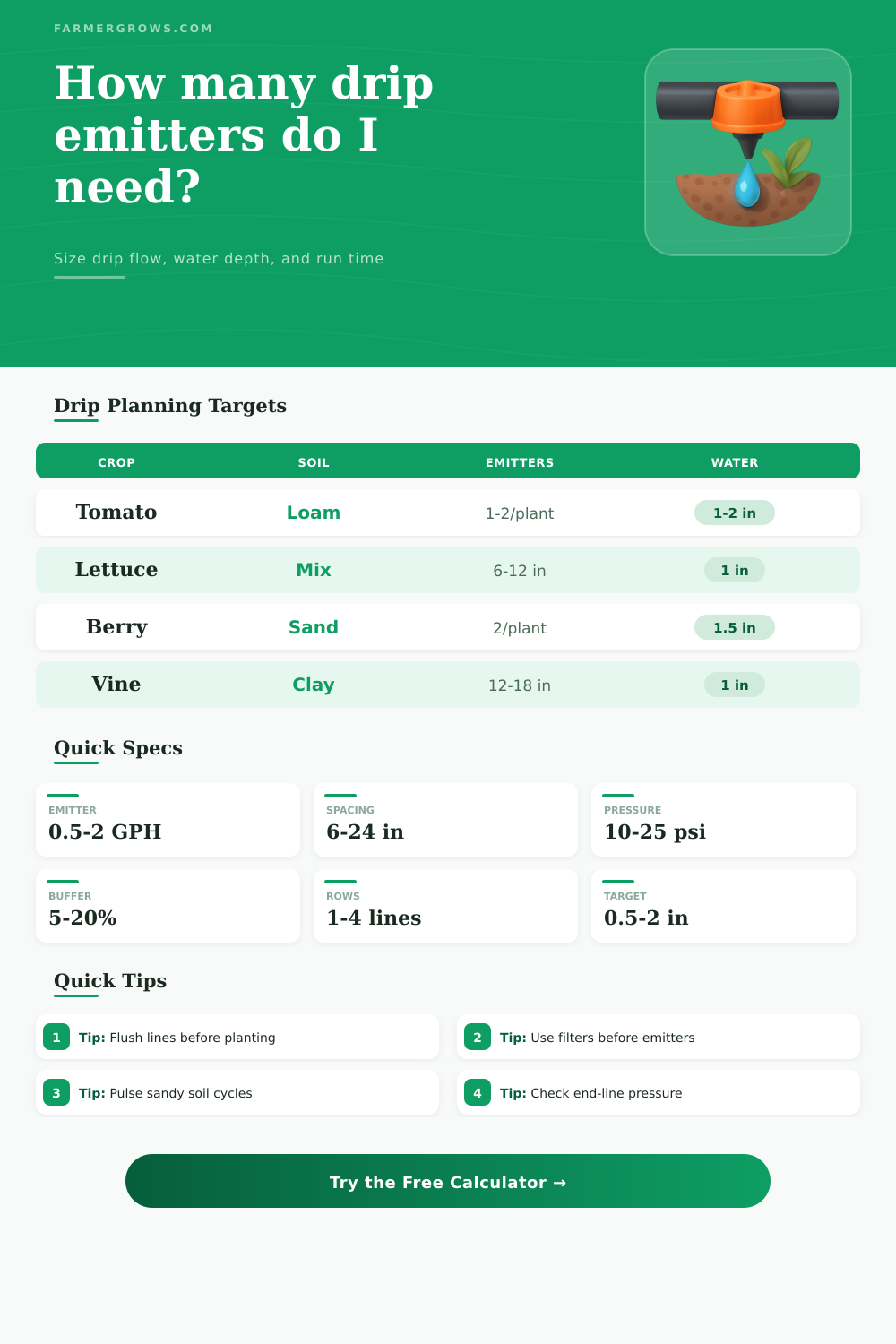
| Tomato, pepper, eggplant | 1.0 to 2.0 in/week | 1 or 2 emitters per plant, or 12 in tape | Increase during fruit fill and heat |
| Lettuce, greens, herbs | 0.75 to 1.25 in/week | 6 to 12 in tape on each bed line | Keep shallow roots evenly moist |
| Strawberry and cane fruit | 1.0 to 1.5 in/week | Two narrow lines or paired point emitters | Avoid wet crowns and pulse in sand |
| Grapes and orchard starts | 0.5 to 1.5 in/week | Point emitters near active root zone | Move or add emitters as canopy expands |
| Melons and squash | 1.0 to 2.0 in/week | 12 to 18 in tape or paired emitters | Do not swing from dry to saturated |
| Soil type | Wetted strip estimate | Efficiency factor | Emitter spacing hint |
|---|---|---|---|
| Sandy soil | 0.70 ft per line | 88% | Use 6 to 12 in spacing and shorter pulses |
| Loam soil | 1.00 ft per line | 94% | Use 12 in spacing for many vegetables |
| Clay soil | 1.30 ft per line | 92% | Use slower flow and avoid surface runoff |
| Raised bed mix | 0.85 ft per line | 90% | Use closer spacing for fast-draining blends |
| High organic soil | 1.10 ft per line | 95% | Moisture holds well but still verify depth |
| Emitter rating | 50 emitters | 100 emitters | 200 emitters | Best fit |
|---|---|---|---|---|
| 0.25 GPH | 12.5 GPH | 25 GPH | 50 GPH | Long tape runs, sandy pulses, young beds |
| 0.50 GPH | 25 GPH | 50 GPH | 100 GPH | Vegetable beds and common drip tape |
| 1.00 GPH | 50 GPH | 100 GPH | 200 GPH | Point emitters, shrubs, berries |
| 2.00 GPH | 100 GPH | 200 GPH | 400 GPH | Trees, vines, large containers |
Before trusting runtime: Catch water from several emitters for a timed test. If the measured flow differs from the rating, enter the measured GPH or LPH.
Before adding more time: Probe the wetted depth after irrigation. Deep moisture below the root zone means fewer minutes or more frequent shorter cycles may work better.
Drip irrigation works because drip irrigation systems is designed to deliver water directly to the root zone of plants, and because drip irrigation systems avoid delivering water to the areas of the plants where the plants dont need water. Because drip irrigation systems deliver water only to the specific areas of the garden that contain the plants that need water, the drip irrigation system must be planned according to the specific needs of each plant in the garden. Instead of adding water to the entire garden, you can determine the amount of water that is needed by each plant, and the drip irrigation system can be configured to deliver water to each plant according to that specific amount of water.
Understanding the measurements on the drip irrigation system is essential, since these measurements will determine the functioning of the drip irrigation system. Row length and emitter spacing are two measurements that are often used when planning a drip irrigation system for a vegetable garden. Each of these measurements will determine the number of emitters that will be included along each irrigation line.
How Drip Irrigation Works and How to Set It Up
These measurements are important variables for drip irrigation systems because they also impact the total amount of water that will flow out of each drip irrigation zone, as well as the width of the “wetted strip” that will be created within the soil. The type of soil in which the plants will be grown will also impact the drip irrigation system; sandy soils will allow water to spread less than clay soils, and an amount of water that can wet a certain number of square feet in sandy soil will wet fewer square feet in clay soil. The drip irrigation calculator included with this project accounts for these calculations, allowing for the system to avoid guesswork in its setup.
Another important factor for drip irrigation systems is water pressure. The water pressure for a drip system will impact the amount of water that leaves each emitter. For instance, if a regulator is set to twenty psi, the emitters will release the amount of water that is rated by the manufacturer of the drip irrigation system.
If the water pressure is dropped to ten psi, however, the amount of water that leaves each emitter will be less than that which is published by the manufacturer. The opposite is true for water pressures that are increased beyond the rating of the emitters; more water will leave each emitter. While the changes in water pressure may seem small for short rows of vegetables, the changes in water pressure will accumulate over hundreds of emitters in a drip irrigation system.
While many drip irrigation system designers set the regulator for their system to their desired pressure, they should check the water pressure at the end of the longest row of vegetables that the system is to irrigate; the purpose for checking the water pressure is to ensure that there are no leak along the irrigation lines. Soil type also impacts another factor for drip irrigation systems: how often that system should be run. Because sandy soils tend to allow water to drain quickly from the root zone of vegetables, irrigation cycles for sandy soil should be shorter and applied more often than in clay soil.
The opposite is true for clay soil, however; clay soil takes longer to dry out, so less frequent irrigation cycles should be applied to those beds. A reference table is provided on the webpage to indicate how often drip irrigation systems should be run according to the type of soil in which the vegetables will be grown; however, the same vegetable may require different irrigation schedules according to soil type. The crop water target is a critical value for drip irrigation systems.
While an inch of water per week may seem like a small amount of water, the water will be delivered to only the narrow strip of soil that is wetted by the emitters. Thus, each emitter will have to work harder to deliver that inch of water to each row of plants than would be required of a sprinkler system. The drip irrigation calculator will calculate the number of gallons of water that will be required to provide each inch of water to each area of the vegetable garden, and the number of minutes that each irrigation line will need to be turned on to provide that amount of water.
A buffer will also be provided to the drip irrigation system; typically, ten percent of the calculated amount of time will be added to the amount of time calculated by the drip irrigation calculator. This additional time for the system to run ensures that the system accounts for the fact that some of the emitters may become clogged during the growing season of vegetables. Drip irrigation systems calculate the amount of time that each emitter should be running to provide the necessary amount of water to each plant.
The drip irrigation calculator can determine the amount of time that the system should be running. However, the best way to determine how long that each drip irrigation system should run is to actually probe the soil after completing the first few irrigation cycles. If the moisture levels are not at the depth of the roots of the plants that the drip irrigation system is to irrigate, then the amount of time that the system is to run should be increased.
Other options to increase the amount of water that is provided to the root zone of the plants include increasing the number of irrigation lines, or replacing the emitters with those that have higher flow rates. Should the moisture levels be too deep below the roots, however, the opposite adjustments should be made. Much of the information provided for drip irrigation systems assumes that the emitters in each system are sized according to the peak flow rates of the plants.
The young plants in the initial growth stages will not require the same amount of water as the mature plants, so irrigation systems that run according to a schedule that provides the amount of water for mature plants will waste both water and heat from the irrigated areas. Instead, the number of emitters and the flow rates of the emitters can remain the same; however, the number of minutes that each irrigation line is running or the number of irrigation events each week can be shortened. Another detail for drip irrigation systems that often gets overlooked is that the flow rate of the emitters might be less than the rates at which the emitters are rated; fine particles in the soil, algae, and minerals can reduce the amount of water that leaves the emitters, and no visible damage can be seen to the emitters.
A test can be performed that will allow for the measurements of the actual flow rate of the emitters; a measuring cup can be used to catch the water from one emitter for a period of one minute. After measuring the amount of water that was caught in the measuring cup, the flow rate of that emitter can be updated in the drip irrigation calculator. Another decision that must be made in planning a drip irrigation system is the number of drip irrigation lines that are to be included in each row of vegetables.
A single drip irrigation line may be enough for many types of vegetables; however, two lines may be needed for wider rows or sandy soil. For dense crops like lettuce, four drip irrigation lines may be needed to provide enough water to each leaf. Adding drip irrigation lines to a vegetable garden will impact the total flow of the irrigation system; more lines mean more flow and more emitters.
The drip irrigation calculator will automatically change the required minutes for each emitter if additional lines are added to the drip irrigation system. The maximum number of lines that can be added is limited to the capacity of the filter, the valve, and the mainline of the drip irrigation system, not the needs of the vegetables that are to be grown. While the amount of time that the drip irrigation system should be running is an important factor in drip irrigation, the factor that should be considered for each vegetable garden is the amount of inches of water that the plants require each week.
The amount of water that is required for each vegetable will change with the type of crops and soil in which the vegetables will grow. However, the logic of the drip irrigation system will remain the same; however, the amount of time that each emitter should run will change with the amount of water that the plants require. Thus, each designer of a drip irrigation system must decide how much water the vegetables that will be planted in the drip irrigation system should receive; the rest of the system’s components will be used to ensure that decision is relayed to the plants.
Drip irrigation works because drip irrigation systems is designed to deliver water directly to the root zone of plants, and because drip irrigation systems avoid delivering water to the areas of the plants where the plants dont need water. Because drip irrigation systems deliver water only to the specific areas of the garden that contain the plants that need water, the drip irrigation system must be planned according to the specific needs of each plant in the garden. Instead of adding water to the entire garden, you can determine the amount of water that is needed by each plant, and the drip irrigation system can be configured to deliver water to each plant according to that specific amount of water.
Understanding the measurements on the drip irrigation system is essential, since these measurements will determine the functioning of the drip irrigation system. Row length and emitter spacing are two measurements that are often used when planning a drip irrigation system for a vegetable garden. Each of these measurements will determine the number of emitters that will be included along each irrigation line.
These measurements are important variables for drip irrigation systems because they also impact the total amount of water that will flow out of each drip irrigation zone, as well as the width of the “wetted strip” that will be created within the soil. The type of soil in which the plants will be grown will also impact the drip irrigation system; sandy soils will allow water to spread less than clay soils, and an amount of water that can wet a certain number of square feet in sandy soil will wet fewer square feet in clay soil. The drip irrigation calculator included with this project accounts for these calculations, allowing for the system to avoid guesswork in its setup.
Another important factor for drip irrigation systems is water pressure. The water pressure for a drip system will impact the amount of water that leaves each emitter. For instance, if a regulator is set to twenty psi, the emitters will release the amount of water that is rated by the manufacturer of the drip irrigation system.
If the water pressure is dropped to ten psi, however, the amount of water that leaves each emitter will be less than that which is published by the manufacturer. The opposite is true for water pressures that are increased beyond the rating of the emitters; more water will leave each emitter. While the changes in water pressure may seem small for short rows of vegetables, the changes in water pressure will accumulate over hundreds of emitters in a drip irrigation system.
While many drip irrigation system designers set the regulator for their system to their desired pressure, they should check the water pressure at the end of the longest row of vegetables that the system is to irrigate; the purpose for checking the water pressure is to ensure that there are no leak along the irrigation lines. Soil type also impacts another factor for drip irrigation systems: how often that system should be run. Because sandy soils tend to allow water to drain quickly from the root zone of vegetables, irrigation cycles for sandy soil should be shorter and applied more often than in clay soil.
The opposite is true for clay soil, however; clay soil takes longer to dry out, so less frequent irrigation cycles should be applied to those beds. A reference table is provided on the webpage to indicate how often drip irrigation systems should be run according to the type of soil in which the vegetables will be grown; however, the same vegetable may require different irrigation schedules according to soil type. The crop water target is a critical value for drip irrigation systems.
While an inch of water per week may seem like a small amount of water, the water will be delivered to only the narrow strip of soil that is wetted by the emitters. Thus, each emitter will have to work harder to deliver that inch of water to each row of plants than would be required of a sprinkler system. The drip irrigation calculator will calculate the number of gallons of water that will be required to provide each inch of water to each area of the vegetable garden, and the number of minutes that each irrigation line will need to be turned on to provide that amount of water.
A buffer will also be provided to the drip irrigation system; typically, ten percent of the calculated amount of time will be added to the amount of time calculated by the drip irrigation calculator. This additional time for the system to run ensures that the system accounts for the fact that some of the emitters may become clogged during the growing season of vegetables. Drip irrigation systems calculate the amount of time that each emitter should be running to provide the necessary amount of water to each plant.
The drip irrigation calculator can determine the amount of time that the system should be running. However, the best way to determine how long that each drip irrigation system should run is to actually probe the soil after completing the first few irrigation cycles. If the moisture levels are not at the depth of the roots of the plants that the drip irrigation system is to irrigate, then the amount of time that the system is to run should be increased.
Other options to increase the amount of water that is provided to the root zone of the plants include increasing the number of irrigation lines, or replacing the emitters with those that have higher flow rates. Should the moisture levels be too deep below the roots, however, the opposite adjustments should be made. Much of the information provided for drip irrigation systems assumes that the emitters in each system are sized according to the peak flow rates of the plants.
The young plants in the initial growth stages will not require the same amount of water as the mature plants, so irrigation systems that run according to a schedule that provides the amount of water for mature plants will waste both water and heat from the irrigated areas. Instead, the number of emitters and the flow rates of the emitters can remain the same; however, the number of minutes that each irrigation line is running or the number of irrigation events each week can be shortened. Another detail for drip irrigation systems that often gets overlooked is that the flow rate of the emitters might be less than the rates at which the emitters are rated; fine particles in the soil, algae, and minerals can reduce the amount of water that leaves the emitters, and no visible damage can be seen to the emitters.
A test can be performed that will allow for the measurements of the actual flow rate of the emitters; a measuring cup can be used to catch the water from one emitter for a period of one minute. After measuring the amount of water that was caught in the measuring cup, the flow rate of that emitter can be updated in the drip irrigation calculator. Another decision that must be made in planning a drip irrigation system is the number of drip irrigation lines that are to be included in each row of vegetables.
A single drip irrigation line may be enough for many types of vegetables; however, two lines may be needed for wider rows or sandy soil. For dense crops like lettuce, four drip irrigation lines may be needed to provide enough water to each leaf. Adding drip irrigation lines to a vegetable garden will impact the total flow of the irrigation system; more lines mean more flow and more emitters.
The drip irrigation calculator will automatically change the required minutes for each emitter if additional lines are added to the drip irrigation system. The maximum number of lines that can be added is limited to the capacity of the filter, the valve, and the mainline of the drip irrigation system, not the needs of the vegetables that are to be grown. While the amount of time that the drip irrigation system should be running is an important factor in drip irrigation, the factor that should be considered for each vegetable garden is the amount of inches of water that the plants require each week.
The amount of water that is required for each vegetable will change with the type of crops and soil in which the vegetables will grow. However, the logic of the drip irrigation system will remain the same; however, the amount of time that each emitter should run will change with the amount of water that the plants require. Thus, each designer of a drip irrigation system must decide how much water the vegetables that will be planted in the drip irrigation system should receive; the rest of the system’s components will be used to ensure that decision is relayed to the plants.