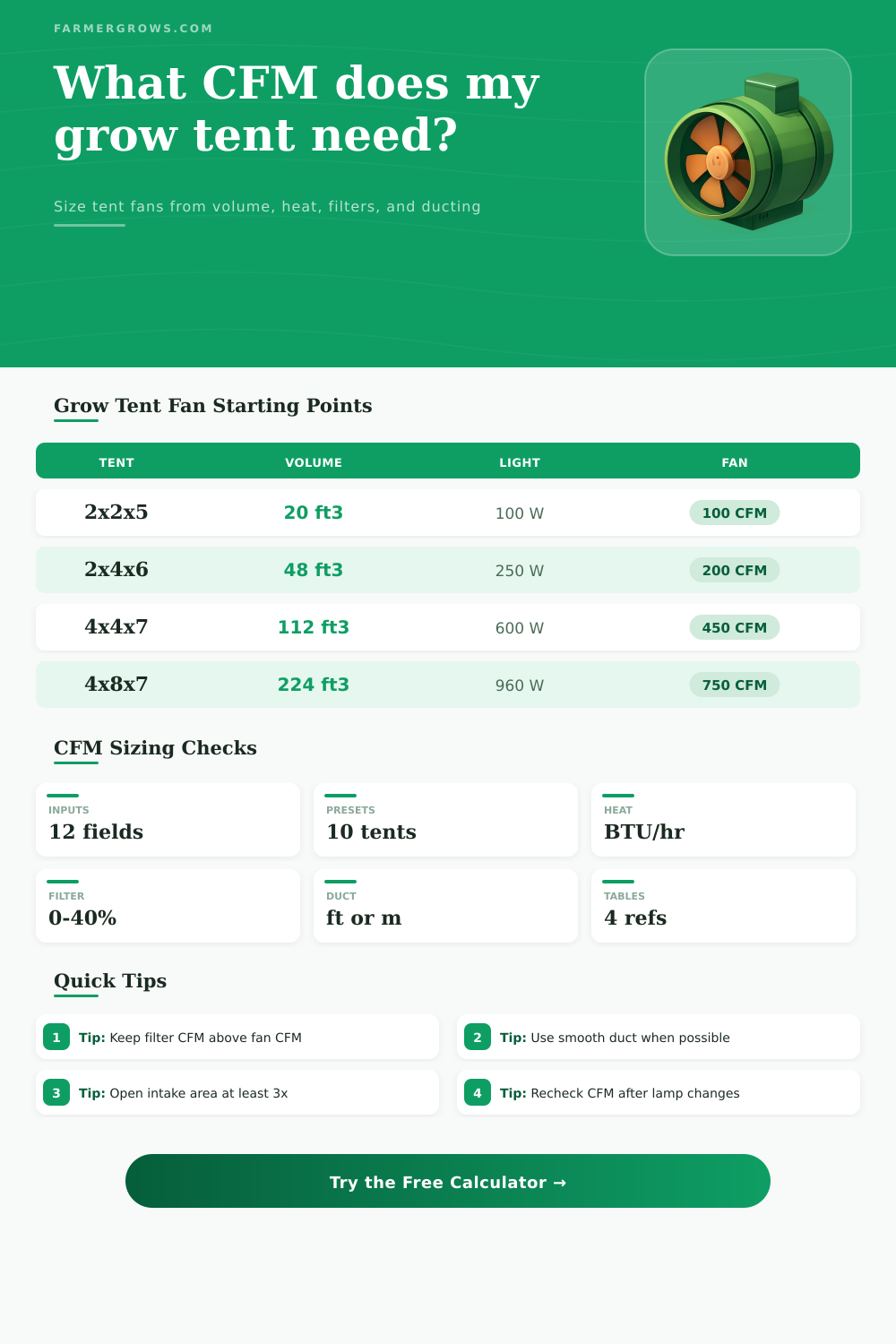
Grow Tent Exhaust Fan Calculator
Size an exhaust fan from tent volume, lighting heat, desired temperature rise, filter drag, duct length, bends, passive intake area, and altitude.
Use the higher of the air-exchange and heat-removal results, then buy a fan/filter combination that can still move that air after real-world resistance is added.
Fan Sizing Results
The recommendation starts with the larger CFM demand, then sizes up for system losses and a margin so the installed fan can still deliver the target airflow.
| Tent use | Target exchange | Volume CFM formula | Notes |
|---|---|---|---|
| Seedlings and clones | 1.5-3.0 min/exchange | Volume / minutes | Lower heat and humidity load, but keep gentle negative pressure. |
| Vegetative canopy | 1.0-2.0 min/exchange | Volume / minutes | Good for leaf movement and humidity control with moderate LED heat. |
| Flowering with filter | 0.75-1.25 min/exchange | Volume / minutes | Odor control usually makes the filter and static pressure important. |
| Hot light or dense canopy | 0.5-1.0 min/exchange | Volume / minutes | Heat-load CFM often becomes the controlling formula. |
| Equipment | Input watts | Heat load | Approx CFM at 10 F rise |
|---|---|---|---|
| Small LED board | 100 W | 341 BTU/hr before profile factor | 32 CFM |
| Mid-size LED bar | 300 W | 1,024 BTU/hr before profile factor | 95 CFM |
| 4x4 LED fixture | 600 W | 2,047 BTU/hr before profile factor | 190 CFM |
| Dual 4x8 fixture set | 960 W | 3,276 BTU/hr before profile factor | 303 CFM |
| Small dehumidifier | Direct BTU field | Often 1,000-2,500 BTU/hr | 93-231 CFM |
| Restriction | Typical derate | Calculator input | Practical check |
|---|---|---|---|
| Clean carbon filter | 15-25% | Carbon filter derate | Match filter rated CFM at or above the fan speed you plan to use. |
| Older or dense carbon filter | 25-40% | Carbon filter derate | Replace when odor leaks or airflow drops noticeably. |
| Flexible duct | About 12% per 10 ft | Duct length | Stretch flex duct tight and keep the run short. |
| 90-degree bends | About 6% each | Duct bend count | Use sweeping bends instead of crushed corners. |
| Passive intake below 2x | 8-25% | Intake ratio | Add flaps, ports, or active intake if tent walls pull in hard. |
| Fan class | Nominal CFM range | Common filter size | Best fit |
|---|---|---|---|
| 4 inch inline | 100-200 CFM | 4 inch carbon filter | 2x2, small 2x4, seedling, drying, or low-watt tents. |
| 6 inch inline | 250-450 CFM | 6 inch carbon filter | 2x4, 3x3, and many efficient 4x4 LED setups. |
| 8 inch inline | 500-800 CFM | 8 inch carbon filter | Hot 4x4, 5x5, short 4x8, or tents with longer duct runs. |
| 10 inch inline | 900-1,200 CFM | 10 inch carbon filter | Large 4x8, multi-light, warm rooms, and high-static systems. |
Size the filter with the fan. A fan rated for 450 CFM can underperform if the carbon filter is only comfortable at 250 CFM. Keep the filter rating equal to or above the fan speed you expect to run.
Protect passive intake area. A tent can show strong negative pressure while still moving less air than expected. More intake area, fewer sharp bends, and shorter ducting usually improve real CFM before a bigger fan is needed.
An exhaust fan is use to remove air from a grow tent. The exhaust fan that is used in a grow tent must be sized correct. If the exhaust fan that is used in the grow tent isnt sized correct, the air within the tent can become to warm, the humidity can become to high, and the odor from the plant can escape from the tent.
Many growers attempt to purchase an exhaust fan by guessing its size. However, guessing the size of the exhaust fan that is to be use within a grow tent often lead to various problems within the grow tent. In order to determine the correct exhaust fan for a grow tent, two different calculation must be performed.
How to choose the right exhaust fan for a grow tent
One calculation will determine the number of times that the air within the tent should be exchanged each minute. Additionally, a calculation will determine the amount of air that must be exhausted from the tent in order to remove the heat that the grow tents light creates. The higher of these two number will determine the amount of air that the exhaust fan must be able to move.
The volume of the tent is one of the primary input that is required to calculate these two figures. The volume of the tent is determined by the area of the tent and the height of the tent. Because a tall tent contains more air than a short tent, a tall tent will require an exhaust fan that can remove more air than a short tent will require.
The growth stage of the plants will change the requirement for the air exchange rate. For instance, when the plants are seedlings, they will require a gentler movement of the air within the tent. However, at the flowering stage, the grow tent will require a faster air exchange rate to control the humidity within the tent.
Another consideration for the exhaust fan that will be used within the tent is the heat load within the tent. Every watt of light that is used within the tent will eventually become heat. Thus, the more heat that the lights create, the greater the exhaust fans required ability to exchange the air within the tent.
One means of reducing the heat load of the tent is to mount the light driver outside of the tent. Additionally, using air-cooled hoods will also reduce the amount of heat that is introduced into the tent. If additional equipment is to be introduced into the tent, such as a dehumidifier or a CO2 burner, it is important to account for the amount of heat that that equipment will create.
This will ensure that the exhaust fan is not underdesigned due to these additional load. In calculating the required air exchange for a tent, it is important to understand that the exhaust fan that is selected for that tent will not move as much air as is rated for the exhaust fan. The carbon filter that is used will reduce the CFM of the exhaust fan.
The carbon filter will reduce the CFM of the exhaust fan by fifteen to twenty-five percent. Additionally, the flexible ducting that is used for the exhaust fan will reduce the CFM of that exhaust fan. Each ninety-degree bend that is incorporated into the ducting will reduce the CFM of the exhaust fan even more.
Additionally, if the intake vent is too small for the exhaust fan, the exhaust fan will create negative pressure within the tent. This negative pressure will make it difficult for the exhaust fan to remove the air from the tent. Therefore, an exhaust fan should of be purchased for a grow tent that is larger than the calculated required CFM of the exhaust fan.
In addition to the factor mentioned above, the altitude of the grow tent can impact the performance of the exhaust fan. If the tent is located in a high-altitude area, the air that is within the tent is less dense than the air that is within the tent at sea level. Because the air within the tent at high altitudes is less dense, the exhaust fan must move more air within the tent in order to remove the same amount of heat from the tent.
Thus, if a grow tent is to be located in a mountain region, these factor must be accounted for when purchasing an exhaust fan for the tent. It is also important to avoid purchasing an exhaust fan for a grow tent prior to deciding on the type of carbon filter and ducting that will be used within the tent. It is possible that the exhaust fan that is purchased will not be compatible with the carbon filter and ducting that are to be used within the tent.
Another thing to avoid is the use of very long flexible ducting for the exhaust fan. Any long ducting will reduce the CFM of the exhaust fan. Additionally, any bend within the ducting will also reduce the CFM of that exhaust fan.
An exhaust fan that is too large for the tent should also be avoided. An exhaust fan that is too large for the tent may make the tent too negative in pressure and it may create excessive noise within the tent. An exhaust fan that is sized correct will allow for the necessary air exchange to take place within the tent.
It will maintain the necessary humidity and temperature level within the tent. Additionally, if the exhaust fan is sized appropriately, negative pressure can be maintained within the tent to allow for the containment of the odor of the plant. By ensuring that the exhaust fan is of the appropriate size for the tent, the grow tent will have consistent air within the tent.
Therefore, the plants will continuously be provided with the fresh air that is necessary for their growth.