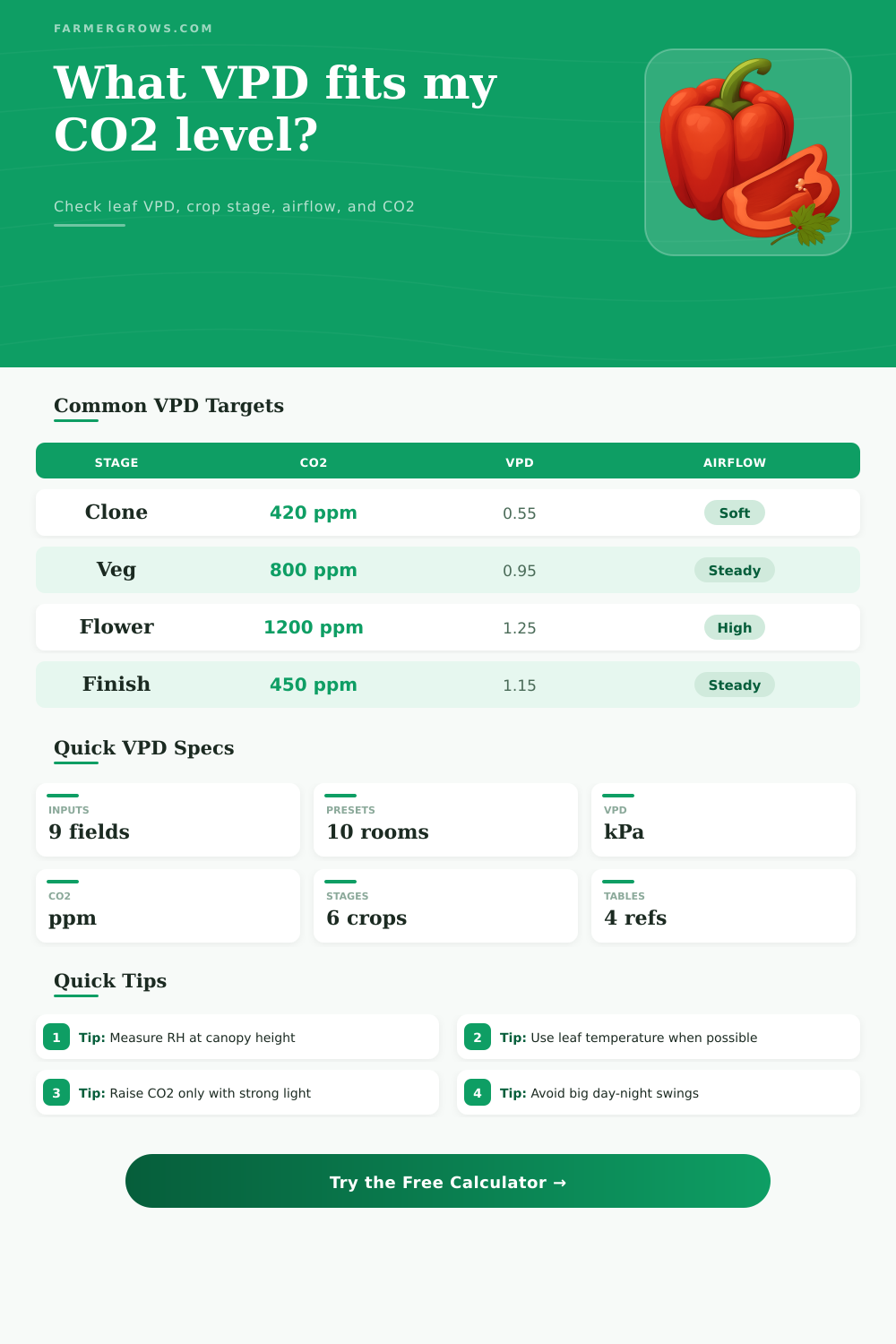
VPD Calculator With CO2
Estimate air VPD, leaf VPD, CO2-adjusted target context, and practical humidity direction for greenhouse, tent, and controlled-environment crops.
VPD is calculated from saturation vapor pressure and actual vapor pressure. CO2 does not change the vapor pressure formula, but elevated CO2 can shift the target context because stomata often run more conservatively.
VPD and CO2 Room Reading
Results use saturation vapor pressure in kPa, actual vapor pressure from RH, and a practical CO2 target-context adjustment.
| Stage | Typical VPD Range | Best Use | Watch For |
|---|---|---|---|
| Clone / propagation | 0.45 to 0.70 kPa | Rooting trays, domes, tender cuttings | Wilting if VPD climbs before roots form |
| Seedling / transplant | 0.60 to 0.90 kPa | Young leaves and small root systems | Slow growth if air stays too wet |
| Vegetative canopy | 0.80 to 1.15 kPa | Leaf expansion and steady uptake | Curling edges if air is too dry |
| Flowering / bloom | 1.00 to 1.35 kPa | Mature canopies and stronger light | Tip burn risk if roots lag behind demand |
| Fruiting vegetables | 0.95 to 1.30 kPa | Tomato, pepper, cucumber production | Blossom issues if humidity swings hard |
| Late finish / hardening | 1.05 to 1.45 kPa | Dense canopies needing drier air | Excess dryback and stalled uptake |
| CO2 Level | Target Context | VPD Shift | Room Note |
|---|---|---|---|
| 350 to 500 ppm | Ambient air baseline | 0.00 kPa | Use normal stage ranges and avoid over-drying tender plants. |
| 600 to 900 ppm | Light enrichment | +0.03 to +0.08 kPa | Often pairs well with steady airflow and moderate light. |
| 900 to 1200 ppm | Active enrichment | +0.08 to +0.15 kPa | Higher light and nutrition must support the added demand. |
| 1200 to 1500 ppm | High-performance room | +0.13 to +0.22 kPa | Keep leaf temperature and irrigation response under close watch. |
| Setting | Adjustment | When It Fits | Practical Cue |
|---|---|---|---|
| Still air | -0.05 kPa target context | Dome, tray, or weak fan coverage | Humidity pockets and wet leaf surfaces are more likely. |
| Gentle airflow | 0.00 kPa target context | Light leaf movement with even mixing | Good default for young plants and small tents. |
| Steady airflow | +0.03 kPa target context | Established canopy with uniform fans | Leaves move lightly without folding or drying edges. |
| Strong airflow | +0.06 kPa target context | High exchange or dense mature canopy | Useful when humidity removal is strong and irrigation is stable. |
| Result Pattern | Meaning | Usual Move | Check First |
|---|---|---|---|
| Leaf VPD below range | Air is too humid or leaf is too cool | Lower RH, add exchange, or warm canopy | Condensation, poor airflow, shaded leaves |
| Leaf VPD in range | Water demand matches crop stage | Hold setpoints and watch trends | Sensor location and day-night swing |
| Leaf VPD above range | Air is too dry or leaf is too warm | Raise RH, reduce heat, or soften airflow | Leaf curl, tip burn, fast media dryback |
| CO2 target above normal | Enrichment supports a slightly drier context | Increase gradually, not all at once | Light intensity, feed strength, irrigation timing |
Leaf temperature matters: A leaf that is 2 to 4 degrees cooler than the air can pull leaf VPD noticeably lower than a simple air-only chart suggests.
CO2 is context, not magic: Enrichment works best when light, nutrition, irrigation, and airflow can support the slightly higher transpiration target.
Vapor pressure deficit is a measurement of both how plants moves water and take up nutrients, as well as a measurement of how the plant respond to the air around itself. While many growers consider vapor pressure deficit to be a secondary measurement of the growing environments, it should be considered a point of daily control for the grower. If the grower is enriching CO2 in the growing area, vapor pressure deficit should be considered a different number within that grow room due to the conservative nature of stomata at higher rate of CO2. By entering the temperature of the room, the humidity of the air, the leaf temperature offset, and the CO2 level into the calculator, it will provide a reading of vapor pressure deficit according to growth stage and airflow in the grow room.
Many growers will often take the temperature and humidity of the room at the head height of the plant. However, this might not reflect the true nature of the growing environment for the plants. The air temperature will read higher than the temperature of the plants’ leaves, which can be several degrees cooler than the air around them.
How to Control Vapor Pressure Deficit in a Grow Room
The grower can enter this offset into the tool to calculate the leaf vapor pressure deficit, which does not have to change the air temperature of the grow room. Small change in temperature will have a big impact upon the vapor pressure deficit reading. Changes to the vapor pressure deficit of 0.1 kPa can place the air within the grow room in the wrong zone for flowering plant or plants that are setting fruit.
Although CO2 do not mathematically impact the calculation of vapor pressure deficit, CO2 does change the amount of vapor pressure deficit that the plant can sustain before its stomata begin to close. With CO2 levels of 800 ppm or 1200 ppm, the plant will be able to sustain a more higher vapor pressure deficit than it would at ambient CO2 levels. The stomatal response mode and CO2 levels that is entered into the calculator will allow the calculator to provide a comparison between the current air in the grow room and the ability of that space to support the demands of enriched CO2.
Growers can often underestimate airflow in the grow room.
If there is still air in the grow room, it will create a boundary layer of humid air against the leaves of the plants. This will lower the effective vapor pressure deficit within the grow room. By increasing the airflow to strip that boundary layer of humid air away from the leaves, the plants are able to transpire at a rate closer to the calculated vapor pressure deficit.
The airflow setting within the tool will allow growers to understand how their fans are contributing to the vapor pressure deficit within the grow room prior to attempting to adjust the humidity of the grow room. Each growth stage will require a different vapor pressure deficit for that crop. Clone and seedling stage will require a gentle vapor pressure deficit to allow the small root systems of the plants to replace the water that the plants are losing.
Vegetative plants can tolerate a wider range of vapor pressure deficits. During the flowering and fruiting stage, a higher vapor pressure deficit is allowed for those plants. Each of the growth stages within the calculator will load the appropriate low and high values for the vapor pressure deficit of the given crop stage.
Growers must make decisions regarding the grow room based off the numbers that is provided by the calculator. If the calculated vapor pressure deficit is below the range for the growth stage, the plants are not pulling the amount of water that they should of. Increasing the air exchange rate or decreasing the humidity of the grow room may fix this problem, but growers should first check the leaf temperature offset.
If the calculated vapor pressure deficit is above the range for that growth stage, the air within the grow room is too dry or the leaves are too warm. Should growers find that the air is too dry or that the leaves are too warm, the stomata of the plants will begin to close even with the elevated CO2 within the grow room. In this situation, growers should soften the airflow within the grow room or add humidity to the air, rather than dropping the CO2 levels.
Although the target vapor pressure deficit will be the same throughout the day, the saturation vapor pressure will change with the shift in temperature throughout the day. By entering a range of different times into the calculator, growers can determine if their humidity controller is maintaining the vapor pressure deficit throughout the day. This is important when enriching the CO2 within the grow room.
Another factor to consider is how fast the air within the grow room can change. Large greenhouses with high air exchange rates can reach the target vapor pressure deficit quickly. However, a sealed tent may take many hours to reach the same target.
The tool does not calculate the response time of the humidifiers or controllers for the grow room. However, it does show the gap between the current conditions of the grow room and the adjusted target. These reference tables will help to contextualize the CO2 levels, airflow settings, and stomatal modes according to each growth stage.
These tables are not meant to replace the calculator, but are instead used to help make a decision of which preset settings within the calculator to use. For example, vegetative plants with CO2 levels of 900 ppm and steady airflow will have a vapor pressure deficit of 1.05 kPa, but the same plants at 420 ppm of CO2 may target 0.95 kPa. While these two vapor pressure deficits may appear to be very similar, the slight difference in vapor pressure deficit will have an impact upon the transpiration rates of the plants canopy and the amount of water that is delivered to the irrigation system that waters those plants.
An important habit to develop as a grower is to measure the vapor pressure deficit at the canopy of the plants rather than measuring the vapor pressure deficit within the CO2 controller for the grow room. By measuring the vapor pressure deficit at the canopy, the grower ensures that the leaf temperature offset is taken into consideration. With the leaf vapor pressure deficit established as a number, the grower can more easily focus upon whether the CO2 enrichment setting for the grow room is correct for the stage of growth of the plants.
It’s also important to make sure your plant’s health is monitored naturaly.